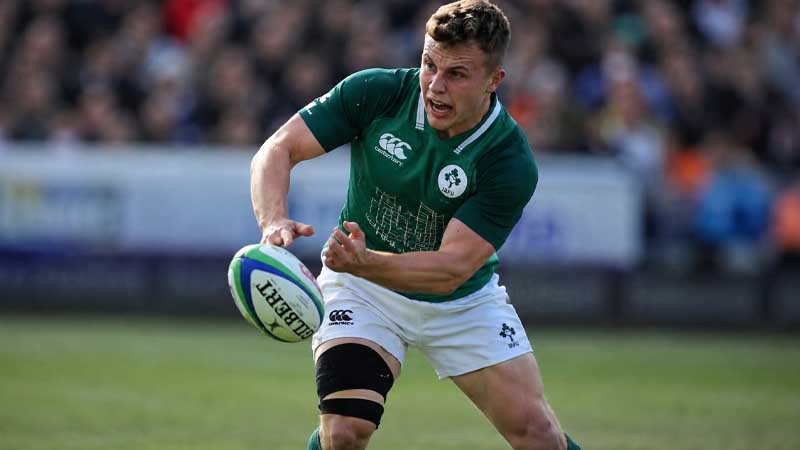
The lights of a professional stadium create a theater where communication is as vital as physical prowess. For decades, one phrase has echoed through cinema and television, becoming the universal shorthand for athletic intensity:
“Blue 42.” However, as global interest in various sporting disciplines grows, a common question arises among fans of the pitch and the gridiron alike: Why do rugby players say “Blue 42”?
The short answer is a revelation for many: They do not.
Despite what Hollywood might suggest, the phrase “Blue 42” belongs exclusively to the lexicon of American football. Understanding why this phrase exists, how it is used, and why it has no place on a rugby pitch requires a deep dive into the tactical architecture of both sports.
The Great Misconception: Rugby vs. American Football
To understand the communication gap between these two sports, one must first recognize that while they share a common ancestor, their evolution has led to entirely different operational “languages.”
American football is a game of discrete segments—short bursts of high-intensity action separated by periods of tactical reorganization. This structure necessitates a formal, rhythmic signaling system known as a cadence.
Rugby, by contrast, is a game of continuous flow. While there are set pieces, such as scrums and lineouts, the majority of the game is played in a fluid state where players must adapt in real-time without the luxury of a pre-snap countdown.
Because of this, rugby players communicate using direct voice calls, hand signals, or specific tactical shorthand established during a huddle or lineout.
They do not utilize the scripted, television-style cadences that define the American quarterback’s presence at the line of scrimmage.
Decoding the American Cadence: What “Blue 42” Actually Means
In the context of American football, “Blue 42” is not a play name; it is a component of a pre-snap cadence. This rhythmic chant serves several critical functions that are unique to the stop-start nature of the gridiron.
1. The Mechanics of Timing and the Snap
The primary purpose of a cadence is to synchronize the offensive line. In the huddle, the quarterback will call a play and designate a “snap count”—for example, “on one” or “on two”.
- “On One”: This indicates that the ball will be snapped roughly one second after the cadence concludes or on the first “Hut”.
- “On Two”: This signals the center to snap the ball on the second “Hut”.
This timing is a practiced mechanism. By varying the rhythm, the quarterback attempts to bait the defensive line into a false start, which results in a five-yard penalty and a free first down.
2. Acoustic Clarity in High-Noise Environments
The choice of words like “Blue” is not accidental. Stadium environments are notoriously loud, often reaching decibel levels that can drown out standard speech.
Research and practice have shown that certain colors and numbers are easier to hear amidst the roar of a crowd.
- Colors: Vowels in words like “Blue” or “Red” tend to carry further and more clearly through stadium noise.
- Numbers: Numbers like “42” provide a rhythmic structure that the offensive line can latch onto even if they cannot hear every syllable perfectly.
3. Information Loading and “Gibberish”
While many parts of a cadence are essentially “gibberish” intended to mask the true signal, some numbers do carry specific weight.
A number might indicate the “Mike” linebacker (the middle linebacker the offense needs to track) or signal a specific “check” where the quarterback changes the play based on the defensive alignment he sees at the last second.
However, for the most part, these phrases serve as a rhythmic runway to the start of the action.
The Rugby Communication Framework: Fluidity Over Script
If rugby players aren’t shouting “Blue 42,” how do they coordinate thirteen to fifteen players in the heat of a match? The answer lies in the Set Play and Direct Communication.
The Huddle and the Lineout
In rugby, most tactical coordination happens in the huddle or during a lineout. A lineout occurs when the ball goes out of bounds; the players form two lines, and the team in possession uses shorthand codes to determine who will jump for the ball and where it will be moved once caught.
These codes are often highly secretive and change from game to game, but they are direct and functional rather than rhythmic.
Voice Calls and Signals
Because rugby is continuous, players must communicate while running. This requires “simple voice calls” and physical signals. A player might shout “Inside!” to indicate they are a passing option, or “Hold!” to tell the defensive line to maintain their position.
There is no “cadence” because there is no “snap.” The ball is constantly in play or being contested in rucks and mauls, requiring a level of spontaneous verbal agility that a scripted cadence cannot provide.
Tactical Divergence: Why One Needs a Script, and the Other Doesn’t
The divergence in communication styles is a direct reflection of the sports’ different tactical philosophies.
- American Football is a Game of “Inches and Seconds”: Because every player must move at the same millisecond to execute a complex blocking scheme, the cadence acts as a metronome. Without “Blue 42… Hut,” the offense would be a chaotic mess of mistimed movements.
- Rugby is a Game of “Space and Support”: Rugby relies on the chemistry and intuition of the players. The communication is less about when to start and more about where to be as the play develops.
Why Hollywood Loves “Blue 42”: The Cultural Echo
If rugby players don’t say it, and it’s often just one of many cadences in football, why is “Blue 42” the one we hear in every movie?
The phrase has become a cultural trope. For screenwriters and directors, “Blue 42” is the quintessential “football sound”.
It provides a familiar rhythm that the audience immediately associates with the tension of a game’s deciding moment.
Even though real high school and professional teams use a vast array of colors and numbers—with some teams even using “Blue” regularly today—the specific combination of “Blue 42” has been cemented in the public consciousness by decades of cinema.
Interestingly, even fans who don’t know much about the technicalities of the sport recognize the phrase.
It has moved beyond a tactical tool and into the realm of a linguistic icon, representing the “alpha” intensity of the gridiron—a vibe that movies sometimes mistakenly try to port over to rugby to make it feel more “American” or “intense” for global audiences.
The Physics of the Field: Why “Blue” and Not “Green”?
Diving deeper into the SEO-relevant “why” of these terms, we look at the acoustics of the field. As noted in technical discussions, colors are chosen for their phonetic impact.
- Plosives and Vowels: The “B” in Blue is a plosive, a sound that starts with a burst of air. This is much easier to distinguish from background static than a softer sound like the “S” in “Silver” or the “G” in “Green.”
- Targeting: Sometimes, these numbers indicate where a running back should be aiming. In a “42” call, the “4” might designate the backfield player, and the “2” might designate the specific gap between the offensive linemen they are supposed to run through.
The Professional Verdict: Strategic Synchronization
For a Fortune 500 sports brand or a global media entity, understanding these nuances is critical for authenticity. In the world of elite athletics, communication is a specialized tool tailored to the environment.
American football requires a synchronous start, making the rhythmic cadence of “Blue 42” an engineering necessity for the offensive machine. Rugby requires asynchronous adaptation, making fluid, direct voice calls the lifeblood of the team’s survival on the pitch.
While “Blue 42” will likely remain a staple of the silver screen, its absence on the rugby pitch is a testament to the sport’s unique demands. Rugby players don’t need a countdown; they need a connection. They don’t need a script; they need a solution.
Conclusion: The Language of the Game
The next time you settle in to watch a match, listen closely. On the football field, you will hear the rhythmic, color-coded architecture of the cadence—a system designed for timing, confusion, and acoustic survival. On the rugby pitch, you will hear the frantic, functional shorthand of a team in constant motion.
Both systems are masterpieces of tactical communication, but they are as different as the sports themselves.
“Blue 42” may be the most famous phrase in sports history, but it is a phrase that stops at the edge of the gridiron. On the rugby pitch, the silence—and the directness—speaks much louder.