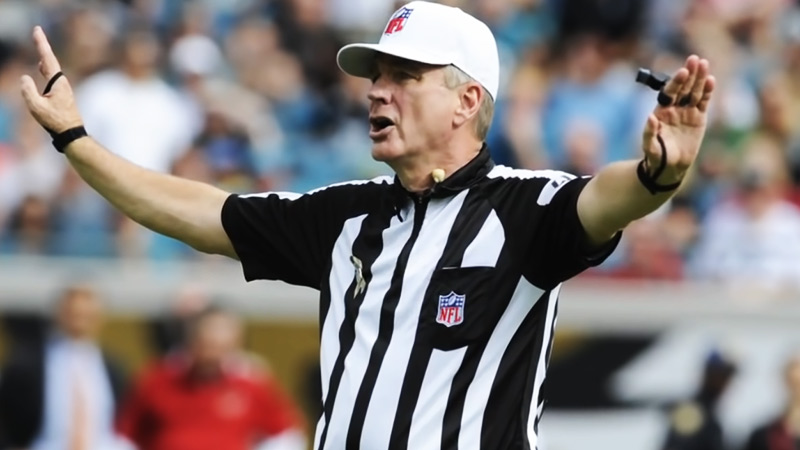
The fast-paced nature of professional football often leaves spectators focused on the flight of the ball or the collision of linemen.
Yet, among the chaos, a small, weighted object frequently arcs through the air, landing with a quiet thud on the turf.
To the casual observer, it might look like a misplaced piece of equipment, but to the officiating crew and the teams on the field, that bean bag is a vital instrument of precision and rule enforcement.
While the yellow flag is the universal symbol for a penalty, the bean bag serves a different, arguably more nuanced purpose. It is the physical placeholder for history in a game where every inch matters.
Understanding why officials use this tool offers a deeper look into the complex mechanics that keep a football game fair, accurate, and moving forward.
The Distinction Between Flags and Bags
Before diving into the specific scenarios that require a bean bag, it is essential to clear up the most common misunderstanding in the stands: the difference between the flag and the bag.
In the heat of a play, a spectator might see something thrown and immediately brace for a yardage penalty. However, their functions are entirely distinct.
A yellow flag signals a violation of the rules—a foul that will result in a penalty once the play concludes. In contrast, bean bags do not signal penalties or fouls.
Instead, they are used to mark a specific spot on the field where a live-ball event occurred. These events are not illegal; they are simply “pivots” in the play that the officials need to remember with mathematical certainty once the whistle blows.
Marking the Pivot Points: Fumbles and Interceptions
The most frequent reason an official reaches for their bean bag is a change of possession or a loose ball. When a player fumbles the football, the chaos that follows can move the pile several yards away from where the ball first hit the ground.
Referees throw or drop the bag to pinpoint exactly where a fumble happened. This is critical because the rules regarding how a fumble can be advanced—or where the ball should be placed if it goes out of bounds—often depend on that exact point of origin.
By “bagging the spot,” the official creates a permanent reference point that remains visible even if a dozen players are diving for the ball elsewhere.
Similarly, the bag is used to mark where an interception took place. In the transition from defense to offense, the momentum shifts instantly.
If a defender intercepts a pass and is immediately tackled, or if a foul occurs during the return, the officiating crew must know the exact yard line where the change of possession began to determine the correct placement of the ball.
The Precision of Special Teams: Punts and Kicks
Special teams play is one of the most difficult phases of the game to officiate because players are sprinting at full speed across the entire length of the field. The bean bag is indispensable here, particularly during punts.
Officials use the bag to mark where a player caught a punt. This serves two primary purposes. First, it establishes the starting point of the return. Second, it acts as a safeguard.
If the receiving team commits a penalty during the return—such as an illegal block in the back—the yardage for that penalty is often assessed from the spot where the ball was caught or the spot of the foul, depending on the specific timing.
Without the bag, the crew would be forced to guess the yard line, which is unacceptable at the highest levels of the game.
Additionally, the bag helps officials calculate the exact length of a kick, return, or fumble advance once the play is completely over.
These statistics are not just for the record books; they are the data points used by coaching staffs to evaluate performance and by officials to ensure the ball is spotted with total accuracy for the next series.
The Math of the Game: Penalty Enforcement
One of the most technical aspects of football officiating is the “Three-and-One” principle of penalty enforcement. This is where the bean bag moves from a simple marker to a critical piece of legal evidence.
If a foul occurs during or after a turnover or loose ball, officials use the bean bag to measure penalty yardage from the exact spot of the change of possession. This is often referred to as the “spot of the foul” rules.
For example, if a team fumbles the ball (marked by a bag) and then an offensive player commits a personal foul to prevent the defense from recovering it, the penalty isn’t necessarily marked from where the foul happened. Instead, the bean bag provides the “basic spot” for enforcement.
Without that physical marker, the crew would have to rely on memory to determine if a foul happened “beyond” or “behind” the spot of the fumble. In a game of inches, the bean bag provides the mathematical integrity required to ensure the non-offending team is properly compensated.
Silent Communication and Crew Clarity
Beyond the technicalities of the rulebook, the bean bag is a powerful tool for crew communication.
On a crowded field, it can be difficult for every official to see every detail. A ball might pop loose in a pile, or a receiver’s knee might hit the ground just before the ball comes out.
Dropping the bag communicates a definitive ruling to the rest of the crew. It acts as a visual signal confirming that an event like a fumble actually happened, rather than the play being a dead-ball situation like an incomplete pass.
When the head referee looks across the field and sees a blue or black bean bag on the turf, they immediately know that a “live-ball” event has been officially recognized by one of their partners.
This prevents conflicting calls and ensures that the entire crew is operating with the same set of facts before they gather to discuss the play. It provides signaling clarity that keeps the game’s tempo consistent and reduces the need for lengthy reviews.
Why the “Bag” Persists in a Digital Age
In an era of high-speed cameras, microchipped footballs, and instant replay, some might wonder why a weighted bag of beans is still the standard. The answer lies in its reliability and immediate feedback.
Electronic systems can fail, and replay takes time. A bean bag, however, provides an instant, physical, and unchangeable record of a moment in time.
It allows the officials to keep their eyes on the players—ensuring safety and watching for fouls—without having to keep their eyes glued to a specific blade of grass where a fumble occurred.
The bean bag is a testament to the “analog” precision of football. It is a simple solution to a complex problem, ensuring that no matter how fast the game moves, the “spot” is never lost.
Summary: The Unsung Hero of Officiating
The bean bag may not be as famous as the yellow flag, but it is just as essential to the integrity of football.
By marking key spots, enabling accurate penalty enforcement, and providing signaling clarity for the crew, this simple tool ensures that the rules are applied with the highest level of precision.
The next time you see that small dark object flying toward the turf, you’ll know you aren’t looking at a mistake or a penalty. You are looking at the officials “pinning” a moment in time to ensure the game remains fair for every player on the field.
It is a hallmark of professional officiating—a blend of human judgment and reliable tools that keep the world’s most popular sport running smoothly.