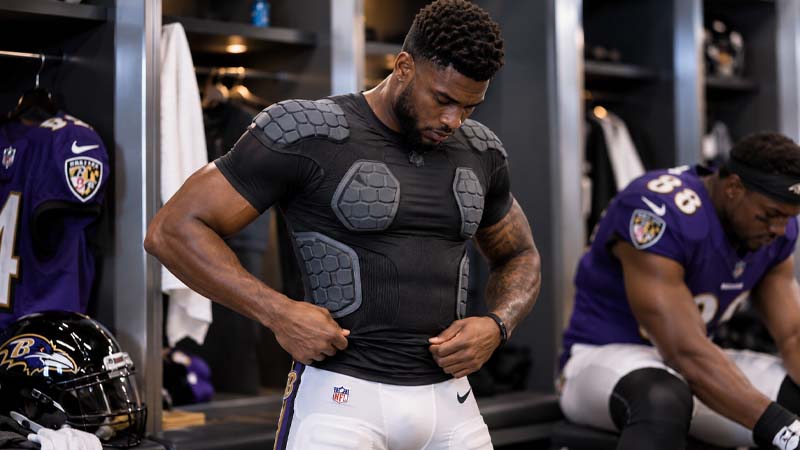
When spectators look at an American football field, the visual is dominated by the hard, armored exterior of the players—the plastic shells of the helmets, the rigid shoulder pads, and the heavy jerseys that define the sport’s iconic silhouette. Yet, beneath this external armor lies a quieter, highly engineered revolution in athletic wear.
The modern professional athlete does not rely solely on hard plastic to survive the relentless impact of the game; instead, they utilize a specialized baseline layer: the padded compression shirt.
This critical garment has transitioned from an optional accessory to a foundational piece of equipment for players across all positions.
To understand why elite athletes wear padded shirts under their gear, one must examine the intersection of high-velocity physics, the violent history of the sport, and the modern physiological demands of athletic performance.
1. The Physics and Mechanics of High-Velocity Contact
To understand why football players need layered protection, compare American football with rugby. Both involve contact, but their rules create different collision forces.
Rugby limits tackles through strict technique. Tacklers must target the shoulder level or below and bind, wrapping their arms around the ball carrier and going to the ground together. This restricts launching and reduces collision force.
American football allows greater impact. Players may:
- Launch themselves through the air to deliver hits.
- Blindside opponents focused on catching a pass.
- Initiate blocks and tackles without wrapping or binding.
At high speeds, collisions can be severe. Hard shoulder pads distribute force but can press sharply against the ribs and chest. A padded compression shirt adds a protective buffer, with foam absorbing shock before it reaches the bones.
2. The Brutal Origins of Football Armor
Protective padding in American football emerged from necessity, not marketing. In the late 19th and early 20th centuries, the game was dominated by ground-based running and violent mass formations such as the “flying wedge.”
Players formed a V-shaped wall around the ball carrier and charged directly into defenders, creating devastating collisions.
The physical demands were extreme:
- Matches consisted of two grueling 40-minute halves with no timeouts or clock stoppages.
- Players were prohibited from resting or drinking water, except during the single halftime break.
- Substitution rules dictated that a player could only leave the field if they were injured, and once substituted out, they were forbidden from returning to the match.
By 1906, football had become a national safety crisis, with numerous deaths and hundreds of serious injuries. President Theodore Roosevelt pressured college leaders to reform the sport.
Players also began sewing wool and cotton padding into sweaters, creating an early form of protective equipment. Over time, these innovations evolved into shoulder pads, helmets, and today’s padded compression gear.
3. The Multi-Dimensional Benefits of Modern Padded Compression Gear
Padded compression shirts do more than absorb impacts. Modern designs combine protection, comfort, moisture control, and performance benefits in one lightweight garment.
Torso and Rib Protection:
Strategically placed foam padding covers vulnerable areas such as the ribs, sternum, spine, and shoulders. These flexible panels help absorb and distribute impact forces during tackles and collisions, reducing the risk of painful bruising and injuries.
Chafing Prevention:
Shoulder pads can shift and rub against the skin during running, tackling, and arm movement. A tight-fitting compression shirt creates a protective barrier between the body and rigid equipment, helping prevent chafing, blisters, and skin irritation.
Sweat and Moisture Control:
Technical synthetic fabrics wick sweat away from the skin and promote faster evaporation. This helps players remain more comfortable while reducing the effects of excessive heat and moisture during demanding games.
Muscle Support:
The compression fit provides gentle support around the torso and shoulders, helping stabilize muscles during explosive movements and reducing unnecessary movement.
Turf Burn Protection:
The shirt also covers exposed skin, helping shield the shoulders, arms, and torso from abrasions caused by falls and slides on artificial turf.
4. The Psychology of Protection: The Armor Paradox
Safety gear can influence not only how athletes are protected, but also how they behave during contact. This is sometimes described as the “illusion of invulnerability.”
Rugby players, who wear less protective equipment, must rely heavily on precise tackling technique, body positioning, and controlled contact to protect themselves.
American football players, by contrast, wear helmets and substantial padding that can create a greater sense of security, encouraging faster and more forceful collisions.
This creates an armor paradox: as protective equipment improves, athletes may feel comfortable playing more aggressively. Hard gear can reduce some injuries while also enabling higher-impact contact.
Padded compression garments provide an additional layer of protection, helping absorb residual shock and cushioning the body against repeated impacts beneath the sport’s heavier external equipment.
Summary
The padded compression shirt represents a quiet, highly sophisticated layer of protection in professional football. It bridges the gap between the rigid, unforgiving exterior of plastic armor and the vulnerable, soft tissues of the human body.
By absorbing secondary impact forces, preventing severe skin friction, managing body sweat, and stabilizing key muscle groups, this essential base layer allows modern athletes to perform at their highest level while protecting them from the extreme, high-velocity contact of the sport.