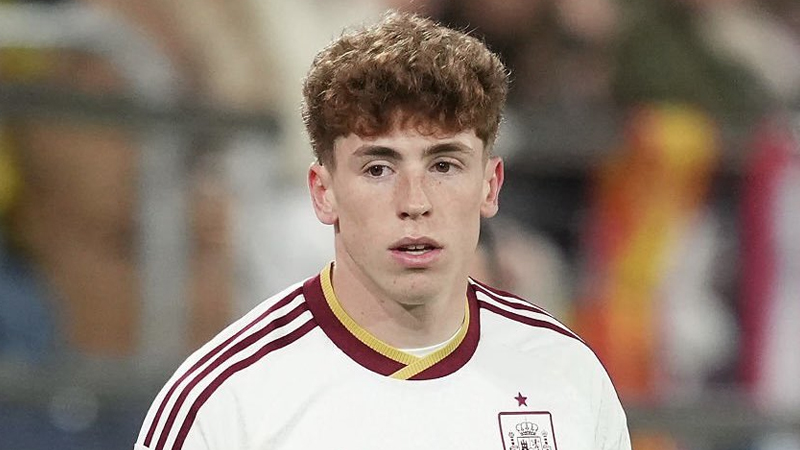
Víctor Muñoz’s departure from Real Madrid in July 2025 marked a pivotal moment for both the player and the club’s academy philosophy.
For years, the skillful winger was heralded as the jewel of La Fábrica, consistently delivering high-level performances under the tutelage of Raúl at Castilla.
However, a combination of tactical bottlenecks and a high-profile incident during his first-team debut fundamentally altered his trajectory.
Understanding why Víctor Muñoz left Real Madrid requires looking past the surface level of simple transfer numbers to explore the complex intersection of elite competition, strategic career management, and modern digital pressures.
The Tactical Logjam: A Pathway Blocked by Stars
The primary driver behind the decision was the sheer lack of a clear pathway into the starting eleven at the Santiago Bernabéu.
Despite being one of the most consistent performers in the Primera Federación for two seasons, Muñoz found himself at a crossroads common to many elite academy graduates.
The presence of world-class attacking talent, most notably Vinícius Júnior, created an insurmountable barrier to regular minutes.
While Muñoz had earned a senior call-up and participated in the Club World Cup, the reality of the Madrid hierarchy meant his opportunities were limited to brief substitute appearances.
For a 21-year-old with international aspirations, the prospect of remaining a rotational depth piece was no longer viable for his professional growth.
The Clásico Catalyst: Psychological and Social Pressures
While the tactical situation provided the logic for a move, a specific moment in May 2025 acted as the emotional catalyst for his exit.
Making a debut in a high-stakes Clásico against Barcelona is the dream of every academy player, but for Muñoz, it turned into a digital nightmare.
The Weight of a Single Miss
During the closing stages of the match, Muñoz missed a significant chance that could have altered the outcome of the game.
In the unforgiving ecosystem of elite football, this single error overshadowed his impressive hustle and the technical skill he displayed to get into that position.
The reaction from a segment of the fanbase was immediate and vitriolic, leading to a level of abuse that forced the young winger to disable his social media comments.
The “Sleeper Agent” Conspiracy
Adding fuel to the fire was Muñoz’s personal history; he had spent time at Barcelona’s La Masia academy until 2017 and was born in the city.
This background led to baseless “sleeper agent” conspiracy theories among disgruntled fans, who accused him of missing the chance on purpose.
This toxic environment highlighted the difficulty academy players face in securing patience from the Bernabéu crowd, where established stars like Vinícius or Mbappé are often granted more leeway for errors than homegrown prospects.
Analyzing the Financial and Strategic Terms of the Transfer
The move to CA Osasuna was not a simple “sale” but a calculated strategic divestment by Real Madrid. The club’s management sought to protect the player’s value while ensuring they maintained a degree of control over his future development.
| Feature | Details of the Agreement |
|---|---|
| Transfer Fee | Approximately €5 million to €6 million |
| Contract Length | Five-year deal with CA Osasuna |
| Economic Rights | Real Madrid retained 50% of future transfer value |
| Buyback Clause | A progressive three-year clause ranging from €8M to €10M |
| Primary Motivation | Guaranteed top-flight playing time |
This structure allowed Muñoz to escape the immediate pressure of the capital while providing Real Madrid with a safety net. If he reached his projected potential in Pamplona, the club could bring him back for a relatively modest fee.
Conversely, if he were sold to a third party, Madrid would realize a significant profit on his development.
The Osasuna Renaissance and International Breakthrough
Since leaving the Bernabéu, Muñoz has undergone a remarkable transformation, proving that his talent was never the issue—only his environment. At El Sadar, he found a project that prioritized his development, pivoting to him after a failed deal for Gonzalo García.
The results of this move were immediate and impactful:
- Breakout Consistency: He secured the regular top-flight minutes he was denied in Madrid, becoming a staple of the Osasuna attack.
- National Team Recognition: His performances earned him a call-up to the Spanish national team, where he made his debut in spectacular fashion.
- Milestone Goal: Muñoz scored his first goal for La Roja in a 3-0 victory against Serbia, silencing critics who had questioned his finishing ability after the Clásico incident.
- Market Value Surge: His success has attracted interest from major clubs across Europe, including several Premier League sides and German outfits.
Strategic Career Management: The Agency Shift
A significant undercurrent in the story of why he left involves his representation. Muñoz recently signed with Niágara Sports, the same agency that manages high-profile players like Dani Olmo and Joan García. This move signaled a shift toward more aggressive career planning.
This agency change has coincided with reports that Barcelona is closely monitoring the winger, especially given his strong personal ties to current Barça stars like Lamine Yamal.
Real Madrid has reportedly taken a hardline stance on this development, indicating they will use all legal and contractual means to prevent their former academy star from joining their direct rivals.
The move to Osasuna was, therefore, not just about playing time, but about positioning Muñoz as a premier talent on the open market, free from the constraints of being “just” a youth prospect.
Enhanced FAQ: Addressing the Most Common Questions
Did Real Madrid want to sell Víctor Muñoz?
The club recognized his talent but could not offer him the minutes required for his development. The inclusion of a 50% sell-on clause and a buyback option suggests they were not ready to let go of him entirely, but rather wanted him to “ripen” in a different environment.
Why did the fans turn on him so quickly?
The intersection of a missed chance in a Clásico and his history at La Masia created a “perfect storm” for toxic social media behavior. This incident highlighted the immense psychological pressure placed on academy players compared to high-priced signings.
Could he return to Real Madrid?
Yes. The three-year buyback clause (valued between €8M and €10M) makes a return to the Bernabéu financially feasible if the club decides they need his profile in the future.
How much did Osasuna pay for him?
The transfer fee was reported to be between €5 million and €6 million, representing a significant investment for the Pamplona-based club.
The Verdict: A Necessary Departure for Professional Survival
Ultimately, Víctor Muñoz left Real Madrid because the club had become a place where he could no longer grow.
The “dungeons” of the bench and the “avalanche of insults” from a vocal minority of the fanbase made the Bernabéu a stifling environment for a young player seeking to find his voice in the professional game.
By choosing Osasuna, Muñoz prioritized his career longevity over the prestige of the Madrid badge.
His subsequent success with the Spanish national team and his rising market value have validated this decision as one of the most astute career moves in recent Spanish football history.
Whether he returns to Madrid, makes a controversial move to Barcelona, or heads to the Premier League, one thing is certain: he is no longer defined by a single missed chance, but by his resilience and undeniable talent.