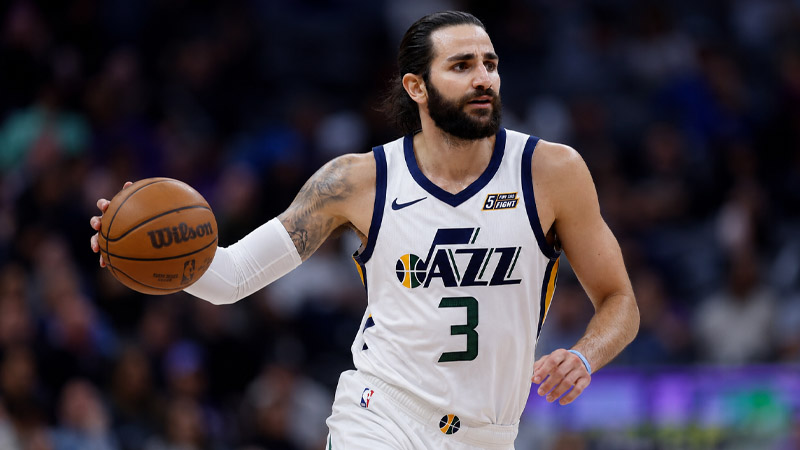
Ricky Rubio left the Utah Jazz in July 2019 primarily because the organization prioritized offensive spacing over his elite distribution skills.
Following consecutive postseason losses to the Houston Rockets, the front office identified a critical need for perimeter shooting that Rubio’s skill set could not provide. This led to a blockbuster trade for Mike Conley, effectively ending Rubio’s tenure as the starting point guard.
By the time free agency arrived, the Jazz explicitly informed Rubio he was no longer a priority. Consequently, as an unrestricted free agent, he signed a significant three-year contract to lead the Phoenix Suns.
Why Did Utah Decide to Move on from Ricky Rubio?
The decision to transition away from a starting point guard who had been instrumental in two successful playoff runs was not made lightly.
It was a strategic pivot born out of necessity, as the Jazz front office analyzed the limitations of their offensive ceiling during the most critical moments of the season.
The modern NBA requires a specific level of perimeter gravity to prevent defenses from collapsing on star creators like Donovan Mitchell, and the internal data suggested that a change was essential for the franchise to take the next step toward championship contention.
The Tactical Deficit in Perimeter Spacing
The primary driver for the roster overhaul was the lack of perimeter spacing that occurred when Rubio was on the floor.
In a league increasingly dominated by the “three-and-D” philosophy and high-volume outside shooting, having a non-shooting point guard became a liability during the postseason.
Opposing teams, specifically the Houston Rockets, utilized a defensive scheme that fundamentally dared Rubio to beat them from the outside.
By leaving him open, defenders were able to sag into the paint, effectively creating a wall that Mitchell and Rudy Gobert could not penetrate.
The Impact of Defensive Sagging on Donovan Mitchell
When defenses “sag off” a point guard, it creates a ripple effect across the entire offensive structure. In Rubio’s final season, his three-point efficiency dipped to 31.1%, a significant regression from the previous year.
This statistical decline meant that defenders no longer felt the need to respect his shot beyond the arc.
Consequently, the Jazz’s primary scoring option, Donovan Mitchell, faced double-teams and crowded driving lanes because Rubio’s defender was constantly acting as a help-man in the middle of the floor.
Consecutive Postseason Failures Against Houston
The Utah Jazz front office viewed their consecutive first-round exits at the hands of the Houston Rockets as a definitive case study in why their backcourt needed more shooting. In those series, the Rockets’ defensive discipline exposed the Jazz’s lack of “three-point efficiency”.
The organizational consensus was that while Rubio’s playmaking was elite, it could not compensate for the tactical advantage given to opponents who could ignore him on the perimeter. The hunt for shooting became the non-negotiable directive for the 2019 offseason.
The Blockbuster Trade That Changed the Backcourt
The departure of Rubio was essentially finalized before the free agency period even began. In professional basketball, the “business aspect” often requires aggressive moves that prioritize long-term fit over personal relationships.
The Jazz identified an upgrade that they believed would solve their spacing woes while maintaining high-level veteran leadership.
Acquiring Mike Conley from Memphis
In June 2019, the Utah Jazz executed a high-stakes trade to acquire veteran guard Mike Conley from the Memphis Grizzlies. This move was the loudest signal possible that Rubio’s time in Salt Lake City had come to an end.
Conley brought a career of consistent outside shooting and pick-and-roll mastery that perfectly complemented the Jazz’s existing core.
By inheriting Conley’s massive contract, the Jazz committed their financial resources to a new direction, leaving no room to re-sign Rubio as a starter.
Solidifying the New Starting Point Guard Role
The acquisition of Conley was not just a roster addition; it was a total replacement of the starting point guard role. The Jazz front office was looking for a player who could both facilitate and act as a secondary scoring threat from the perimeter.
Conley’s ability to hit the “pull-up three” forced defenders to stay attached to him, which theoretically opened the floor for Mitchell’s rim pressure and Gobert’s lob threats. This strategic roster upgrade effectively closed the door on the Rubio era before July 1st arrived.
Managing the Psychological Strain of Trade Rumors
The end of Rubio’s tenure was marked by a growing sense of alienation that began long before the final paperwork was signed. The interpersonal dynamics between a player and a front office can become strained when the “writing on the wall” becomes too obvious to ignore.
For Rubio, the professional reality of being a trade asset became a central theme of his final months with the team.
The February Trade Deadline Fallout
The roots of the departure can be traced back to the February 2019 trade deadline. During this window, Rubio’s name was openly and frequently floated in trade rumors involving Mike Conley.
While no deal was reached at that time, the damage to the relationship was significant. Rubio later expressed that being featured so prominently in trade talks made it incredibly difficult to feel like a “core piece” of the franchise’s future.
The lack of stability during the mid-season push created an environment where an eventual exit became a mutual expectation.
The Alienation of a Professional Veteran
Rubio has always been known for his emotional intelligence and commitment to his teammates. However, the feeling of being an “afterthought” in the team’s long-term plans took a toll.
When a player understands that the organization is actively looking for their replacement, the sense of belonging vanishes.
Rubio noted that while he understood the cold logic of professional sports, the lack of transparency or priority made the transition period challenging.
This psychological shift ensured that when free agency hit, he was prepared to find a market that valued him as a primary option.
Quantitative Review of the Rubio Era in Salt Lake City
Despite the tactical mismatch that led to his exit, it is important to recognize that Rubio was highly productive during his two seasons in Utah.
His performance in the 2018 playoffs, including a memorable triple-double against Russell Westbrook, remains a highlight for the fanbase. The following table provides a clear view of his output during this period.
| Season | Games Played | Points Per Game | Assists Per Game | Steals Per Game | 3PT % |
|---|---|---|---|---|---|
| 2017–18 | 77 | 13.1 | 5.3 | 1.6 | 35.2% |
| 2018–19 | 68 | 12.7 | 6.1 | 1.3 | 31.1% |
The Final Breakdown: Why Phoenix Was the Best Choice
When the 2019 free agency period officially opened, the situation was clear for both parties. The Jazz had their new point guard in Conley, and Rubio was free to test the market for a situation that offered both financial security and a guaranteed starting role.
The Explicit “Not a Priority” Message
In an unusual display of front-office bluntness, the Utah Jazz explicitly informed Rubio and his agent that he was “not a priority” for the organization moving forward. This notification happened in June 2019, removing any ambiguity about a potential return in a reduced role.
Rubio revealed this information to the media, highlighting the lack of a future project for him in Salt Lake City. This clarity allowed him to pivot his focus immediately toward teams that needed a veteran floor general.
Securing a Long-term Future in Phoenix
On July 8, 2019, Rubio signed a three-year, $51 million contract with the Phoenix Suns. This move was a win for Rubio, as it provided him with a significant payday and the opportunity to lead a young roster featuring Devin Booker and Deandre Ayton.
The Suns were desperate for a “true point guard” to bring structure to their offense, a role Rubio was perfectly suited for. While the Jazz moved toward shooting, Rubio moved toward a team that prioritized his specific brand of playmaking and leadership.
Essential FAQ Regarding the Utah Jazz Transition
Did Ricky Rubio want to stay with the Utah Jazz?
While Rubio understood the business side of the league, he felt alienated by the constant trade rumors during the 2018-19 season. By the time free agency arrived, the mutual understanding was that both parties needed a fresh start.
Who replaced Ricky Rubio as the starting point guard?
The Jazz traded for Mike Conley from the Memphis Grizzlies in June 2019 to serve as the new starting point guard, valuing his superior perimeter shooting and spacing.
Why did Rubio’s shooting matter so much to the Jazz?
In the playoffs, opponents like the Houston Rockets would “sag off” Rubio, allowing them to crowd the paint and prevent Donovan Mitchell from scoring effectively. This tactical disadvantage made high-efficiency shooting a priority for the front office.
How much was Ricky Rubio’s contract with the Suns?
Rubio signed a three-year deal worth $51 million to join the Phoenix Suns as an unrestricted free agent.
What was Rubio’s best moment in Utah?
Many fans point to his performance in the 2018 playoffs, where he recorded a triple-double in a victory over the Oklahoma City Thunder.
Conclusion: A Necessary Strategic Evolution
The departure of Ricky Rubio from the Utah Jazz serves as a prime example of how tactical needs can outweigh individual productivity in the high-stakes world of professional basketball.
Rubio was a consummate professional and a productive starter, but the Jazz’s “Houston Problem” required a different mathematical approach to the game.
By choosing perimeter spacing and three-point efficiency, the Jazz sought to unlock the full potential of their star players. Rubio, in turn, found a new home where his veteran presence could help a young Phoenix team rise to prominence.
Ultimately, the transition was a logical conclusion to a partnership that had reached its tactical limit.