The landscape of professional football is often defined by those who finish the play—the prolific goalscorers whose names dominate the headlines and highlight reels.
For a decade, between 2008 and 2017, this narrative was solidified by a historic duopoly. However, 2018 marked a definitive transition in how greatness is measured in the sport.
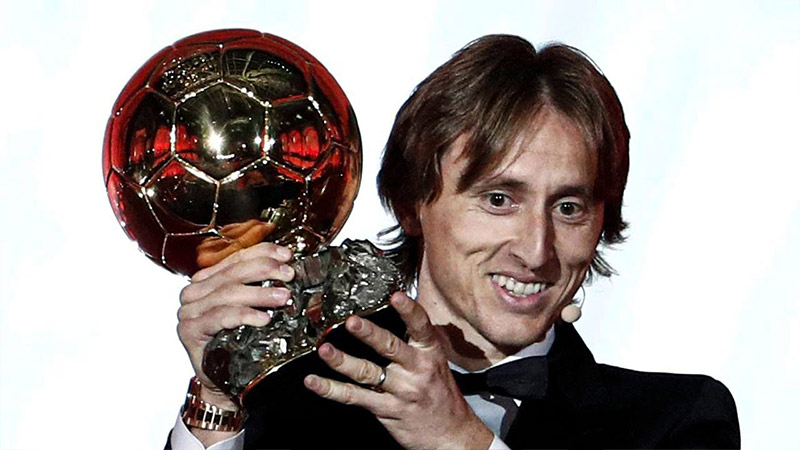
The coronation of Luka Modrić as the Ballon d’Or winner was not merely an individual achievement; it was a collective recognition of tactical intelligence, leadership, and the art of the midfield.
The End of an Era: Breaking the Ten-Year Duopoly
To understand the significance of the 2018 awards season, one must first look at the preceding decade. For ten years, the Ballon d’Or was effectively a closed circuit, shared exclusively between Lionel Messi and Cristiano Ronaldo.
Their dominance was built on unprecedented statistical output, with goal tallies that often defied logic. By 2018, however, a shift in the global footballing consciousness began to take hold.
The criteria for “the best” began to expand beyond raw numbers. While Messi and Ronaldo remained elite, 2018 presented a unique set of circumstances where neither held a flawless narrative.
Ronaldo’s transition to Juventus and an early exit from the World Cup, combined with Messi’s struggles on the international stage and a domestic collapse in the Champions League, created a window for a new type of candidate.
Luka Modrić stepped into this void, not with a flurry of goals but with a masterclass in game management and influence.
The World Cup Miracle: Orchestrating an Underdog Story
The most compelling chapter of the 2018 season unfolded in Russia. As the captain of Croatia, Modrić was the primary architect of one of the most improbable runs in World Cup history.
Croatia, a nation of just four million people, found itself competing on equal footing with the world’s traditional giants.
Modrić’s performance during this tournament was characterized by extraordinary endurance and mental fortitude.
He led his team through three consecutive knockout matches that required extra time, essentially acting as the “engine room” for a squad that refused to quit.
His role was multifaceted: he was the primary outlet for defense-to-attack transitions, the creative hub in the final third, and the defensive shield when under pressure.
Although Croatia ultimately fell to France in a 4–2 final, the global community was unanimous in its appraisal of the Croatian captain.
Modrić was awarded the World Cup Golden Ball, a trophy reserved for the tournament’s absolute best player.
This recognition was a crucial signal; it proved that voters were prioritizing the “miraculous underdog story” and the leadership required to sustain it over the simple act of winning the final match.
European Dominance: The Indispensable Heartbeat of Madrid
While the World Cup provided the emotional peak of the year, Modrić’s case was built on a foundation of sustained excellence at the club level.
At Real Madrid, he was the “indispensable heartbeat” of a team that achieved what many thought impossible in the modern era: a third consecutive UEFA Champions League title.
The 2018 final in Kiev against Liverpool was the culmination of a “three-peat” that cemented that Real Madrid squad as one of the greatest dynasties in history.
Within this star-studded roster, Modrić’s value was found in his “unmatched positioning, distribution, and press-resistance”.
In high-stakes European fixtures, where matches are often won or lost in the middle third, Modrić’s ability to retain possession under duress allowed Real Madrid to dictate the tempo of play against any opponent.
His peers and technical observers recognized this mastery. Modrić was named the UEFA Champions League Best Midfielder for the season, further validating his status as the continental benchmark for his position.
A Shift in Analysis: The Value of the Unseen
One of the most significant hurdles for any midfielder seeking individual honors is the lack of “traditional” statistics. In 2018, Modrić did not lead the charts in goals or assists.
Instead, his victory was a win for a different kind of data: progressive passes, successful dribbles under pressure, and “pre-assists”—the pass that leads to the assist.
Voters in 2018 chose to reward a player whose influence was felt in the rhythm of the game rather than the final scoreline.
This represented a conscious effort by football journalists and experts to look past the “immense goal numbers” that had dominated the previous decade.
Modrić himself acknowledged this historical significance. Upon receiving his award, he dedicated the trophy to legendary playmakers like Xavi Hernandez and Andrés Iniesta—icons of the sport who had masterminded similar eras of dominance but had been overlooked for the top individual prize in favor of their goal-scoring teammates.
The Grand Slam: A Unanimous Mandate
The Ballon d’Or was not an isolated incident in 2018; it was the final piece of a “clean sweep” of individual honors that left no room for debate regarding his status that year. Modrić’s 2018 trophy cabinet included:
- The Best FIFA Men’s Player: Awarded by coaches, captains, and fans worldwide.
- UEFA Men’s Player of the Year: Recognizing him as the premier talent in European competition.
- World Cup Golden Ball: Confirming his status as the best player on the world’s biggest stage.
- IFFHS World’s Best Playmaker: A data-leaning award that highlighted his creative efficiency.
- Goal 50: Further proof of his standing among global journalists.
This consensus across different voting bodies—players, coaches, and journalists—underscored that Modrić’s 2018 was a “midfield masterclass” that transcended subjective preference.
Conclusion: The Legacy of the Architect
Luka Modrić’s triumph in 2018 remains a landmark moment in football history. It serves as a blueprint for how excellence can be achieved through technical precision and collective leadership rather than individual stardom.
By breaking the duopoly of Messi and Ronaldo, Modrić opened the door for future generations of midfielders to be viewed as the true “architects” of the game.
His victory was a reminder that while goals win matches, it is the control of the midfield that wins championships. For those who value the nuance of the sport, 2018 will always be remembered as the year the “engine room” finally received its due.
Strategic Deep Dive: Frequently Asked Questions
How did Luka Modrić win the Ballon d’Or with such low goal statistics?
The 2018 voting cycle represented a departure from traditional metrics. Voters focused on his “complete control over the tempo, creativity, and leadership” of both Real Madrid and the Croatian national team.
His ability to dictate play in high-pressure environments, such as three consecutive World Cup knockout matches involving extra time, was viewed as more influential than the high goal tallies of his competitors.
What were the specific club achievements that supported his candidacy?
Modrić was the central figure in Real Madrid’s historic “three-peat,” securing their third consecutive UEFA Champions League title in 2018.
He was officially recognized as the UEFA Champions League Best Midfielder, highlighting his “unmatched positioning and distribution” during that campaign.
Who did Modrić beat to win the award?
While the exact voting breakdown showed a wide range of support, he primarily displaced the decade-long dominance of Lionel Messi and Cristiano Ronaldo.
He also outperformed other top performers from the 2018 World Cup, such as Antoine Griezmann and Kylian Mbappé, by virtue of his “clean sweep” of all major individual awards leading up to the Ballon d’Or ceremony.
What is the lasting impact of his 2018 win on the sport?
Modrić’s win validated the “invisible” work of midfielders. By dedicating his award to previous greats like Xavi and Iniesta, he shifted the narrative to ensure that playmakers who control the “rhythm” of a match are given equal consideration alongside prolific forwards.