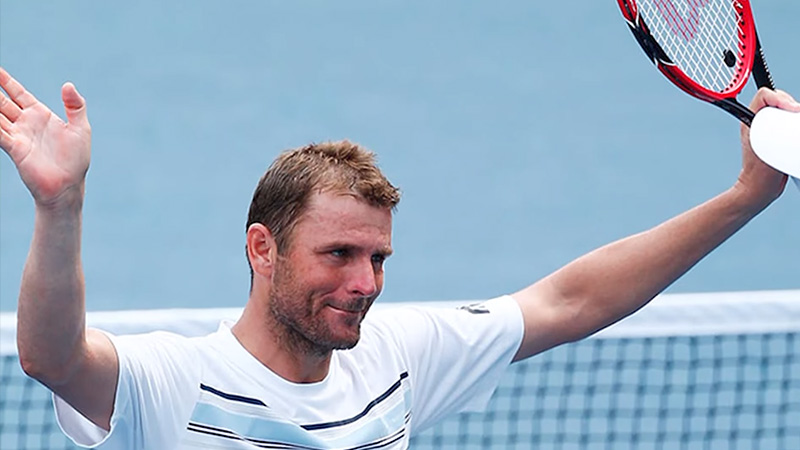
Mardy Fish withdrew from the US Open in 2012 and 2013 due to a complex intersection of cardiac arrhythmia and severe anxiety disorder.
While initially attributed to “precautionary measures,” the 2012 withdrawal occurred just hours before a high-profile match against Roger Federer because Fish suffered an uncontrollable panic attack.
These mental health struggles were deeply connected to a May 2012 heart surgery intended to correct a racing heartbeat.
Fearing that physical exertion would lead to a fatal cardiac event, Fish faced a debilitating panic disorder that eventually led to his retirement after a final “conquering” run in 2015.
Why Did Mardy Fish Withdraw from the 2012 US Open?
The 2012 season was supposed to be the pinnacle of Mardy Fish’s career, but it became the stage for a public and personal crisis.
After entering the tournament as a top-seeded player, his sudden departure left fans and the media questioning what happened behind the scenes at Flushing Meadows.
The High-Stakes Showdown with Roger Federer
In the fourth round of the 2012 US Open, Mardy Fish was scheduled to face world-renowned champion Roger Federer on Labor Day.
The anticipation was immense, as Fish had recently reached a career-high ranking of world No. 7 and was the top-ranked American male player. However, just hours before he was set to walk into Arthur Ashe Stadium, his team announced his withdrawal.
Initially, the public was told the exit was due to “precautionary measures” under strict medical advice, but this was a sanitized version of a much more harrowing reality.
The Uncontrollable Panic Attack in Queens
The true cause of the withdrawal was a massive, uncontrollable panic attack that struck Fish during the car ride from his hotel in Manhattan to the tournament site in Queens.
This crisis did not appear out of thin air; it was the culmination of a night of terror following his grueling three-hour victory over Gilles Simon in the previous round.
At 3:30 a.m. the night before the Federer match, Fish woke up experiencing intense dread and a racing heart. He realized in that moment that his mind and body were no longer capable of handling the extreme physical and mental stress required to compete at an elite level.
The Connection Between Cardiac Arrhythmia and Panic Disorder
To understand why a world-class athlete would suffer such a debilitating breakdown, one must look at the physical trauma Fish experienced earlier that year.
The relationship between his heart health and his mental state created a feedback loop that made professional tennis feel like a life-threatening endeavor.
The 2012 Cardiac Catheter Ablation
In March 2012, Fish’s life changed when he woke up with his heart beating at triple its normal rate. This medical emergency led to a diagnosis of heart arrhythmia, specifically faulty electrical pathways in his heart.
In May 2012, he underwent a cardiac catheter ablation, a surgical procedure designed to correct these pathways by scarring the problematic heart tissue.
While the surgery was a physical success, the psychological impact of having a malfunctioning heart remained deeply embedded in his psyche.
The Trauma of a Racing Heartbeat
The trauma of the heart condition manifested as a severe anxiety disorder. Even though the surgery fixed the physical issue, Fish was haunted by the fear that his heart would fail again.
He developed a specific form of panic disorder where he became consumed by the terrifying belief that pushing his heart to maximum exertion during a match would trigger a fatal cardiac arrest.
This meant that the very thing he needed to do to succeed—play high-intensity tennis—was the very thing he feared would kill him. At the height of his struggle, he suffered panic attacks as frequently as every 30 minutes.
The 2013 US Open Withdrawal: Understanding the Triggers
A year after the Federer walkover, Fish attempted to return to the tournament that had become the epicenter of his struggles. Unfortunately, the 2013 season proved that the road to recovery would be long and fraught with setbacks.
The Winston-Salem Heat Stroke Incident
Leading up to the 2013 US Open, Fish’s fragile mental state was severely tested during a tune-up tournament in Winston-Salem. While playing a match against Jarkko Nieminen, Fish suffered from heat stroke and was forced to abandon the match.
For a person struggling with cardiac-related anxiety, heat stroke is a devastating trigger because it naturally causes an elevated heart rate.
This physical setback heavily reignited his panic disorder, making the prospect of playing best-of-five-set matches in the New York heat seem impossible.
Choosing Personal Health Over Professional Success
Just days before the 2013 main draw was set to begin, Fish pulled out of the US Open once again. The United States Tennis Association (USTA) officially cited “personal reasons” for his departure.
Fish later clarified via social media that his health simply would not allow him to compete at that time.
This withdrawal was a calculated move to prioritize his long-term well-being over the pressure of the professional tour, as he had barely played on the ATP Tour for two years during this period of recovery.
Mardy Fish US Open Performance History
The following table provides a comprehensive overview of Mardy Fish’s career results at Flushing Meadows, highlighting the transition from his competitive peak to his medical struggles and eventual closure.
| Year | Seed | Result | Defeated By |
|---|---|---|---|
| 2000 | Unseeded | 1st Round | Jan-Michael Gambill |
| 2001 | Unseeded | 1st Round | Magnús Norman |
| 2002 | Unseeded | 2nd Round | Fernando Vicente |
| 2003 | 24 | 2nd Round | Karol Kučera |
| 2004 | 26 | 2nd Round | Michal Tabara |
| 2005 | Unseeded | 1st Round | Ivo Karlović |
| 2006 | Unseeded | 2nd Round | Novak Djokovic |
| 2007 | Unseeded | 2nd Round | Tommy Robredo |
| 2008 | Unseeded | Quarterfinals | Rafael Nadal |
| 2009 | 25 | Withdrew | Rib Injury |
| 2010 | 19 | 4th Round | Novak Djokovic |
| 2011 | 8 | 4th Round | Jo-Wilfried Tsonga |
| 2012 | 23 | 4th Round (WD) | Roger Federer (Walkover) |
| 2013 | Unseeded | Withdrew | Anxiety/Personal Reasons |
| 2015 | PR | 2nd Round | Feliciano Lopez |
The 2015 US Open: A Story of Emotional Resilience
After years of fighting an internal battle, Mardy Fish decided he did not want his career to be defined by a panicked withdrawal. He chose to return to the site of his greatest trauma to finish his story on his own terms.
Conquering the Court at Flushing Meadows
Using a protected ranking, Fish entered the 2015 US Open with the announcement that it would be his final professional tournament. His primary objective was not to lift the trophy, but to “conquer” the very court where his mental health crisis had peaked years prior.
By returning to the venue that had triggered so much dread, Fish was engaging in a form of exposure therapy on a global stage, proving that he could face the environment that had once broken him.
A Legacy of Mental Health Advocacy
Fish’s final match was an emotional, grueling five-set thriller against 18th seed Feliciano Lopez. Although he lost the match (2-6, 6-3, 1-6, 7-5, 6-3), the result was secondary to the achievement of simply being there.
As he walked off the court to a standing ovation, he achieved something far more significant than a win: he successfully destigmatized mental health discussions for future generations of athletes.
His openness about panic disorder and the price of pressure changed the conversation within the tennis world and beyond.
Impact of Mardy Fish on Mental Health in Professional Tennis
The story of Mardy Fish serves as a vital case study in the intersection of physical injury and mental trauma. His journey highlights how the demands of elite sports can exacerbate underlying medical conditions, leading to crises that are often invisible to the public.
The Reality of Athlete Burnout and Pressure
Fish’s 2011 transformation into the top-seeded American brought with it a level of scrutiny and expectation that likely contributed to his internal strain.
When his heart condition emerged in 2012, the pressure of maintaining his status while fearing for his life created an unsustainable environment.
His willingness to speak honestly about the “dread” he felt at 3:30 a.m. humanized the often-robotic perception of professional athletes.
Lessons in Recovery and Self-Care
The two-year gap in Fish’s career between 2013 and 2015 illustrates the necessity of taking time for mental recovery. By stepping away from the tour, he acknowledged that health must come before performance.
His 2015 return was not about recapturing his world No. 7 ranking, but about personal closure. This shift in focus—from external accolades to internal peace—remains a powerful lesson for athletes facing similar struggles today.
Frequently Asked Questions Regarding the Mardy Fish Retirement
What was the medical reason for Mardy Fish’s withdrawal?
Mardy Fish suffered from heart arrhythmia, specifically an elevated heart rate that required a cardiac catheter ablation in May 2012.
This physical condition triggered a severe anxiety and panic disorder, which was the primary cause of his withdrawals from the US Open in 2012 and 2013.
Did Mardy Fish ever play Roger Federer at the US Open?
No. While they were scheduled to play in the fourth round in 2012, Fish withdrew just hours before the match due to a severe panic attack. Federer advanced via a walkover.
How did Mardy Fish finish his tennis career?
Mardy Fish retired after the 2015 US Open. He used a protected ranking to enter the tournament and played a memorable five-set match against Feliciano Lopez in the second round before officially hanging up his racket.
Conclusion: Finding Peace Beyond the Baseline
The story of Mardy Fish is one of profound courage. It is easy to celebrate an athlete for their physical dominance, but it takes far more strength to admit to a “silent break” in one’s mental well-being.
By choosing to share his struggle with panic disorder and cardiac trauma, Fish moved beyond the statistics of his quarterfinal runs and top-ten rankings.
He became a pioneer for mental health awareness in sports, ensuring that his legacy is defined not by the matches he missed, but by the barriers he broke down for those who follow in his footsteps.
His 2015 “conquering” of the US Open remains a testament to the fact that closure is possible, even after the most harrowing of setbacks.