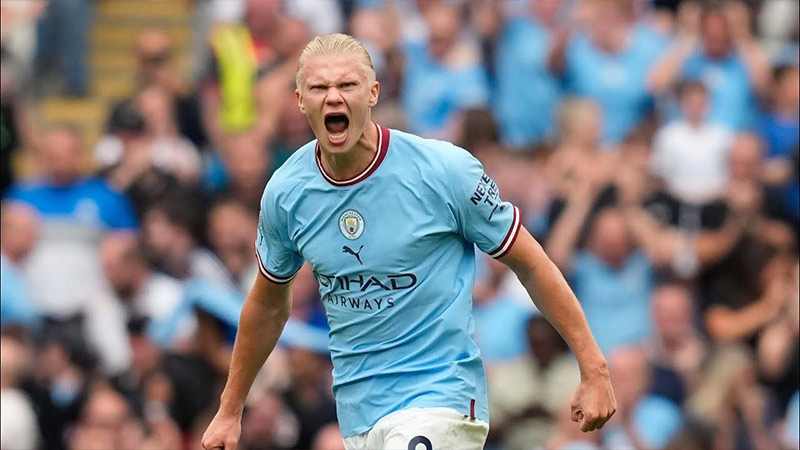
In the summer of 2022, the footballing world stood still. Every major European powerhouse—from the historic halls of the Bernabéu to the financial juggernauts in Paris—was vying for the signature of a once-in-a-generation talent: Erling Haaland.
Yet, despite the allure of the “White Ballet” in Madrid or the prestige of Bayern Munich, the Norwegian phenom chose the blue side of Manchester.
While critics often point to financial incentives, the reality is far more nuanced. Haaland’s decision was a masterclass in strategic planning, blending deep-seated familial sentiment with a cold, data-driven evaluation of his professional future.
This blog post explores the four pillars that brought the “Nordic Meat Shield” to the Etihad and why he has recently committed his long-term future to the club.
The Emotional Foundation: A “Homecoming” Decades in the Making
For many players, a transfer is a business transaction. For Erling Haaland, joining Manchester City was described as a “homecoming”. This emotional tether was built long before Erling became a household name.
Following the Legacy of Alfie Haaland
The connection begins with his father, Alfie Haaland, who donned the City blue between 2000 and 2003. Erling was born in Leeds, England, shortly after his father signed for the club, effectively making him a “son of the city” from birth.
A Lifelong Supporter
Growing up, Erling wasn’t just a fan of football; he was a lifelong supporter of Manchester City. The club famously leaned into this narrative during his official signing announcement by recreating a childhood photo of a toddler-aged Erling wearing a 2000s-era City kit.
This wasn’t marketing fluff; it was a testament to a genuine, deep-seated passion that remained even as he rose through the ranks of Molde, Red Bull Salzburg, and Borussia Dortmund.
The “Guardiola Factor”: Reaching the Next Level
Beyond the heart, there was the head. Haaland’s professional ambition is singular: to be the best in the world. To achieve that, he believed he needed the world’s best architect.
Elite Technical Development
The opportunity to work under Pep Guardiola was a decisive factor in his choice. Haaland was already a prolific goalscorer at Dortmund, but he believed that Guardiola was the specific manager who could help him “go up another gear”.
He sought a coach who would refine his movement, improve his link-up play, and integrate him into a complex tactical system.
A Service-Rich Tactical Environment
Haaland and his team were highly analytical about City’s style of play. He admired the team’s offensive philosophy, noting that Manchester City “create a lot of chances”.
For a striker who thrives on volume and precision, joining a squad featuring creators like Kevin De Bruyne meant he wouldn’t just be a passenger; he would be the focal point of a service-rich environment designed to maximize his output.
The Objective Logic: A Data-Driven “Points System”
Perhaps the most fascinating aspect of Haaland’s move was the “Points System” used by his team to evaluate potential destinations. Eschewing pure emotion, Haaland, his father, and his advisors used a rigorous, objective scoring method to rank Europe’s elite clubs.
The 10/10 Need for a Forward
In 2022, Manchester City was a team at a crossroads. Following the departure of the legendary Sergio Agüero, the club had spent an entire season playing primarily with a “false nine” system.
When Haaland’s team evaluated the “Team Need” metric, Manchester City scored a perfect 10/10. The vacancy at the No. 9 position was absolute; he wouldn’t just be joining a great team; he would be filling their only significant tactical void.
Avoiding the “Benzema Blockade”
To understand why City won, you have to look at why others lost. Real Madrid, arguably the biggest brand in football, scored a much lower 5/10 on the same scale.
The reason? Karim Benzema. At the time, Benzema was in the form of his life, having just led Madrid to a Champions League title and on his way to a Ballon d’Or.
Haaland’s team realized that moving to Madrid would mean competing with an established icon, whereas City offered the chance to be the undisputed focal point of the attack from day one.
The Result: A Historic Nine-Year Commitment
The ultimate proof that Haaland chose correctly lies in his recent contract activity. While many expected him to use City as a stepping stone to Spain, the “Man City project” has proven too successful to leave.
The 2034 Extension
In early 2025, Haaland doubled down on his commitment by signing a massive nine-and-a-half-year contract extension. This deal, which keeps him at the Etihad until 2034, effectively spans the entirety of his prime years.
Becoming the Club’s Cornerstone
This record-breaking agreement did more than just increase his wages to a reported £500,000 per week; it fundamentally changed his status within the club:
- Removal of Release Clauses: The new deal reportedly removed previous release clauses that had fueled constant transfer speculation.
- Long-Term Vision: By committing for nearly a decade, Haaland has transitioned from a star signing to the cornerstone of the club’s future.
Conclusion: Heart, Science, and Success
Erling Haaland did not choose Manchester City by accident. It was the result of a rare alignment where childhood dreams met cold-blooded sports science.
By prioritizing tactical fit and a clear path to the starting XI over the glamour of other clubs, Haaland has not only secured his financial future but has positioned himself to break every goal-scoring record in English football.
As he looks toward a future that keeps him in Manchester until 2034, it is clear that the “homecoming” was just the beginning of what is becoming the most dominant era for a striker in Premier League history.