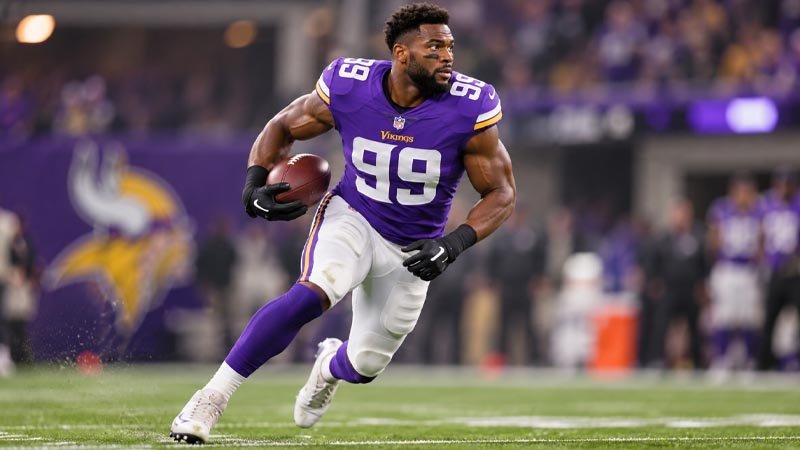
The transition of an elite athlete from a franchise where they have spent their entire career is rarely a simple narrative of wins and losses.
In March 2024, the professional football landscape shifted when Danielle Hunter, a cornerstone of the Minnesota Vikings’ defense for nearly a decade, finalized a move to the Houston Texans.
This decision was not merely a change of scenery but a calculated strategic pivot by two organizations moving in opposite directions of their respective competitive cycles.
To understand the departure of a player who delivered 16.5 sacks in his final season in Minnesota, one must analyze the intersection of market value, roster construction philosophy, and the mathematical reality of the modern salary cap.
The Financial Architecture: A Record-Breaking Commitment
The primary driver behind Hunter’s move to Houston was a massive, highly lucrative contract that Minnesota was ultimately unwilling to match.
While the Vikings have historically valued Hunter’s contributions, the open market provided a valuation that exceeded the team’s internal projections for a player entering his 30s.
| Contract Metric | Houston Texans Agreement |
|---|---|
| Total Value | $49 Million |
| Contract Duration | 2 Years |
| Total Guaranteed | $48 Million |
| Annual Average (AAV) | $24.5 Million |
| 2023 Performance Baseline | 16.5 Sacks |
This agreement is notable for its high percentage of guaranteed money—roughly 98% of the total contract value is secured.
For Hunter, this represented the “top-tier payday” he sought after a career-best statistical season. For the Texans, it was an aggressive investment in a proven disruptor to pair with their emerging young core.
The Vikings’ Strategic Pivot: The “Roster Reset”
While the financial gap was significant, the departure was also rooted in a broader organizational philosophy currently being implemented in Minnesota.
The team is undergoing a “roster reset,” a phrase that describes a fundamental shift in how they allocate resources.
- The Quarterback Catalyst: The departure of veteran quarterback Kirk Cousins signaled a new era. Without a high-priced veteran under center, the Vikings began re-evaluating every high-salary position on the roster to ensure long-term sustainability.
- Asset Diversification: Instead of concentrating $25 million per year into a single edge defender, the Vikings chose a “committee” approach. By spreading that capital across multiple players, the team aims to build a more resilient depth chart.
- The Age Factor: Hunter signed his new deal at age 29. In professional football, the transition from 29 to 31 is often where elite physical production begins to align with increased injury risk. Minnesota’s leadership chose to avoid paying for past performance and instead invested in the upward trajectory of younger talent.
The Replacement Theory: Efficiency Over Individualism
The decision to let an elite player walk is only justifiable if the plan to replace them is sound. Minnesota’s approach was to reallocate the funds that would have gone to Hunter into two younger, ascending defenders.
- Jonathan Greenard: Targeted as a high-upside replacement who offers a younger profile than Hunter.
- Andrew Van Ginkel: Brought in to provide versatility and scheme fit within Brian Flores’ aggressive defensive system.
By signing both Greenard and Van Ginkel, the Vikings are betting that the combined production of two high-level starters will outweigh the individual brilliance of one superstar. This is a classic “Moneyball” application to defensive football: replacing a singular 16.5-sack season with a collective pressure rate that keeps the defense unpredictable.
The Houston Context: A Perfect Match
For the Houston Texans, the acquisition of Hunter was the final piece of a defensive puzzle. Coming off a surprising playoff run, the Texans were in a unique position:
- Rookie Contract Advantage: With a star quarterback on a rookie deal, Houston had the excess cap space to overpay for veteran leadership and elite production.
- Immediate Super Bowl Window: The Texans are not resetting; they are accelerating. Hunter provides a “win-now” impact that matches the team’s current trajectory.
- Hometown Connection: While the financial terms were the primary motivator, the move also brought Hunter back to his Texas roots, providing a personal incentive to finish his career in a familiar environment.
Impact Analysis: Measuring the Fallout
The consequences of this move will be felt for several seasons as both teams test their respective philosophies.
The Minnesota Risk Profile:
The Vikings’ defense now lacks a “gravity” player—someone who requires a constant double-team. If Greenard and Van Ginkel fail to reach their projected ceilings, the Minnesota pass rush could become stagnant, placing immense pressure on a young secondary.
However, the financial flexibility gained allows the team to be aggressive in future free-agency periods or during the draft.
The Houston Reward Profile:
The Texans now possess one of the most feared edge-rushing tandems in the league. By securing Hunter with a massive guarantee, they have stabilized their defensive front for the next two years.
The risk for Houston is purely health-related; at $24.5 million per year, any significant time missed by Hunter would be a major blow to their cap efficiency.
The Final Verdict on the Move
The departure of Danielle Hunter from the Minnesota Vikings is a textbook example of the “Business of Football.” It was a move where every party achieved their primary objective.
Hunter secured the generational wealth and guaranteed security he earned through years of elite production.
The Houston Texans acquired a blue-chip pass rusher to solidify their status as a title contender.
Meanwhile, the Minnesota Vikings successfully cleared the deck for a new era, trading individual star power for roster-wide flexibility and youth.
In the high-stakes environment of the NFL, sentiment rarely outweighs the balance sheet. Hunter’s legacy in Minnesota is secure, but his future in Houston represents a new chapter of aggressive, high-value competition.