In the modern landscape of professional football, finding a franchise cornerstone outside of the first round is often viewed as a statistical anomaly.
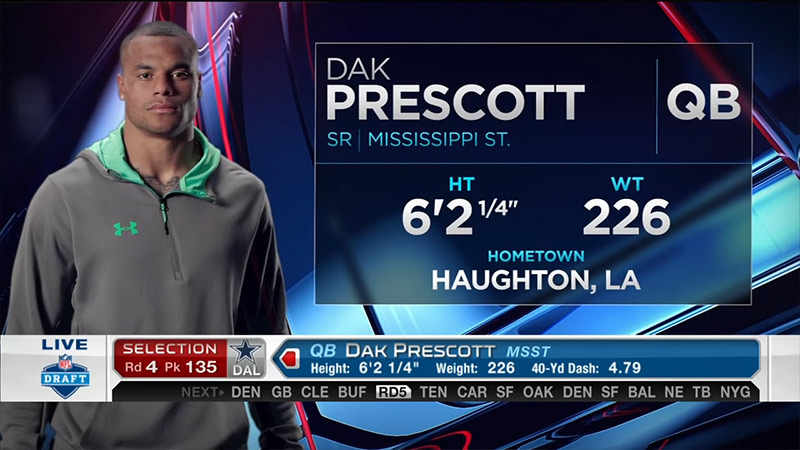
Yet, the trajectory of the 135th overall pick in the 2016 professional draft serves as a perennial case study for front offices and analysts alike.
When the Dallas franchise eventually selected Dak Prescott in the fourth round, thirty-one other organizations had repeatedly bypassed a player who would soon become a statistical titan and a leader of one of the world’s most valuable sporting brands.
Understanding why a player of this caliber remained on the board for three full rounds requires a meticulous examination of the scouting reports, the prevailing offensive philosophies of the era, and a specific sequence of events that created a “perfect storm” for his draft-day slide.
The Technical Paradox: Mechanical Inconsistency
The primary deterrent for high-level evaluators during the 2016 cycle was rooted in technical biomechanics.
In professional scouting, a quarterback’s “base”—the positioning and stability of the feet—is considered the foundation of every successful play. For Prescott, this foundation was frequently under scrutiny.
The Breakdown of the Base
Scouts and technical analysts noted that Prescott’s lower-body mechanics often faltered under pressure or during complex movement patterns within the pocket.
Specifically, his base was prone to “breaking down,” a term used to describe a loss of structural integrity in a quarterback’s stance.
When a quarterback’s feet are not properly aligned or set, the kinetic energy required for a powerful and accurate throw is dissipated.
This mechanical flaw had a direct correlation to his statistical output in specific areas of the field. Evaluators consistently cited this lack of footwork discipline as the root cause for his inconsistent accuracy on intermediate and deep passing routes.
In a league where the margin for error is measured in centimeters, the inability to consistently deliver a precise ball 20 yards downfield was viewed as a significant ceiling on his professional potential.
The Accuracy Gap
The “accuracy” label is one of the most difficult for a prospect to shed. While Prescott’s completion percentages in college were respectable, the tape revealed a player who often forced his receivers to make adjustments to poorly placed balls.
Because his footwork was viewed as “raw,” many teams feared that his accuracy issues were not just a minor glitch, but a fundamental trait that would be exploited by faster, more disciplined professional secondaries.
The Schematic Barrier: The “Spread” Offense Stigma
To understand Prescott’s fall, one must also understand the philosophical state of the league in 2016.
We were in the final years of a rigid divide between “pro-style” offenses and the “spread” systems that dominated the collegiate ranks.
Transitioning from Mississippi State
At Mississippi State, Prescott flourished in a spread system that emphasized his dual-threat capabilities. However, at that time, many front offices were still skeptical of quarterbacks coming out of these schemes.
The prevailing wisdom suggested that spread quarterbacks were “products of the system” rather than independent processors of the game.
The specific concerns regarding Prescott’s transition included:
- Operating “Under Center”: Many spread systems utilize the shotgun formation almost exclusively. Scouts questioned how long it would take for Prescott to master the footwork and timing required to take snaps directly from the center.
- Reading Complex Defenses: Collegiate spread systems often simplify the “reads” for a quarterback, sometimes relying on sideline signals or single-key progressions. There were significant doubts about Prescott’s ability to decipher the sophisticated, disguised coverages utilized by professional defensive coordinators.
The Speed of Progression
A recurring theme in Prescott’s pre-draft evaluation was the perceived lack of “mental speed.” Evaluators felt that his decision-making process was too deliberate. In the pocket, the window to deliver the ball is often less than three seconds.
The consensus among many scouts was that Prescott needed to significantly accelerate his ability to move through his progressions—transitioning from his primary receiver to his secondary and tertiary options.
This perceived “slow processing” made teams hesitant to invest a high-value pick, as they feared he would be prone to sacks or forced turnovers when faced with professional-grade pass rushes.
The Character Variable: A Costly Timing Error
While technical and schematic concerns form the bulk of a scouting report, “intangibles” and off-field conduct often dictate the final draft grade. For Prescott, a single incident in the spring of 2016 threatened to derail his entire career.
The Pre-Draft Incident
Shortly before his Pro Day—arguably the most important job interview for a prospective athlete—Prescott was charged with a DUI.
In the high-stakes environment of the draft, timing is everything. An incident of this nature occurring so close to the draft date sent immediate “red flags” through front offices across the country.
The Impact of Uncertainty
For many organizations, the talent-to-risk ratio is a delicate balance. Even though the charges against Prescott were eventually dismissed, the initial reports of the arrest created a cloud of uncertainty.
Teams that were already on the fence regarding his mechanical flaws or his ability to read defenses used this off-field incident as a justification to move him down their boards.
In an industry where job security is tied to the character of the players you draft, the DUI charge served as a convenient reason to pass in favor of “safer” prospects.
The Competitive Landscape: The Quarterback Class of 2016
Prescott’s slide was also a byproduct of the specific market conditions of the 2016 draft. The year was defined by a massive “run” on quarterbacks at the very top of the board, followed by a period of extreme skepticism.
- The Top Tier: Jared Goff and Carson Wentz were the consensus top two picks, with teams trading massive hauls of assets to secure them.
- The “Project” Picks: Players like Paxton Lynch and Christian Hackenberg were selected ahead of Prescott based on “prototypical” physical traits (height, arm strength) that scouts often overvalue.
- The Value Gap: By the time the third round concluded, many teams felt they had addressed their needs or were unwilling to take a chance on a player with both mechanical and off-field questions.
This created a vacuum in the fourth round, where the Dallas organization—having failed to secure other targets earlier in the draft—found a value proposition that was too significant to ignore.
The Evaluation Failure: What the Experts Missed
The fall of Dak Prescott to the 135th pick is ultimately a story of the limitations of traditional scouting. By focusing so heavily on what Prescott couldn’t do in 2016, the league’s evaluators failed to see what he would do.
The Growth Mindset
The scouting reports correctly identified that his footwork was inconsistent and his progressions were slow. However, they failed to account for his work ethic and “coachability.”
The “gaps” in his game were not permanent traits; they were addressable skills. Once he entered a professional environment with elite coaching and a dominant offensive line, those mechanical flaws were rapidly corrected.
The Power of Intangibles
While the DUI was a red flag for some, it obscured the fact that Prescott was a massive leader on his college campus.
The mental toughness required to navigate a draft-day slide and a legal hurdle proved to be the same mental toughness required to start as a rookie for the most scrutinized team in professional sports.
Conclusion: The Legacy of the 135th Pick
The descent of Dak Prescott in the 2016 draft serves as a permanent reminder that the “perfect prospect” is often a mirage.
The concerns regarding his footwork, his system transition, and his off-field judgment were documented and, at the time, based on tangible evidence.
However, the 135th pick proved that technical flaws are often temporary, while character and the ability to learn are the true indicators of long-term success.
For organizations looking to find the next “steal,” the lesson is clear: do not let a player’s current mechanics blind you to their future ceiling. The 2016 draft didn’t just give us a star quarterback; it gave us a new blueprint for evaluating the modern athlete.