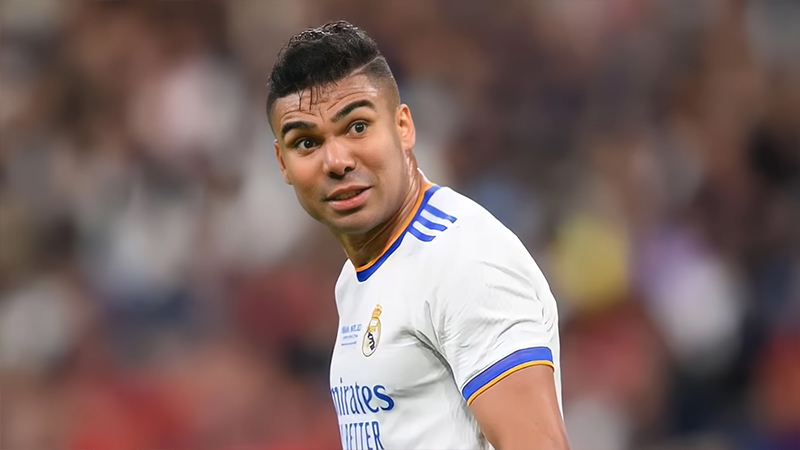
The departure of Carlos Henrique Casemiro from Real Madrid in August 2022 stands as a landmark case study in professional transition, strategic career management, and the cyclical nature of elite sports organizations.
While the transfer of a world-class defensive midfielder to Manchester United initially appeared to be a sudden shift in the European football landscape, a closer analysis reveals a calculated alignment of personal ambition, financial pragmatism, and club-level succession planning.
The Architecture of an Exit: A Strategic Overview
To understand the motivations behind one of the most significant transfers of the modern era, one must look beyond the pitch. Casemiro’s move was not a flight from failure, but rather a deliberate exit following a period of unprecedented success.
After securing five Champions League titles and three La Liga trophies, the Brazilian international reached a psychological plateau where he felt his “cycle” at the Santiago Bernabéu had reached its natural conclusion.
The following analysis explores the multifaceted reasons for this transition, focusing on how a veteran professional navigates the final peak of his career.
1. The Pursuit of a New Competitive Frontier
At 30 years of age, many elite athletes begin to consider the preservation of their legacy. For Casemiro, the motivation was rooted in a desire for a new professional challenge while he still possessed the physical and mental willpower to compete at a high level.
Cultural and Linguistic Integration
Beyond the tactical demands of the English Premier League, Casemiro expressed a profound interest in experiencing a different culture and mastering a new language.
This desire for personal growth is a common trait among high-performing individuals who seek to avoid stagnation.
By moving to Manchester, he wasn’t just changing clubs; he was immersing himself in a different footballing philosophy and a new social environment.
Testing the “Tank” in England
The English Premier League is often cited as the most physically demanding domestic competition in the world. Casemiro viewed this as the ultimate litmus test for his “willpower and ambition.”
Having “won everything” in Spain, the prospect of revitalizing a historic giant like Manchester United offered a narrative arc that staying in Madrid—where excellence had become routine—could not provide.
2. Financial Pragmatism and Long-Term Security
In any professional industry, the window for maximizing earning potential is limited. In elite football, this window is even narrower for players entering their thirties.
Generational Wealth Acquisition
Manchester United’s proposal included a highly lucrative four-year contract, with an optional fifth year.
This deal represented a significant escalation in compensation, with reports indicating his weekly wages nearly doubled, moving from approximately £184,000 at Real Madrid to a range between £350,000 and £415,000.
Such a contract provides “generational wealth” and long-term security that is rarely available to players of his age group.
Real Madrid’s Contract Philosophy
Real Madrid is known for a disciplined approach to veteran contracts, typically offering short-term extensions to players over 30 to mitigate the risk of physical decline.
It was highly improbable that the Spanish club would match the length or the financial scale of the United offer.
Recognizing this, Casemiro and his representatives identified the 2022 window as the optimal time to secure his financial future before his market value began to diminish.
3. Institutional Succession and the Arrival of the “New Guard.”
One of the most critical factors in Casemiro’s decision was his observation of Real Madrid’s long-term tactical planning.
The club had already begun the process of “future-proofing” its midfield, a move that signaled an inevitable shift in Casemiro’s status as an undisputed starter.
The €100 Million Signal
Months before Casemiro’s exit, Real Madrid made a massive statement of intent by signing Aurélien Tchouaméni for €100 million.
This investment, combined with the earlier acquisition of Eduardo Camavinga, made it clear that the club was actively preparing for a post-Casemiro era.
Managing the Decline of the “KMC” Era
For years, the trio of Kroos, Modrić, and Casemiro (KMC) defined the midfield standard in Europe. However, as the club secured long-term replacements, Casemiro realized his “absolute grip” on the defensive midfield role would eventually be challenged.
Rather than staying to witness a gradual reduction in his playing time or a transition to a rotational role, he chose to depart while his value to the team remained at its zenith.
4. The Art of the Peak Exit: Timing the Departure
A hallmark of great leaders is the ability to recognize when a mission has been accomplished. Casemiro’s epiphany regarding his departure occurred immediately following the 2022 Champions League final victory against Liverpool in Paris.
Leaving “On Top”
The emotional and professional satisfaction of winning a fifth European crown provided the perfect closing chapter. Casemiro explicitly noted that he preferred to leave a “historic giant” like Madrid while performing at his “absolute peak.”
Leaving at this juncture ensured that his legacy would remain untarnished by the inevitable physical regression that comes with age. It allowed him to exit through the “front door” as a conquering hero rather than being forced out due to declining performance.
5. Professional Decorum and the Role of Management
The transition was also defined by the high degree of mutual respect between the player and the club’s leadership. This professional transparency facilitated a smooth exit that benefited all parties involved.
The Ancelotti and Pérez Dynamic
The emotional weight of the move was evidenced by manager Carlo Ancelotti, who reportedly broke into tears when Casemiro informed him of his decision.
Despite the personal and tactical loss, both Ancelotti and club president Florentino Pérez respected Casemiro’s wishes.
From a corporate perspective, the £70 million transfer package offered by Manchester United was an excellent return on investment for a 30-year-old player, allowing the club to recoup a significant fee while honoring the wishes of a club legend.
Strategic Analysis: The Broader Implications
Casemiro’s departure offers several insights into the management of elite talent:
- Proactive Career Pivoting: By identifying the “end of a cycle” early, players can maintain control over their career narrative.
- Market Timing: Real Madrid demonstrated how to sell an asset at the peak of its value, even if it is a beloved one.
- The Power of the New Challenge: For high-achievers, the psychological need for a “new mountain to climb” often outweighs the comfort of established success.
Frequently Asked Questions (FAQ)
Why did Casemiro choose Manchester United specifically?
While several clubs may have been interested, Manchester United offered a unique combination of a historic brand seeking revitalization, the challenge of the Premier League, and a financial package that was unmatched by his current club.
Did Casemiro leave because of a falling out with Real Madrid?
No. The departure was characterized by mutual respect. Both the manager and the president accepted his decision, and the club’s active recruitment of younger midfielders showed they were already planning for a future without him.
How much did his salary increase after the move?
His weekly earnings reportedly nearly doubled, jumping from approximately £184,000 at Real Madrid to between £350,000 and £415,000 at Manchester United.
What was the “Paris Epiphany”?
Casemiro realized his time at Madrid was over right after winning the 2022 Champions League final against Liverpool. He felt he had achieved everything possible and wanted to leave while still at the top of his game.
Who replaced Casemiro at Real Madrid?
The club had already signed Aurélien Tchouaméni for €100 million and Eduardo Camavinga earlier, ensuring a smooth transition into a new era of midfield play.
Conclusion: A Legacy Defined by Choice
The story of Casemiro’s exit from Real Madrid is a testament to the importance of autonomy in a professional career.
By recognizing the arrival of a new generation of talent and the natural conclusion of his own “golden cycle,” Casemiro was able to negotiate an exit that preserved his legendary status in Madrid while securing his financial and professional future in Manchester.
For Real Madrid, it was a masterclass in squad evolution and financial management. For Casemiro, it was a courageous leap into the unknown, driven by the same ambition that saw him win five European cups. His departure was not an end, but a calculated pivot to a new chapter of high-stakes competition.