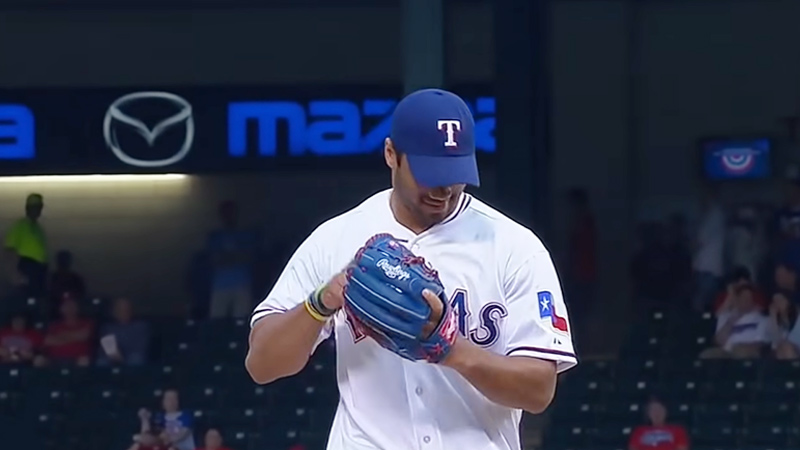
If you have ever seen an umpire send a pitcher back to the dugout to change his undershirt, you have watched one of baseball’s lesser-known equipment rules at work.
Many fans ask the same question: why can’t pitchers wear white sleeves? The answer has nothing to do with fashion or team branding. It comes down to how a hitter sees the baseball.
From Major League Baseball to high school fields and Little League diamonds, rulebooks keep white and gray off the pitcher’s arm. This guide explains the reason behind the rule, what each level of play says, and how players and coaches can stay within it.
The Short Answer: White Sleeves Hide the Baseball
A baseball is white. When a pitcher wears a white or gray sleeve, the ball blends into the arm as it leaves the hand. The hitter can lose the ball for a split second at the most important moment of the pitch.
Rulebooks treat this as an unfair edge for the pitcher. The aim is a clear contrast between the ball and everything around it, so the batter can pick up the pitch at release.
That is also why the rule targets the pitcher and not the fielders, whose sleeves are not in the hitter’s line of sight when the ball is thrown.
How Hitters Track a Pitch
Hitting a baseball is a race against time. A 90 mph fastball covers the distance from the mound to home plate in roughly four-tenths of a second. In that window, the batter has to spot the ball, judge its speed and spin, decide whether to swing, and start the bat.
Most of that work begins at the release point. Hitters train their eyes on the pitcher’s hand and the area around it.
If the ball shows up the instant it leaves the fingers, the batter gains time. If a white sleeve masks it, the read starts late. Against hard throwers like the one in our story on Spencer Strider’s record strikeout pace, even a tiny delay can decide the at-bat.
Sleeve color also affects how much a hitter can learn about the pitch. A dark, solid sleeve frames the hand and makes arm angle and grip easier to notice.
A white sleeve can blur those details, leaving the batter with less information about whether a fastball, curveball or changeup is coming.
The same thinking explains the batter’s eye in ballparks. That is the dark, empty area in center field directly behind the pitcher.
Clubs keep it a solid dark color and free of fans, so hitters see a white ball against a plain background. Rules on the pitcher’s sleeves apply that idea to the pitcher’s own body.
What MLB Rules Say About Pitcher Sleeves
In Major League Baseball, the standard comes from Official Baseball Rule 3.03, which covers player uniforms.
Any part of an undershirt that shows must be one solid color for every player on the team. Other players may add numbers, letters or logos to their undershirt sleeves, but the rule leaves the pitcher out of that allowance.
For many years, the official rulebook did not spell out a direct ban on white sleeves for pitchers. Umpires handled the issue through their power to remove anything they judged distracting.
The topic drew attention during the 2001 postseason, when manager Lou Piniella raised a complaint about it.
That gray area closed before the 2020 season. MLB’s Playing Rules Committee amended Rule 3.03(e) to bar pitchers from wearing sleeves that are white, gray, or distracting in the umpire’s judgment.
Today, a big league pitcher who takes the mound in a white or gray sleeve will be told to change before he throws another pitch.
High School Baseball Rules (NFHS)
High school baseball in the United States follows the National Federation of State High School Associations (NFHS) rulebook, and its wording is the most detailed of any level.
Rule 1-4-2 states that if a pitcher’s undershirt sleeves are exposed, they cannot be white or gray. It also bans any white or gray sleeve that extends below the elbow.
Compression sleeves get their own treatment. Since 2016, a compression sleeve that runs below the pitcher’s elbow must be solid black or another solid dark color. A sleeve that stops at the elbow may be white, gray, black or a dark color, and it can be worn on either arm.
NFHS interpretations also cover a few common situations:
- Vest-style jerseys: A white shirt under a vest is legal for the pitcher as long as its sleeves do not go past the elbow. A long-sleeve white or gray shirt under the vest is not.
- Gray road jerseys: If a team’s gray road jersey has sleeves that reach beyond the pitcher’s elbow, that jersey is illegal for the pitcher.
- A different color for the pitcher: If teammates wear long white sleeves under a vest, the pitcher may wear a short white sleeve or a long sleeve in a different, non-distracting color.
Rule 6-2-1 lists exposed white or gray undershirt sleeves among the infractions by a pitcher, next to distracting items on the hands, wrists or arms.
College Baseball Rules (NCAA)
The NCAA takes a slightly different route. Rule 1-14 requires any exposed part of an undershirt to be the same solid color for the whole team, and that color cannot be white. In college baseball, white undershirt sleeves are off the table for every player, not just the pitcher.
The NCAA also says that compression-type sleeves worn by a pitcher must be covered by an undershirt.
A pitcher cannot pull a bare compression sleeve over his throwing arm. It has to sit under a team-colored sleeve, which keeps the look uniform and removes any bright sleeve near the release point.
Little League and Youth Baseball
Little League applies the same idea to its young players. Any visible part of the pitcher’s undershirt must be a solid color, and exposed undershirt sleeves cannot be white or gray.
Little League treats neoprene sleeves a bit more loosely than the NCAA. A pitcher may wear one without covering it, provided the sleeve is one solid color and not white or gray.
Even then, the umpire can have it removed if it seems distracting to the batter. The rulebook also says a pitcher should not wear items such as sweatbands on the hands, wrists or arms if they could distract the hitter.
Local youth and travel leagues often add their own rules. Some allow pitchers to wear a batting glove under the fielding glove only if it is not white or gray. Parents should check their league’s rulebook before buying gear for the season.
Other Pitcher Equipment Rules With the Same Purpose
Sleeves are only one part of a wider set of rules built around the batter’s view of the ball.
- Gloves: Under MLB Rule 3.07, a pitcher’s glove cannot be white or gray, apart from piping, and cannot be distracting in the umpire’s judgment. No material of a different color may be attached to it. High school rules also ban white, gray or multicolored gloves for pitchers.
- Hands and wrists: The MLB rulebook says a pitcher may not attach anything to either hand, any finger or either wrist, such as a bandage, tape or a bracelet.
- Tape on the uniform: MLB Rule 3.03(f) bars any player from attaching tape or other material of a different color to the uniform.
- Caps: MLB rules ban any uniform pattern that suggests the shape of a baseball. During the 2019 Players Weekend, pitchers on teams in all-white uniforms were told to wear black caps instead of white ones.
- Wristbands: Since 2024, high school pitchers who wear a wristband holding play calls must use one that is not white, gray or distracting.
What Happens If a Pitcher Breaks the Rule?
In most cases, the penalty is simple: the pitcher has to fix the problem. The umpire stops play and orders the pitcher to remove or cover the sleeve, or change into a legal undershirt, before the next pitch.
High school case plays take the same approach with gloves, where a pitcher can swap the glove or darken white lettering with a dark marker, with no further penalty.
Things change if the player refuses. MLB rules state that a player whose uniform does not match his teammates may not take part in the game, and a player who ignores the umpire’s order can be ejected.
The opposing manager can also ask the umpire to check the pitcher’s gear, so a violation rarely goes unnoticed. That matters in close races, such as the chase for the MLB wild card spots, where one at-bat can shape a season.
Tips for Pitchers, Coaches and Parents
A quick gear check before the game prevents most problems:
- Buy dark team undershirts. Black, navy or the team’s darkest color lets pitchers and fielders wear the same shirt.
- Check what shows below the elbow. Swap any white or gray sleeve before the pitcher warms up.
- Choose solid compression sleeves. Go with solid black or dark sleeves, and cover them with an undershirt in college.
- Look at the glove. Skip white or gray gloves and large white logos.
- Read your league’s rules. Youth and travel leagues often add details to the national codes.
Conclusion
So, why can’t pitchers wear white sleeves? Because a white or gray sleeve can hide a white baseball at the moment it leaves the pitcher’s hand.
That takes away the brief look a hitter needs to judge speed, spin and location. MLB made the ban explicit in 2020, and high school, college and Little League rules carry the same principle in their own words.
The fix for teams is easy: dark, solid undershirts, legal compression sleeves and a quick check before the first pitch. Follow those steps, and the only thing a batter has to worry about is the pitch itself.