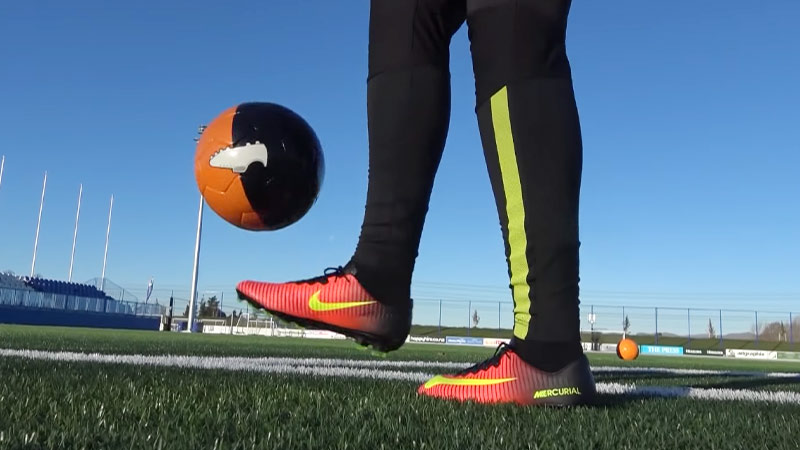
Every competitive soccer player knows the restrictive squeeze of a new pair of elite boots. This isn’t a manufacturing oversight; it’s a deliberate choice by engineers to create a “second skin”.
By narrowing the shoe’s profile, brands aim to eliminate any disconnect between the athlete’s foot and the ball. While this delivers the high-speed responsiveness required on the modern pitch, it often forces a compromise on natural comfort.
This article explores the mechanical, performance-driven, and commercial reasons behind this design trend and offers professional insights on finding your perfect anatomical fit for elite-level play.
The Engineering Philosophy of the “Second Skin”
In the realm of elite sports, the term “second skin” represents the pinnacle of footwear engineering. For a soccer player, the boot is not merely a protective layer but a technical instrument that facilitates the interaction between the body and the ball.
By creating a narrow silhouette, manufacturers ensure that the upper material remains flush against the foot, minimizing the gap that traditionally exists in standard athletic footwear.
Maximizing Touch and Control
The primary objective of this narrow construction is to maximize “touch.” When a shoe is wide or has excess internal volume, a micro-delay occurs during ball contact as the material shifts before engaging with the foot.
A narrow fit eliminates this extra space, ensuring that every movement of the foot is translated immediately to the ball. This responsiveness is essential for the high-speed maneuvers and technical dribbling seen in modern professional leagues.
The Neural Connection and Proprioception
Beyond physical contact, a narrow boot enhances proprioception—the athlete’s subconscious sense of the foot’s position and movement. When the boot is tight, the sensory receptors in the skin are more effectively stimulated by the ball’s impact.
This feedback loop allows players to execute delicate touches and adjustments with surgical precision, a feat that would be impossible in a loose-fitting, bulky shoe.
The Biomechanics of Precision and Ball Feel
The mechanics of the modern game require more than just protection; they demand a platform for extreme technicality. The narrow design is a fundamental requirement for the subtle physics involved in manipulating a soccer ball at high velocities.
- Eliminating Internal “Air”: Reducing the “air” or dead space inside the boot allows players to feel the ball better. This is critical for applying subtle spins, whether you are curving a free kick or providing a weighted through-ball.
- Energy Transfer in Passing: In a narrow boot, the energy from the leg is transferred more consistently through the foot to the ball. A snug fit ensures the foot doesn’t shift at the moment of impact, leading to higher accuracy in long-range passing.
- Ball Manipulation: For players who rely on “close control” in tight spaces, the reduced profile of the boot allows for a more intimate connection with the ball’s surface, facilitating rapid-fire changes in direction.
The Evolution of Speed: Weight Reduction and Agility
Modern soccer has transformed into a game of extreme transitions and explosive bursts of speed. To meet these athletic demands, footwear brands have engaged in a “race to the bottom” regarding boot weight. The narrow profile of the modern soccer shoe is a direct byproduct of this minimalist design philosophy.
Minimalist Material Selection
Every additional millimeter of width in a shoe requires more outsole rubber, more upper fabric, and more internal reinforcement.
By narrowing the “last”—the mold upon which a shoe is built—manufacturers can significantly reduce the total mass of the boot. Lighter boots are essential for players to maintain their top-end speed and agility throughout a grueling 90-minute match.
Reducing Rotational Inertia
From a physics perspective, reducing the weight at the end of the leg (the foot) allows for faster leg turnover. A narrow, lightweight boot decreases the rotational inertia the player must overcome to swing their leg, which translates to quicker acceleration and faster reaction times during defensive lunges or offensive sprints.
Safety and Biomechanics: The Lockdown Effect
A common misconception is that a narrow boot is inherently less safe. However, in the context of high-intensity sports, a “lockdown” fit is a critical safety feature. When a player makes a sharp turn or a sudden stop, the forces exerted on the foot are immense.
| Feature | Performance Benefit | Safety Benefit |
|---|---|---|
| Lockdown Fit | Prevents the foot from sliding, ensuring maximum power transfer. | Reduces the risk of ankle rolls and ligament strain by keeping the foot centered over the soleplate. |
| Minimal Internal Space | Improves “feel” and technical control. | Eliminates friction between the foot and the shoe, which is the primary cause of blisters. |
| Streamlined Outsole | Enhances agility and speed. | Provides a more stable platform during high-velocity pivots. |
The Business of Soccer: Aesthetics and Manufacturing
While performance is the driving force, the commercial reality of the footwear industry cannot be ignored. The sleek, narrow aesthetic has become synonymous with “elite” status in the eyes of the consumer.
The Marketing of Speed
From a marketing perspective, a narrow design is often considered more visually appealing and “fast”. Brands spend millions on research and development to ensure their boots look as aerodynamic as they perform.
This visual language signals to the consumer that the product is a high-performance tool, similar to how a sports car’s sleek lines suggest speed.
Scalability and Production Efficiency
There is also a manufacturing incentive behind the narrow trend. Narrower toe boxes can be easier and cheaper to produce at scale.
By standardizing narrower lasts, manufacturers can streamline their production lines and use less material per unit, which improves profit margins while maintaining the high-performance narrative that the market demands.
The Physiological Cost: Addressing Foot Health
Despite the undeniable performance benefits, the trend toward narrow boots has raised concerns among biomechanical experts and podiatrists. The conflict between a “perfect touch” and anatomical health is a growing topic of discussion in the athletic community.
The Risk of “Crushed Toes” and Instability
When a fit is too extreme, the narrow design can lead to discomfort or significant foot issues, such as crushed toes and general instability.
If the toes are compressed and unable to splay naturally, the foot’s natural shock-absorption system is compromised. This can lead to long-term issues such as bunions or persistent arch pain.
Expert Insights on Foot Function
Experts at Squat University have pointed out that many modern soccer boots are built significantly narrower than the natural shape of the human foot.
They suggest that this persistent compression can hinder natural foot function over time, potentially weakening the foot’s intrinsic muscles and affecting a player’s overall balance and power.
Strategic Solutions: Finding the Right Match
If you find that standard elite boots are too restrictive, you do not have to sacrifice performance for comfort. There are specific strategies and models designed to accommodate different foot shapes without losing the “second skin” feel.
| Solution Strategy | Key Details | Recommended For |
|---|---|---|
| Leather Material | Natural leather (like the Nike Tiempo) stretches and molds to the foot shape over time. | Players seeking a custom, “forgiving” fit after a short break-in period. |
| Wide-Fit Specialists | Brands like New Balance and Mizuno offer dedicated wide-fit versions of their top boots. | Players with anatomically wide feet who need more room in the midfoot and toe box. |
| Specific Models | The New Balance 442 and Tekela are renowned for their accommodating lasts. | Technical players who refuse to compromise on either touch or comfort. |
Overcoming the Sizing Myth
One of the most persistent issues in the soccer world is the “sizing myth.” Many players are convinced they have “wide feet” simply because they struggle to fit into the latest narrow releases from major brands.
Understanding Anatomical Norms
In reality, modern boots are simply built narrower than the natural foot shapes of a large portion of the population.
You may not have a “wide” foot by medical standards; you may simply have a “natural” foot that is being forced into a shoe designed for an idealized, narrow athletic profile.
Recognizing this allows you to stop sizing up—which leads to heel slippage—and instead start looking for shoes with the correct width.
The Dangers of Sizing Up
When players buy a size too large to accommodate width, they create a new set of problems. A shoe that is too long places the foot’s arch in the wrong position relative to the boot’s chassis.
This can lead to plantar fasciitis and reduced traction, as the studs are not aligned with the foot’s natural pressure points. The solution is always to find a wider last, not a longer shoe.
Frequently Asked Questions
Do all professional soccer players wear narrow boots?
Most elite-level “speed” and “control” boots are narrow by design to facilitate touch. However, many professionals receive custom-made boots built on a personal “last” that matches their exact foot shape.
For the average player, choosing leather or wide-fit specific models is the best way to achieve a similar custom-fit feeling.
How long does it take for leather boots to stretch?
Natural leather typically requires two to four sessions of play to fully mold to your foot shape. To speed up the process, some players recommend wearing them around the house or using a light application of leather conditioner to soften the material.
Why does New Balance offer wide-fit soccer boots?
New Balance has identified a significant gap in the market where players were being forced into narrow boots that didn’t fit. By offering their top-tier models like the Tekela and 442 in wide variants, they provide a professional-grade alternative for players who need more internal volume.
Final Verdict: Balancing Precision and Health
The narrow design of soccer shoes is a masterclass in performance engineering, designed to provide the touch, speed, and lockdown required for elite-level play. However, the best boot for your game is one that respects your anatomy.
By choosing materials like leather that offer a “forgiving” fit or seeking out brands like New Balance and Mizuno that prioritize wide-fit models, you can enjoy the benefits of modern technology without the “crushed toe” trade-off. Prioritize a fit that moves with you, and your performance on the pitch will follow.