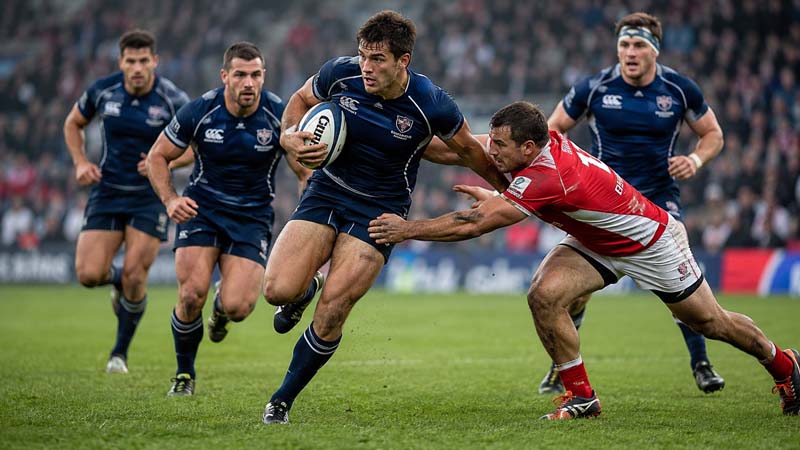
In the world of professional athletics, every piece of equipment is a byproduct of rigorous evolution, designed to solve specific problems on the field of play.
While the casual observer might view the distinctive cut of rugby shorts as a mere nod to tradition or a stylistic relic of the past, the reality is rooted in high-performance engineering.
In a sport defined by extreme physical contact, explosive speed, and intricate set-piece maneuvers, the garment’s design is a calculated tactical advantage.
The short length of these garments is not a fashion statement; it is a utilitarian response to the unique demands of the game.
By examining the intersection of biomechanics, safety, and tactical utility, we can uncover why the rugby short remains one of the most specialized pieces of kit in the sporting world.
The Biomechanics of the Sprint: Maximizing Leg Mobility
At the heart of the design is the fundamental requirement for unrestricted movement. Rugby is a game of high-intensity intervals, requiring players to transition from a stationary position to a full-speed sprint in a matter of seconds.
Stride Efficiency and Range of Motion
The mechanics of a high-speed sprint require the hip and knee joints to move through a complete range of motion without interference. Longer garments, such as those found in basketball or modern casual wear, pose a significant mechanical hurdle.
As a player lifts their knee to drive forward, excess fabric tends to catch on the quadriceps or the knee joint itself. This creates a micro-resistance that, while seemingly negligible in a single stride, becomes a significant energy drain over the course of an eighty-minute match.
By utilizing a shorter inseam, designers ensure that the fabric ends well above the knee. This allows for an unobstructed “knee drive,” enabling the athlete to achieve maximum stride frequency and length.
In a sport where a fraction of a second can determine whether a player breaks through a defensive line or is caught from behind, the removal of fabric-induced friction is essential for peak performance.
Reducing Aerodynamic and Mechanical Drag
Beyond the internal mechanics of the stride, the fit of the short plays a role in reducing “mechanical drag.” Loose, baggy fabric acts as a sail, catching the wind and creating unnecessary weight when wet with sweat or rain.
The shorter, more contoured fit of modern rugby apparel ensures that the athlete remains as streamlined as possible, focusing all kinetic energy on forward propulsion rather than overcoming the weight of their own kit.
Defensive Mitigation: The Physics of the “Grab Point”
Rugby is perhaps the most physically demanding contact sport played without significant padding. Because the rules allow for full-body tackling, every inch of a player’s uniform is a potential liability.
Eliminating Leverage for the Tackler
The primary objective of a defender is to bring the ball carrier to the ground. To do this, they seek leverage. In the heat of a match, a defender will grab whatever they can reach to impede the runner’s progress.
Longer or looser shorts provide “handles” or grab points that a defender can latch onto to slow a player down or pull them off-balance.
By keeping the shorts short and the fit relatively snug against the thigh, the surface area available for a defender to grip is drastically reduced.
This forced “skin-to-hand” or “skin-to-jersey” contact is much harder for a tackler to maintain than a grip on a handful of loose polyester.
Consequently, the shorter design directly contributes to a player’s ability to “break” tackles and maintain their footing under pressure.
Safety and Injury Prevention
There is also a significant safety component to the reduced fabric. When a defender’s fingers become entangled in loose clothing during a high-speed collision, the risk of finger dislocations, fractures, and ligament tears increases for the tackler.
Simultaneously, if a ball carrier is jerked backward by their clothing, it can lead to awkward falls and spinal or neck strain.
The streamlined nature of the rugby short mitigates these risks, facilitating a “cleaner” tackle that focuses on the body’s core rather than the extremities of the clothing.
The Line-Out: The Short as a Tactical Tool
One of the most unique aspects of rugby union is the line-out—a set-piece where players are hoisted high into the air to compete for a ball thrown from the sidelines.
In this scenario, the shorts transition from a passive garment to an active piece of lifting equipment.
The Mechanics of the Lift
During a line-out, “jumpers” are supported by “lifters” who must propel them upward and hold them steady at the peak of their jump.
This requires a secure point of contact. Because of the intense vertical force and the need for a stable hold, lifters often use the bottom of the jumper’s shorts as a handle.
The design of the short must accommodate this specific interaction:
- Reinforced Seams: The hemlines and seams of rugby shorts are significantly more durable than those of standard athletic wear, designed to withstand the full weight of a professional athlete being hoisted into the air.
- Heavy-Duty Materials: The fabric must have a high tensile strength to prevent stretching or tearing during the lift.
- Grip Retention: If the shorts were longer, they would slide down the leg under the pressure of the lift, making the jumper unstable. The short length ensures the lifter’s hands remain positioned correctly on the powerful muscles of the thigh, providing a secure and safe platform.
Material Science: From Cotton to High-Tech Synthetics
The evolution of the rugby short is also a story of material science. Historically, these garments were made of heavy, reinforced cotton. While durable, cotton absorbed water and sweat, becoming heavy and abrasive.
Modern Fabric Integration
Today’s professional shorts are constructed from sophisticated synthetic blends. These materials are engineered to be:
- Ripstop-Resistant: Utilizing specialized weaving techniques to ensure that even if a small tear occurs, it does not spread under tension.
- Hydrophobic: Wicking moisture away from the skin to keep the garment light and the player comfortable.
- Elasticated Gussets: Many designs now incorporate “stretch panels” in the crotch and inner thigh, allowing the short to move with the athlete during deep squats or wide strides while maintaining its structural integrity.
A Comparative Analysis: Why Other Sports Differ
To understand the specificity of the rugby short, it is helpful to compare it to other disciplines.
- Soccer: Players also require mobility, but because it is a low-contact sport (relative to rugby), the risk of being “grabbed” by the shorts is minimal. Therefore, soccer shorts can be longer and lighter.
- American Football: Players wear integrated pants that go over the knee, but these are paired with extensive hard padding. The mechanics of the tackle are different, and the players do not engage in line-out lifting.
- Basketball: The aesthetic has shifted toward longer, baggier styles that prioritize a specific cultural look and comfort during a game with less lateral “ground-scraping” contact.
Rugby stands alone in its requirement for a garment that is simultaneously a mobility aid, a defensive shield, and a lifting harness.
Conclusion: Form Follows Function
The rugby short is a testament to the principle that in elite sport, form must follow function. Every design choice—from the abbreviated length to the reinforced stitching—is a response to the physical realities of the pitch.
By maximizing mobility, minimizing defensive leverage, and providing a critical tool for set-piece maneuvers, these shorts enable athletes to perform at the absolute limit of their physical potential.
As the game continues to evolve, with athletes becoming faster and the collisions more impactful, the engineering behind the kit will only become more sophisticated.
Yet, the core silhouette of the rugby short is likely to remain: a short, tough, and indispensable tool for the world’s most demanding field sport.