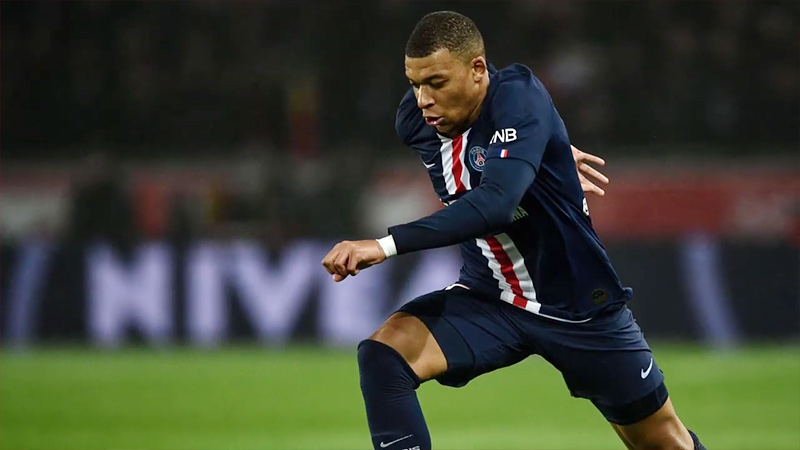
In the high-octane world of modern football, speed is no longer just an advantage—it is a fundamental requirement for elite performance.
The transition from tactical chess matches to explosive, high-pressing systems has turned the pitch into a laboratory for human velocity.
Fans and analysts alike are obsessed with a single question: Who is the King of Speed in football?
While the title is often debated, current data and match performances point toward a select group of athletes who are redefining what it means to be fast.
The Undisputed Monarch: Kylian Mbappé
When discussing the “Speed King” of the sport, the conversation inevitably begins and ends with Kylian Mbappé. The French superstar, now plying his trade at Real Madrid, is widely recognized as the premier speedster in the game today.
What separates Mbappé from his peers isn’t just a one-off sprint but his remarkable consistency. He regularly records top speeds around 38 km/h, a figure that places him at the very top of the global hierarchy.
His “lethal threat” comes from a combination of unmatched acceleration and the ability to maintain explosive pace over long distances, making him a nightmare for defenders in both domestic leagues and international tournaments.
While other players may occasionally edge him out in specific match statistics, his ability to reach his peak velocity repeatedly is why he remains the recognized “Speed King” of the sport.
The Premier League’s High-Velocity Challengers
The English Premier League is often cited as the fastest league in the world, and the data support this claim with some of the highest recorded speeds in football history.
Micky van de Ven: The Defensive Sonic Boom
Perhaps the most surprising entry in the race for the speed crown is Tottenham’s Micky van de Ven. In a league filled with lightning-fast wingers, it is a center-back who holds the record for the fastest player in the English Premier League.
Van de Ven has been clocked at a staggering top speed of 37.38 km/h. His ability to track back and recover makes him one of the most effective defensive assets in modern football, proving that the King of Speed doesn’t always wear a number 9 or 11 shirt.
Kyle Walker: The Gold Standard of Longevity
For years, Kyle Walker has been the benchmark for defensive speed. The Manchester City veteran continues to defy the typical aging curve, hitting top speeds of up to 37.31 km/h.
Walker’s speed is often used as a tactical weapon by Pep Guardiola to nullify the world’s best wingers, demonstrating that top-tier velocity is as much about defensive positioning as it is about offensive breaks.
Adama Traoré: The Power-Speed Hybrid
Wolverhampton’s Adama Traoré offers a different profile of speed. Known for his unique combination of immense physical power and explosive acceleration, Traoré has recorded a high top speed of 36.60 km/h.
His “explosive acceleration” is often cited as his most dangerous attribute, allowing him to bypass defenders from a standing start in a way few others can replicate.
The Continental Speedsters: Bundesliga and Ligue 1
Beyond England and Spain, other European leagues are home to athletes who push the boundaries of human performance.
- Karim Adeyemi (Borussia Dortmund): The Bundesliga has long been a breeding ground for pace, and Adeyemi is its current torchbearer. He is officially one of the fastest players in the German top flight, consistently reaching speeds over 36 km/h.
- Achraf Hakimi (PSG): As one of the fastest defenders globally, Hakimi is a vital component of PSG’s attacking transitions. The Moroccan international has been recorded at a top speed of 36.48 km/h, using that velocity to dominate the entire right flank.
Top Speed vs. Acceleration: Addressing the Gap
In the quest to identify the true King of Speed, it is essential to distinguish between raw top speed and explosive acceleration.
While players like Micky van de Ven may hold higher specific match records, the reason Kylian Mbappé is generally considered the “Speed King” is his “unmatched acceleration”.
In football, the first ten yards are often more critical than the next thirty. A player who can reach 30 km/h in a matter of seconds can create a gap that even a player with a higher ultimate top speed cannot close.
Mbappé’s ability to transition from a jog to a full-tilt sprint almost instantaneously is what makes him the most “lethal threat” on the counter-attack.
The Impact of Velocity on Modern Tactics
The presence of a “Velocity King” changes how a team plays. For teams with players like Mbappé or Adeyemi, the “long ball” or “counter-press” becomes a primary scoring route.
Defenses are forced to sit deeper to avoid being caught in a footrace they cannot win.
Conversely, having a speedster like Van de Ven or Walker allows a team to play a high defensive line, knowing their defenders have the recovery pace to catch almost any attacker who breaks through the initial line of pressure.
Conclusion: A New Era of Speed
While the data shows several players pushing the 37 km/h barrier, Kylian Mbappé remains the standard-bearer for speed in modern football due to his consistency and game-changing acceleration.
However, with newcomers like Micky van de Ven breaking league records, the hierarchy of speed is more competitive than ever.
Modern football is faster than it has ever been, and as sports science and training methods continue to evolve, we may soon see the 38 km/h barrier broken more frequently.
For now, the crown remains with the Frenchman, but the “Velocity Kings” of the Premier League and Bundesliga are breathing down his neck.
Would you like me to create a slide deck that visually compares the top speeds of these players across the different European leagues?