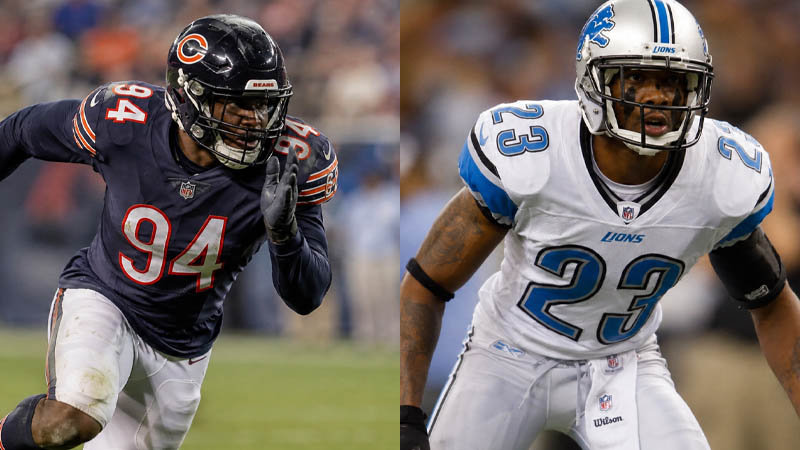
Robert Quinn is definitively the better NFL player when compared to Chris Houston due to his higher career ceiling, superior individual accolades, and significantly longer tenure in the league.
While both players occupied completely different levels of the defensive unit—Quinn as an elite edge rusher and Houston as a starting boundary cornerback—Quinn reached the pinnacle of individual defensive success.
By entering the exclusive 100-sack club and earning multiple All-Pro honors, Quinn established an elite legacy that outshines Houston’s solid but accolade-free seven-year starting career in the professional football landscape.
Robert Quinn vs Chris Houston: Positional Demands and Profiles
To fairly analyze Robert Quinn vs Chris Houston, we must first examine their physical baselines and collegiate entries, which set the trajectory for their respective roles on opposite sides of the defensive front.
The Elite Pass-Rushing Profile of Robert Quinn (DE/OLB)
Quinn was selected 14th overall in the 2011 draft by the Rams after battling a brain tumor in high school.
Standing 6’4″ and 245 lbs, his professional identity was defined by his extraordinary “bend”—the physical capacity to dip incredibly low to the ground while running around offensive tackles at top speeds.
He brought elite edge pressure over a highly productive 12-season career.
The Lockdown Cornerback Blueprint of Chris Houston (CB)
Houston entered the league as a second-round pick in 2007, selected 41st overall by Atlanta out of Arkansas. Standing 5’11” and weighing 180 lbs, his defining characteristic was elite baseline speed.
Clocking a blazing 4.32-second 40-yard dash at the combine, Houston utilized his raw physical coverage speed to survive on the perimeter for seven professional seasons.
Defensive Dominance: Comparing Career Ceilings
Understanding who was better requires evaluating each player at the absolute peak of their defensive power, mapping Quinn’s historical quarterback hunting against Houston’s top-tier cornerback play.
Robert Quinn’s Defensive Player of the Year Peak
Quinn hit a legendary high in 2013 with 19.5 sacks and a league-leading 7 forced fumbles to win Defensive Player of the Year honors.
Nearly a decade later in 2021, he achieved a spectacular career rebirth with the Bears, setting their franchise single-season record with 18.5 sacks, cementing his status as a persistent pocket terrorizer.
Chris Houston’s Shutout Prime with Detroit
Houston reached his defensive peak between 2010 and 2012 after being traded to the Lions, where his speed stabilized a developing defense.
During Detroit’s historic 2011 playoff season, Houston served as a premier defensive catalyst, snagging 5 interceptions and returning two of them for scores while matching up against elite divisional receivers in press-man coverage.
NFL Career Stats: Head-to-Head Comparison
A objective side-by-side metric comparison highlights the contrasting defensive responsibilities of these two defenders, illustrating the raw production differences that define their respective career values.
| Defensive Metric | Robert Quinn (DE/OLB) | Chris Houston (CB) |
|---|---|---|
| Draft Selection | Round 1, Pick 14 (2011) | Round 2, Pick 41 (2007) |
| Career Longevity | 12 Seasons (2011-2022) | 7 Seasons (2007-2013) |
| Games Played (Starts) | 169 Games (142 Starts) | 101 Games (91 Starts) |
| Total Sacks | 102.0 (Elite Club) | 0.0 |
| Total Tackles (Solo) | 369 Tackles (295 Solo) | 376 Tackles (324 Solo) |
| Forced Fumbles / Rec | 32 Fumbles / 1 Recovery | 4 Fumbles / 0 Recovery |
| Interceptions | 0 | 13 |
| Pass Deflections | 25 Deflections | 80 Deflections |
| Defensive Touchdowns | 1 Touchdown | 2 Touchdowns |
| Peak Individual Honors | 3x Pro Bowl, 1x First-Team All-Pro | None |
Key Statistical Takeaways
- Draft Pedigree Difference: Quinn was a highly-touted first-round selection (14th overall) in 2011, while Houston was a second-round selection (41st overall) in 2007.
- Longevity Disparity: Quinn played 12 active seasons across 169 games, whereas Houston was limited to 7 active seasons across 101 games.
- Elite Sacking Volume: Quinn compiled 102.0 total sacks, earning entry into the legendary 100-sack club, while Houston finished with 0.0 sacks as a cornerback.
- Coverage Superiority: Houston recorded 13 interceptions and 80 deflections, highlighting his primary responsibility of defending target passes.
- Award Collection: Quinn gathered three Pro Bowls and a First-Team All-Pro selection, whereas Houston retired with no individual pro-bowl accolades.
Career Durability and the Impact of Catastrophic Injuries
The substantial disparity in overall defensive value and long-term career metrics between these two competitors ultimately boils down to physical health and positional longevity.
Chris Houston’s Sudden Retirement at Age 29
As a cornerback dependent on lightning-fast acceleration and sudden change-of-direction movements, Houston’s athletic career was derailed by severe injuries.
After suffering a high-ankle sprain and serious toe subluxation requiring surgical intervention in 2014, the Lions released him, bringing a premature conclusion to his promising seven-year career at just age 29.
Robert Quinn’s Remarkable Longevity and Evolution
Despite battling back and hamstring complications in his mid-career window, Quinn successfully adapted his rush mechanics to preserve his body.
Spanning 12 seasons and ending with a Super Bowl appearance with the 2022 Eagles as a rotational pass-rusher, Quinn proved his physical durability by staying effective well into his thirties.
Best Defensive Peak Legacy: Who Had the Better NFL Career?
To wrap up the comparison, we evaluate their permanent impact on the game, assessing how each defender is remembered in franchise history and the broader pro football landscape.
Why Robert Quinn Wins the Ultimate Comparison Verdict
Quinn is the clear victor because his high-end performance was historically dominant. Not only did he secure Defensive Player of the Year honors, but his 102.0 career sacks place him in the legendary “100-sack club”.
His ability to anchor elite defensive fronts across multiple franchises gives him an undeniable advantage over a standard starting corner.
Chris Houston’s Legacy as a Premium Starting Boundary Defender
Although Houston lacks the elite individual awards of his counterpart, his career remains highly respected.
He was an essential piece of playoff-bound secondaries and a highly reliable starter who went toe-to-toe with elite wide receivers during a passing-dominated era. His contributions to Detroit’s historic 2011 playoff run remain a career high point.
Frequently Asked Questions: Robert Quinn vs. Chris Houston
How many sacks did Robert Quinn record in his career?
Quinn accumulated exactly 102.0 sacks over his 12-season career. His peak single-season marks include 19.5 sacks with the St. Louis Rams in 2013 and 18.5 sacks with the Chicago Bears in 2021, making him a member of the elite “100-sack club”.
Why did Chris Houston retire early from the NFL?
Houston was forced into early retirement at age 29 due to severe physical setbacks. A catastrophic toe injury (subluxation) requiring surgery in 2014 stripped him of the elite speed and sharp change-of-direction ability crucial for a starting NFL cornerback.
Did Robert Quinn or Chris Houston win a Super Bowl?
Neither player won a Super Bowl ring during their active careers. However, Quinn came closest at the very end of his tenure, appearing in the championship game as a veteran rotational pass-rusher for the 2022 Philadelphia Eagles before retiring.
What was Chris Houston’s fastest 40-yard dash time?
Houston was widely recognized as a lockdown speedster, running a blistering 4.32-second 40-yard dash at the NFL Combine. This elite speed allowed him to play press-man coverage against the top-tier perimeter wideouts of his era.
Professional Verdict on Defensive Dominance
Our comprehensive analysis reveals that while Chris Houston provided valuable, high-level secondary coverage for seven seasons, Robert Quinn operated at a Hall-of-Fame-fringe tier.
Quinn’s individual awards, multiple Pro Bowl appearances, and 102.0 career sacks secure his spot as the superior player.
For football enthusiasts analyzing defensive efficiency, Quinn represents the gold standard of edge disruption, while Houston represents the tragedy of an elite athletic career cut short by injury.