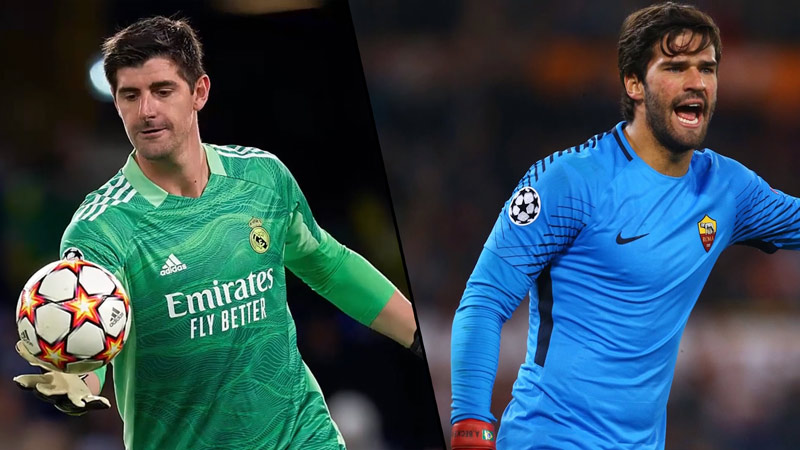
In the modern era of football, the role of the goalkeeper has evolved from a simple shot-stopper into a foundational pillar of tactical systems.
When discussing who holds the mantle of the world’s best, two names consistently dominate the conversation: Thibaut Courtois and Alisson Becker.
Determining who is “better” is a task rooted in subjectivity, as both are elite athletes with vastly different profiles that cater to different styles of play.
While their statistics often show them to be comparable, they remain distinct in their roles and execution on the pitch.
Thibaut Courtois: The Wall of Madrid
Thibaut Courtois represents the pinnacle of the traditional goalkeeper archetype, refined for the modern age. His physical stature is perhaps his most defining characteristic, standing as a towering presence that can shrink the goal for any oncoming striker.
Traditional Mastery and Physical Reach
Courtois is widely recognized for his incredible reach. His height allows him to cover portions of the goal that other keepers simply cannot reach, making him a nightmare for players attempting to find the top corners.
This physical advantage translates directly into his aerial dominance; Courtois has a significant edge in commanding his penalty area and claiming crosses, largely due to his superior height and stature.
The Big-Game Specialist
One of the most compelling arguments for Courtois is his reputation as a big-game player. He has a knack for producing match-winning saves when the stakes are highest.
The most notable example of this was the 2022 Champions League final, where his performance was instrumental in securing the trophy for Real Madrid. In moments of extreme pressure, Courtois provides a level of security that can define an entire season.
Alisson Becker: The Blueprint of the Modern Keeper
While Courtois dominates the goal line, Alisson Becker has redefined what it means to be a proactive goalkeeper. His style is synonymous with the “sweeper-keeper” role, acting as an essential component of a team’s defensive and offensive structure.
Proactive Defending and 1v1 Prowess
Alisson is often described as an extra defender who plays behind a high defensive line. His ability to read the game allows him to sprint off his line to intercept long balls or clear danger before a shot is even taken.
When a striker does break through, Alisson is arguably the best in the world at 1v1 shot-stopping. He uses his positioning and timing to smother opportunities, staying on his feet as long as possible to force the attacker into a mistake.
Elite Distribution
In the modern game, a goalkeeper’s contribution to the attack is just as important as their defensive work. Alisson excels in this regard, possessing superior distribution with both feet.
Whether it is a short pass to a center-back or a booming long ball to a winger, his ability to build play from the back is a vital tactical tool.
Head-to-Head: Breaking Down the Metrics
To understand the gap between these two titans, we must look at how their specific skills compare in the heat of competition.
Shot-Stopping: Reflexes vs. Positioning
Both keepers are considered elite shot-stoppers, but they achieve their results through different means. Courtois relies on his wingspan and traditional positioning to wall off the goal. Alisson, however, often ranks higher in expected goals against (xG) statistics.
This suggests that Alisson may be more effective at stopping high-quality chances—situations where a goal is mathematically likely to occur.
The Tactical Divide: Distribution and Build-up
If a manager wants to play a possession-based game starting from the goalkeeper, Alisson is generally considered the better choice due to his comfort with the ball at his feet.
Conversely, if a team prioritizes a deep defensive block and needs a keeper who can dominate the air and protect the goal mouth during a barrage of crosses, Courtois’s aerial presence and height give him the advantage.
Conclusion: The Subjectivity of Greatness
The debate between Courtois and Alisson does not have a single objective answer. Instead, the “better” goalkeeper is usually the one who fits a specific team’s needs at a specific moment.
- Choose Courtois if you need a traditional, towering presence who will dominate the air and save your team in the most high-pressure finals.
- Choose Alisson if you play a high defensive line and need a proactive keeper who can act as a playmaker and win 1v1 duels through elite positioning.
Ultimately, both players are regularly featured among the best in the world. Whether it is the reach of Courtois or the distribution of Alisson, football fans are currently witnessing two distinct versions of goalkeeping perfection.
The choice between them is less about who is superior and more about which philosophy of the “beautiful game” you prefer to uphold.