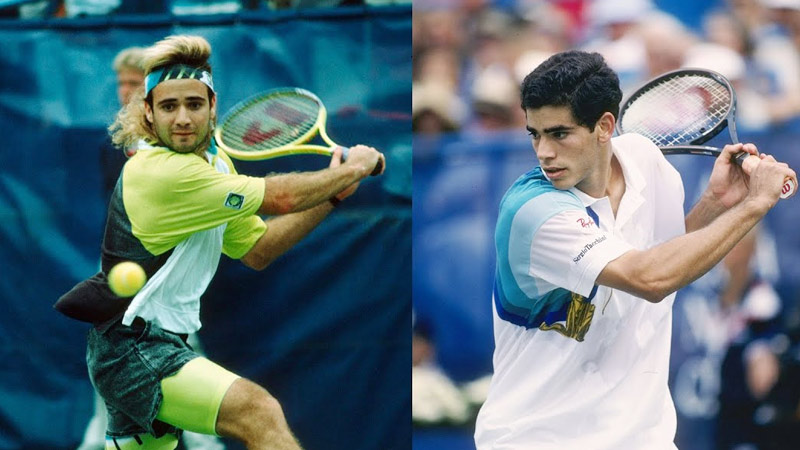
Pete Sampras is often hailed as the superior champion because of his 14 Grand Slam titles, a long-standing record of 286 weeks at world No. 1, and a commanding 20-14 head-to-head lead over Andre Agassi.
However, Agassi is celebrated as the more complete player, being one of only a few men to achieve a Career Grand Slam and an Olympic Gold Medal—milestones Sampras never reached.
While Sampras dominated on grass, Agassi’s versatility and higher Masters count (17 to 11) fuel the debate: was peak dominance more valuable than being an all-surface legend?
Comparing Career Grand Slam Titles and Major Success
The primary metric used to evaluate tennis greatness usually begins and ends with Grand Slam titles. In this category, the numbers provide a distinct advantage to one side while the variety of those titles tells a different story for the other.
The Statistical Supremacy of Pete Sampras
Pete Sampras retired with 14 Grand Slam titles, which was the all-time record for men in the Open Era at the time of his departure from the sport. His dominance was particularly evident at Wimbledon, where he secured seven titles, and the US Open, where he won five.
Beyond the total count, Sampras was the “yardstick” for the modern era, maintaining a level of consistency that allowed him to win at least one major per year during his peak.
He also excelled in the year-end World Championships, winning that prestigious title five times, a record he held alongside other legends.
This record of winning at the highest level of competition suggests a level of mental fortitude that few have ever matched in professional athletics.
Agassi’s Rare Career Grand Slam Achievement
While Andre Agassi won fewer total majors with eight titles, his resume contains a feat that Sampras never accomplished: the Career Grand Slam.
By winning the French Open in 1999, Agassi became one of only seven men at the time to win all four major titles on all surfaces.
Furthermore, Agassi added an Olympic Gold Medal in 1996 to his trophy cabinet, completing the “Career Golden Slam,” a distinction that cements his legacy as a more versatile and adaptable competitor.
His success at the Australian Open was also notable; he won four titles there, including a victory on his debut in 1995. For many fans, the ability to win on the slow red clay of Paris and the lightning-fast grass of London makes Agassi the more “complete” player.
Analyzing the Head-to-Head Rivalry History
A rivalry is often defined by how two athletes perform when standing directly across the net from one another. For Sampras and Agassi, their 34 meetings provided a microcosm of the clash between two different philosophies of tennis excellence.
| Category | Pete Sampras | Andre Agassi |
|---|---|---|
| Overall Head-to-Head | 20 Wins | 14 Wins |
| Grand Slam Meetings | 6 Wins | 3 Wins |
| Grand Slam Finals | 4 Wins | 1 Win |
| Hard Court Matches | 11 Wins | 9 Wins |
| Clay Court Matches | 2 Wins | 3 Wins |
| Grass Court Matches | 2 Wins | 0 Wins |
Sampras’s Dominance in High-Stakes Grand Slam Finals
When the pressure was at its highest, Sampras usually found a way to win. He led their Grand Slam head-to-head 6-3 and was even more dominant in Major finals, holding a 4-1 advantage.
Their first meeting in a Grand Slam final at the 1990 US Open saw a 19-year-old Sampras defeat Agassi in straight sets to claim his first major.
This trend continued through their final match at the 2002 US Open, where Sampras defeated Agassi in four sets to capture his 14th and final title before retiring.
The 1999 Wimbledon final is another prime example, where Sampras played what some consider a perfect match to defeat his rival.
Agassi’s Tactical Edge on Slower Clay Surfaces
Agassi found his most consistent success against Sampras on slower surfaces, particularly clay, where he led their head-to-head 3-2. His ability to take the ball early and dictate play from the baseline neutralized some of the power that Sampras relied on.
One of Agassi’s most significant wins came in the 1995 Australian Open final, where he defeated Sampras in four sets to claim the title. He also secured a vital quarterfinal win at the 1992 French Open, highlighting the gap in their comfort levels on the dirt.
Agassi’s strategic approach, developed under coach Brad Gilbert, allowed him to turn matches into physical and mental chess games that occasionally wore down his athletic opponent.
Who Had the Better World No. 1 Ranking Record?
The ranking system is the ultimate objective measure of a player’s standing over time. In this arena, the data points toward a level of dominance that is nearly unprecedented in the history of the sport.
| Ranking Metric | Pete Sampras | Andre Agassi |
|---|---|---|
| Total Weeks at No. 1 | 286 Weeks | 101 Weeks |
| Year-End No. 1 Finishes | 6 (Consecutive) | 1 |
| Career Win-Loss Record | 762–222 | 870–274 |
| Titles on Hard Court | 34 | 46 |
Sampras held the world No. 1 ranking for a total of 286 weeks, a record at the time of his retirement. Perhaps even more impressive was his ability to finish the season as the year-end No. 1 for six consecutive years from 1993 to 1998.
This sustained excellence required him to defend titles year after year, dealing with the immense pressure that comes with being the target of every other player on tour.
In contrast, Agassi spent 101 weeks at the top spot and finished as the year-end No. 1 only once, in 1999. While Agassi had more total wins over a longer 20-year career, Sampras’s “peak” was both higher and more consistently maintained at the very top of the rankings.
Playing Style Clash: The Serve vs. The Return
The technical brilliance of this rivalry stemmed from the fact that both men were masters of opposing skills. It was the quintessential battle between the best serve and the best return in the history of the game.
Sampras and the Unstoppable Serve-and-Volley
Sampras was a conventional all-court player who relied on arguably the most powerful and disguisable serve ever seen. He used this serve to set up an elite serve-and-volley game, especially on faster surfaces like grass and indoor carpet.
On hard courts, he was comfortable staying back to rally, but his instinct was always to attack. His athleticism allowed him to reach volleys that seemed out of range, and his “slam dunk” overhead became a trademark of his aggressive style.
This high-risk, high-reward approach meant that he could take the racket out of his opponent’s hands, making him nearly unbeatable when his serve was clicking.
Agassi and the Revolution of the Baseline Return
Andre Agassi, alongside players like Monica Seles, revolutionized how the return of serve was played. He possessed incredible reflexes and footwork, allowing him to take the ball very early and redirect the power of opponents like Sampras.
Agassi was an aggressive baseline player who looked to control the middle of the court with pinpoint groundstrokes. Unlike many of his peers, Agassi played the same aggressive baseline game regardless of the surface, even treating clay like a hard court.
This tactical consistency made him a nightmare for serve-and-volleyers, as he could consistently dip passing shots at their feet or fire winners down the line off the return.
Career Versatility vs. Peak Dominance
When debating Who is better, Andre Agassi Vs Pete Sampras, the answer often depends on what a fan values more: the height of a player’s peak or the breadth of their accomplishments across different environments.
Why Agassi’s Career Resumé is More Diverse
Agassi’s supporters argue that his resumé is “more satisfying” because it represents a complete mastery of the sport. He won 17 Masters titles—significantly more than Sampras’s 11—and demonstrated an ability to win in any city and on any surface.
His success was not limited to a specific time of year; he was a threat from the Australian Open in January to the US Open in September.
For those who believe a “great” player must be able to win on every surface, Agassi’s Career Grand Slam and Olympic Gold provide a compelling argument that he was the more well-rounded athlete.
Why Sampras is the Yardstick for Modern Greatness
Sampras’s legacy is built on the sheer volume of his most important trophies. In the world of tennis, Grand Slam titles are the ultimate currency, and Sampras has six more than Agassi.
His dominance at Wimbledon and the US Open, combined with his record-breaking stint at world No. 1, creates a statistical wall that is difficult for any Agassi argument to overcome.
Even though Sampras never won the French Open, his 14 majors were won in an era of extreme surface specialization, making his tally even more impressive. For many, being the “best in the world” for six straight years is the definitive proof of superiority.
Legacy and Longevity: Looking Beyond the Trophies
The impact these two men had on the game extends beyond the lines of the tennis court. Their personal journeys and public personas also play a role in how they are remembered by history.
Agassi’s Great Resurrection from No. 141
Agassi’s career was marked by dramatic “peaks and troughs”. After losing the 1995 US Open final to Sampras, his career spiraled, and his ranking dropped as low as No. 141 in 1997.
His subsequent return to No. 1 in 1999 is considered one of the greatest comebacks in sports history. This “human” element of struggle and redemption made Agassi a massive superstar who many felt “carried the ATP” with his charisma and endorsements.
His longevity was also superior, as he remained highly competitive into his 30s, reaching Grand Slam finals and winning Masters titles late in his career.
Sampras’s Quiet Brilliance and Health Challenges
Sampras was often viewed as a more reclusive or “boring” introvert compared to the flamboyant Agassi.
However, his accomplishments are even more staggering when considering he played his entire career with thalassemia minor, a blood disorder that can lead to anemia and reduced stamina.
Despite this, he maintained a work ethic that made him virtually unbeaten when combined with his natural talent.
Sampras was the ultimate professional, focused almost exclusively on winning the biggest titles, and he achieved that goal with a level of efficiency that remains a benchmark for the legends of today.
Frequently Asked Questions on the Sampras-Agassi Rivalry
Who won more Grand Slam titles?
Pete Sampras won 14 Grand Slam titles, while Andre Agassi won 8.
Did Pete Sampras ever win the French Open?
No, Sampras never won the French Open. His best result was reaching the semifinals in 1996.
What is the Golden Slam in tennis?
A “Golden Slam” occurs when a player wins all four Grand Slam titles and an Olympic Gold Medal in their career. Andre Agassi is one of the few players to achieve this.
How many times did they play each other?
They played 34 official matches. Sampras won 20 of those meetings, and Agassi won 14.
The Final Verdict: Choosing Your Tennis Icon
Ultimately, the debate over who is better comes down to individual preference. If you value peak dominance, a record-breaking number of weeks at world No. 1, and a clear winning record in high-stakes finals, Pete Sampras is the undisputed choice. His 14 majors and six consecutive year-end No. 1 finishes set a standard that defined a generation.
However, if you value versatility, the ability to win on every surface, and a career that overcame incredible adversity, Andre Agassi holds the edge. His Career Grand Slam, Olympic Gold, and superior Masters title count prove that he could succeed anywhere against anyone.
While the numbers may lean toward Sampras as the greater champion, Agassi remains the more celebrated icon for his range and impact on the sport’s global popularity.