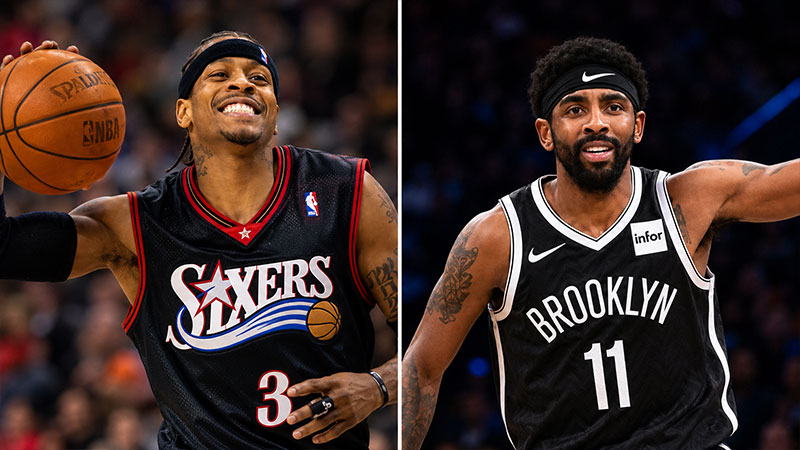
The debate over who is better, Allen Iverson or Kyrie Irving, has sparked endless conversations among basketball purists and modern fans alike.
On one side, we have “The Answer,” a cultural icon who defined an era with his relentless scoring and pound-for-pound toughness.
On the other stands “Uncle Drew,” perhaps the most skilled ball-handler to ever lace them up, possessing shooting efficiency that Iverson could only dream of.
This analysis dives deep into their accolades, advanced metrics, and career impact to determine which small guard truly deserves the crown in this legendary head-to-head comparison.
The Statistical Breakdown: Volume vs. Precision
When evaluating who is better, the conversation must begin with the raw data. Both players have logged 14 seasons in the league, providing a substantial sample size for comparison.
While their scoring averages are somewhat similar, the methods by which they achieve those numbers reveal two entirely different basketball philosophies.
| Metric / Accolade | Allen Iverson | Kyrie Irving |
|---|---|---|
| NBA Championships | 0 | 1 (2016) |
| Regular Season MVP | 1 (2001) | 0 |
| Scoring Titles | 4 | 0 |
| Steals Titles | 3 | 0 |
| Career PPG | 26.7 | 23.7 |
| Career APG | 6.2 | 5.6 |
| Career RPG | 3.7 | 4.1 |
| Field Goal % | 42.5% | 47.4% |
| Three-Point % | 31.3% | 39.4% |
| Free Throw % | 78.0% | 88.8% |
Analyzing the Efficiency Gap
Allen Iverson was a high-volume, high-usage guard who frequently took over 25 shots per game to carry his team’s offense.
His career field goal percentage of 42.5% is often criticized by modern fans, but it must be viewed through the lens of the “molasses” era of the early 2000s, where spacing was poor and league average scores were often in the 90s. In 2002, Iverson averaged 30 points for a team that only averaged 91 as a whole.
Conversely, Kyrie Irving is the gold standard for efficiency at the guard position. Irving famously joined the elite 50-40-90 club in 2021, a feat Iverson never approached.
His career 39.4% shooting from beyond the arc makes him a much more dangerous off-ball threat and a more versatile scorer in a modern NBA system that prioritizes spacing.
Playmaking and Defensive Impact
While both are primarily known as scorers, Iverson holds the edge in traditional playmaking and defensive disruptiveness. Iverson averaged more assists (6.2) and significantly more steals (2.2) per game than Irving.
His ability to lead the league in steals three separate times demonstrates a level of defensive activity and anticipation that Irving has rarely displayed consistently.
Allen Iverson: The Ultimate Franchise Floor-Raiser
The strongest argument for Allen Iverson in the “who is better” debate is his proven ability to carry a franchise as the undisputed primary option. Iverson was not just a player; he was the entire engine of the Philadelphia 76ers for a decade.
The Legendary 2001 Finals Run
The pinnacle of Iverson’s career was the 2001 season, where he secured the regular-season MVP and single-handedly willed a roster devoid of other offensive superstars to the NBA Finals.
Fans and analysts often point to Game 1 of the 2001 Finals—where Iverson “stole” a victory from the undefeated Shaq-and-Kobe Lakers—as proof of his superior “Alpha” status.
Many argue that Kyrie Irving has historically struggled to lead teams deep into the postseason when acting as the absolute number-one option without a secondary megastar.
Durability and Competitive Fire
Iverson’s toughness is a significant factor in his legacy. Standing at just 6’0″ and 165 lbs, he routinely led the league in minutes played and played through an exhaustive list of physical injuries that would have sidelined lesser players.
In their first ten seasons, Iverson played 682 games compared to Irving’s 582, highlighting a gap in availability that is crucial for franchise stability.
The Pressure of the “Molasses Era”
Comparing Iverson’s scoring to Irving’s requires context regarding the defensive environment of the early 2000s. During Iverson’s prime, the league was dominated by physical defenses and a lack of three-point shooting.
Iverson’s free throw rate was between 40-50% for his career because he relentlessly attacked the paint and finished through contact, whereas Irving (at a 25% free throw rate) often uses his elite skill to avoid contact entirely.
Kyrie Irving: The Pinnacle of Basketball Skill
If Allen Iverson is the choice for toughness and leadership, Kyrie Irving is the choice for pure, unadulterated skill. Many analysts and even Iverson himself have suggested that Irving may be the most “skilled” player to ever play the game.
The Greatest Handles in NBA History
The handle debate is central to the Kyrie vs. AI comparison. While Iverson popularized the modern crossover and made the move a cultural phenomenon, Kyrie has evolved ball-handling into a creative art form.
Iverson famously stated in an interview that Kyrie’s handles are the best he has ever seen, effectively passing the torch to the younger guard. Irving’s ability to navigate tight spaces and finish with either hand at the rim is arguably peerless.
The Ultimate Championship Co-Star
Kyrie Irving’s legacy is defined by his performance on the biggest stage. His 2016 NBA Championship with the Cleveland Cavaliers included one of the most iconic clutch shots in league history.
While critics point out his struggles as a solo leader, his value as the “perfect secondary option” alongside stars like LeBron James, Kevin Durant, or Luka Dončić is unmatched.
In a championship setting, Irving’s hyper-efficiency and ability to create a shot out of nothing make him an invaluable asset for a contending team.
Elite Shooting and Shot-Making
Irving’s shooting splits are significantly higher than Iverson’s across almost every category: at the rim, in the mid-range, and from deep.
This versatility allows him to fit into various team structures more seamlessly than Iverson, who required a specific type of defensive-minded roster built around his high-volume shooting to be successful.
Era Comparison: How the Game Has Changed
To truly answer who is better, one must consider how each player would perform in the other’s era. The modern NBA, with its emphasis on spacing and “freedom of movement” rules, seems tailor-made for a player with Iverson’s speed and ability to draw fouls.
Iverson in the Modern Era
Imagine a prime Allen Iverson playing with the floor spacing provided by modern shooters. In the early 2000s, Iverson was often met by three defenders in the paint because teams didn’t fear the three-point shot.
With modern “relaxed” traveling and carrying rules, Iverson’s legendary crossover would likely be even more devastating, and his efficiency would almost certainly rise as the lane opened up.
Kyrie in the Hand-Check Era
Conversely, Kyrie Irving’s finesse game would face a grueling test in the hand-checking era of the 1990s and early 2000s.
While his skill would still shine, the physical toll of that era might have impacted his durability even further. However, his elite shooting is a “portable” skill that translates to any era of basketball history.
Final Verdict: Building a Team vs. Finishing a Champion
Deciding who is better ultimately depends on the goal of your organization. The sources suggest a clear divide based on team needs and roster construction.
- Choose Allen Iverson if: You are building a franchise from scratch and need a “floor-raiser.” Iverson’s ability to carry a massive offensive load and withstand the physical pressure of being a lone superstar is a rare trait that has been proven at the highest levels.
- Choose Kyrie Irving if: You already have a primary superstar and need a “ceiling-raiser.” Irving is the ideal piece to complete a championship puzzle, providing hyper-efficient scoring and clutch playmaking that complements other elite talents.
Frequently Asked Questions (FAQ)
Who has more individual awards, Iverson or Irving?
Allen Iverson holds a significant lead in individual accolades. He has one regular-season MVP, four scoring titles, and three steals titles. Kyrie Irving has yet to win a regular-season MVP or a scoring title, though he does have one NBA Championship ring.
Is Kyrie Irving’s handle really better than Allen Iverson’s?
This is subjective, but Allen Iverson himself has publicly stated that Kyrie Irving has the best handles in NBA history. While Iverson’s crossover was more explosive and culturally impactful, Irving’s handle is considered more creative and versatile.
Why was Allen Iverson’s shooting percentage so low?
Iverson’s 42.5% career field goal percentage was a product of his era and his role. He played in an era with limited spacing and was often forced to take “bad” shots at the end of the shot clock because his teammates lacked offensive skill.
Can Kyrie Irving win a championship as the primary leader?
History suggests this is difficult. Kyrie struggled to reach the playoffs as the lone lead in Cleveland before LeBron James returned, and his subsequent stints in Boston and Brooklyn as the “main guy” faced various challenges. He is widely regarded as the ultimate co-star rather than a solo franchise-carrier.
Conclusion: Two Legends, Two Different Paths
Whether you prefer the heart and “Alpha” mentality of Allen Iverson or the surgical precision and elite skill of Kyrie Irving, both players have left an indelible mark on the game.
Iverson changed the culture of the NBA and proved that a small guard could carry a team to the doorstep of a title. Irving took the torch and refined the skill set of the small guard to an unprecedented level of efficiency and flair.
What do you value more in a legendary guard? The relentless engine of “The Answer” or the pure artistry of “Uncle Drew”? Join the conversation and let us know your pick!