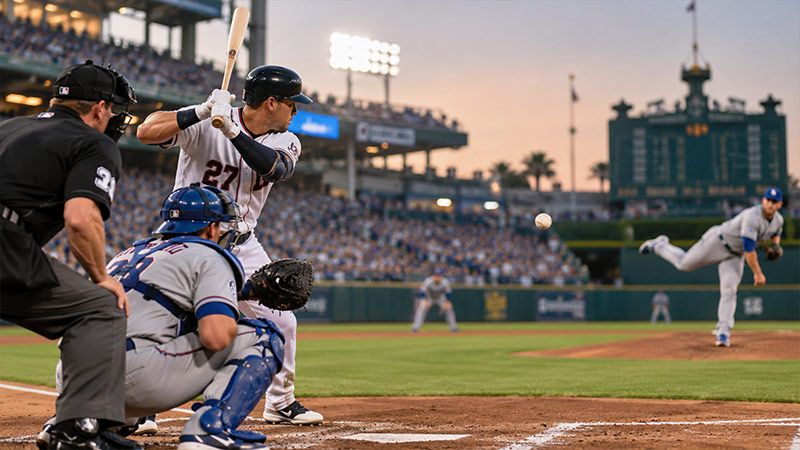
If you have ever tuned into a game a few minutes late, you may have wondered who hits first in baseball. The answer is simple: the visiting team always bats first.
The home team takes the field in the top of the first inning, and the visitors’ leadoff hitter is the first batter of the game.
That one rule shapes the whole game, from late-inning strategy to the way scoreboards are laid out. But it is only half the story. Within each team, the manager decides exactly who steps to the plate first through the batting order.
In this guide, we break down who bats first in baseball, why the home team bats last, how the batting order works, and what changes at neutral sites, in youth leagues, and in extra innings.
The Quick Answer: The Visiting Team Bats First
Every baseball game is made up of innings, and every inning is split into two halves. The order of those halves decides who hits first.
- Top of the inning: The visiting (away) team bats while the home team plays defense.
- Bottom of the inning: The home team bats while the visiting team plays defense.
Because the top half always comes first, the visiting team gets the first turn at bat in every inning. When the umpire calls “Play ball,” the home team’s starting pitcher throws the first pitch to the visiting team’s leadoff hitter.
You can see this order on any scoreboard. The visiting team is listed on the top line and the home team on the bottom line, mirroring the two halves of each inning.
A standard professional game runs nine innings, so each team usually gets nine turns at bat, unless the home team doesn’t need its last one.
Why Does the Home Team Bat Last?
Batting last is one of the biggest advantages of playing at home. Baseball calls it having “last licks,” and it matters most when a game is close late.
The Home Team Always Knows the Target
The team that bats last knows exactly what it needs. If the home team trails by two runs in the bottom of the ninth, two runs ties the game and three wins it.
The manager can bunt, steal, pinch-hit, or swing away with the full picture in front of him.
The visiting team has no such luxury. In the top of the ninth, it has to guess how many runs will be enough.
The Walk-Off Win
Batting last also makes the walk-off possible. If the home team takes the lead in the bottom of the ninth or any extra inning, the game ends right away.
Walk-off hits and home runs are some of the most memorable moments in the sport, and only the home team can produce them.
Skipping the Bottom of the Ninth
If the home team is already winning after the top of the ninth, the bottom half isn’t played at all. The visitors have used up their final chance, so there is nothing left to decide.
That’s why a line score sometimes shows an “X” in the home team’s ninth-inning box instead of a number.
A Brief History: How Batting First Was Decided
The visiting team hasn’t always been locked into batting first. In baseball’s early decades, the order was settled in other ways, such as a coin toss or a choice given to the home team’s captain.
Some early clubs actually preferred to bat first. One common explanation is that a single ball was often used for most of a game, so hitting first meant getting swings at the newest, firmest ball before it went soft.
Over time, managers came to see the strategic value of batting last, and home teams overwhelmingly chose it.
The professional rulebook eventually made it official, and today nearly every organized level of baseball follows the same rule: visitors bat first, the home team bats last.
Who Hits First Within a Team? The Batting Order Explained
Knowing which team bats first only answers half the question. Within each team, the first hitter is decided by the batting order, also called the lineup.
The Lineup Card
Before the game, each manager hands a lineup card to the home plate umpire. The card lists nine players in the order they will hit, along with their defensive positions. Once the umpire accepts it, that order is official.
Managers can still make substitutions, but a new player takes over the batting spot of the player he replaces. The order itself never gets reshuffled mid-game.
The Leadoff Hitter
The first name on the lineup card is the leadoff hitter, who bats first for his team in the first inning. For the visiting team, that makes him the first batter of the entire game.
How the Order Carries Over Between Innings
The leadoff hitter is only guaranteed to bat first in the first inning. After that, each half-inning starts with the player who follows the last batter to complete a turn at the plate.
For example, if the No. 6 hitter makes the final out of the third inning, the No. 7 hitter leads off the fourth. After the No. 9 hitter bats, the order cycles back to the top.
There is one useful exception. If the third out is made on the bases, such as a runner caught stealing, the batter at the plate didn’t finish his turn. He leads off the next inning with a fresh count.
What Makes a Good Leadoff Hitter?
Because the leadoff spot sets the tone, managers think carefully about who fills it.
The Traditional Leadoff Hitter
For generations, the ideal leadoff hitter was fast and patient. He made contact, drew walks, stole bases, and got into scoring position for the power hitters behind him.
The Modern Approach
Today, many teams focus first on on-base percentage. The leadoff hitter’s main job is to reach base, and speed is a bonus rather than a requirement.
Teams have also noticed a simple fact: the higher a player bats in the order, the more plate appearances he gets over a season. That’s why many clubs now put one of their best all-around hitters at the top.
How the Rest of the Order Is Built
Every manager has a philosophy, but a typical lineup looks something like this:
- No. 1 (leadoff): Gets on base and starts rallies.
- No. 2: Increasingly, one of the team’s best overall hitters.
- No. 3: A strong hitter who combines average and power.
- No. 4 (cleanup): Often the top power hitter, there to drive runners home.
- Nos. 5 and 6: Additional run producers.
- Nos. 7 to 9: Usually the weaker bats, with the No. 9 spot sometimes acting as a “second leadoff” hitter.
Before the designated hitter became universal in the major leagues, the pitcher usually batted ninth. Now that every lineup uses a designated hitter, the bottom of the order is stronger than it used to be.
What Happens If a Team Bats Out of Order?
Mistakes happen, and baseball has a rule for when the wrong player comes to the plate.
- Caught during the at-bat: The correct batter simply steps in and takes over the count. There is no penalty.
- Appealed after the at-bat: If the improper batter finishes his turn and the defense appeals before the next pitch, the proper batter is called out. Any runs or advances that came from the improper batter’s turn are erased.
- Not noticed in time: If nobody appeals before the next pitch, the turn at bat stands. The order then picks up with the player who follows the improper batter in the lineup.
Because the defense has to raise the issue, coaches keep a close eye on the opposing lineup card all game long.
Who Bats First at Neutral Sites and in Special Games?
Even when a game isn’t played in either team’s regular park, one club is still named the home team, and that club bats last.
- Postseason series: In each game, the team playing in its own ballpark bats last. When the series moves to the other city, the roles flip.
- All-Star Game: One league is designated the home team and bats in the bottom of each inning.
- International and special-event games: When major league teams play abroad or at a unique venue, one club is officially listed as the home team, even though neither is truly at home.
- Makeup games: If a postponed game is made up in the original visitor’s ballpark, the original home team can keep its home designation. In that case, a club may bat last while playing on the road.
- Tournaments: In college, high school, and amateur events, the home team is often set by seeding, the schedule, or a coin flip.
Who Hits First in Youth Baseball and Softball?
The same structure applies in youth leagues. In Little League and most other youth programs, the schedule names a home team and a visiting team, and the visitors bat first.
In tournaments and all-star play, a coin flip often decides which team is home. When the winner gets to choose, most coaches pick home so they can bat last.
Fastpitch and slowpitch softball follow the same pattern: visitors hit in the top of the inning, the home team in the bottom.
In backyard and pickup games, players sometimes settle it the old-fashioned way, climbing hand over hand up a bat until one person grabs the knob and wins the choice.
Does Anything Change in Extra Innings?
No. If the score is tied after nine innings, the game goes to extra innings, and the visiting team still bats in the top half of each one. The home team keeps its last-at-bat advantage for as long as the game lasts.
In recent major league regular seasons, each extra half-inning begins with a runner on second base. That runner is the player who batted just before the inning’s leadoff hitter, so the batting order still decides who is involved.
Final Thoughts
So, who hits first in baseball? The visiting team always bats first, in the top of every inning, and its leadoff hitter is the first batter of the game.
The home team bats last, which lets it know exactly what it needs late in a close game and gives it the chance to win on a walk-off.
Within each team, the batting order decides who comes up first. The manager’s lineup card sets the leadoff hitter for the first inning, and from then on each inning starts with the next player due up.
Once you understand these rules, the game is easier to follow. You’ll know why the scoreboard is arranged the way it is, why the bottom of the ninth is sometimes skipped, and why the first name on the lineup card matters so much.