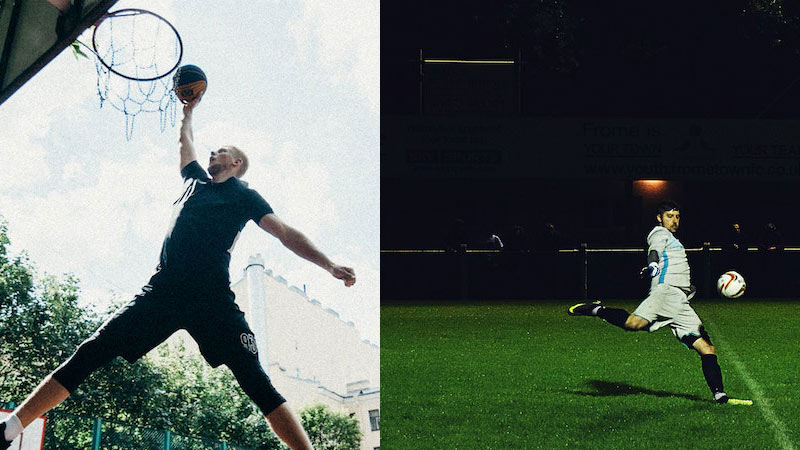
The debate over which sport—soccer or basketball—demands more from its athletes is a cornerstone of modern sports discourse. While fans often favor their preferred game, a clinical analysis reveals a complex “Athletic Paradox.”
Soccer is widely regarded as physically harder in terms of pure endurance, whereas basketball presents a higher challenge in fast-paced skill and technical precision.
To determine which is definitively “harder,” one must examine specific physiological metrics, ranging from aerobic capacity to anaerobic power.
This exploration moves beyond surface-level comparisons to provide a professional breakdown of the grueling realities found on the pitch and the hardwood court.
The Endurance Engine: Cardiovascular Demands of Soccer
Soccer is an exercise in sustained physical suffering, defined primarily by its staggering aerobic requirements and the sheer volume of space athletes must navigate.
The 10-Kilometer Standard: Mastering the Pitch
The most immediate differentiator for soccer is the distance covered. Professional players are expected to run between 10 and 14 kilometers during a standard 90-minute match.
This distance is not merely a steady jog; it is a mixture of low-intensity movement, tactical positioning, and high-velocity sprints.
Covering a playing field that can reach up to 110 meters in length demands elite spatial awareness and a VO2 max that rivals cross-country runners.
The sheer scale of the pitch means that a player out of position by even five meters can compromise the entire team’s defensive integrity, adding a mental load to the physical exhaustion.
The Relentless Clock: Minimal Recovery Windows
Unlike many sports that offer frequent commercial breaks or situational timeouts, soccer is a game of continuous flow.
The clock never stops, and substitutions are strictly limited, meaning the majority of the starting lineup must endure the full duration of play with minimal rest periods.
This limits recovery time significantly, forcing the body to operate in a state of semi-permanent fatigue.
When the body is deprived of rest, technical errors increase, yet soccer players must maintain their foot-eye coordination under these extreme conditions to remain effective.
The High-Octane Volatility of Professional Basketball
While soccer wins the battle of distance, basketball is an elite demonstration of anaerobic power, explosive transitions, and high-impact physical stress.
Anaerobic Power: The Science of the Short Burst
Basketball is defined by its intensity rather than its duration. Players are required to execute explosive, short-burst sprints every few seconds.
This places a massive strain on the anaerobic system, requiring the body to rapidly regenerate energy during the brief seconds of a dead ball.
The constant change of direction—shifting from a full sprint to a defensive stance in milliseconds—requires a level of fast-twitch muscle fiber activation that few other sports can match.
This “stop-start” nature is often more taxing on the central nervous system than a steady-state run.
Vertical Demands and Joint Impact
One of the most overlooked aspects of basketball’s difficulty is the verticality of the game. Players are constantly jumping for rebounds, shots, and blocks, which results in high-impact landings on a hardwood surface.
Over the course of a 48-minute game, the cumulative force exerted on the knees, ankles, and lower back is immense.
This vertical demand, combined with continuous two-way play where every player must instantly transition from offense to defense, creates a unique type of physical exhaustion that is focused on power and agility.
Technical Execution: The Complexity of Feet vs. Hands
Beyond the physiological data, the “hardness” of a sport is often measured by the difficulty of its fundamental mechanics and the margin for error in skill execution.
The Unnatural Nature of Foot-Eye Coordination
A primary argument for soccer being the harder sport technically is the tool of engagement. Humans are naturally more coordinated with their hands than their feet.
Soccer requires athletes to control, dribble, and strike a ball at high speeds using only their feet, which demands a lifetime of practice to achieve proficiency.
The level of fine motor control required to curve a ball around a wall of defenders while running at full tilt is an extraordinary athletic feat.
Because the feet are further from the brain and less dextrous than hands, the learning curve for elite soccer skills is exceptionally steep.
High-Speed Precision and Scoring Pressure
Basketball players operate in a more confined environment, but the precision required is arguably higher due to the frequency of scoring. In basketball, missing multiple shots can quickly hurt a team because the scoring frequency is so high.
There is a relentless psychological pressure to maintain a high field-goal percentage while navigating dense body contact under the hoop.
While using hands is more natural, the requirement to put a ball through a 18-inch rim from 25 feet away while a 7-foot defender is closing in requires a level of “touch” and mental composure that is difficult to replicate in other disciplines.
Direct Comparison: A Professional Metric Breakdown
To better understand how these demands stack up, we can look at the specific athletic categories where each sport excels or struggles.
| Athletic Metric | Soccer Requirements | Basketball Requirements |
|---|---|---|
| Primary Energy System | Aerobic (Long-term endurance) | Anaerobic (Short-burst power) |
| Average Distance | 10 – 14 Kilometers | 3 – 5 Kilometers |
| Skill Mechanism | Feet (Higher difficulty) | Hands (Natural coordination) |
| Rest Opportunities | Extremely Low | High (Timeouts/Subs/Quarters) |
| Physical Contact | Strategic/Lower Frequency | Constant/High Density |
| Scoring Pressure | Low Frequency/High Stakes | High Frequency/High Consistency |
Tactical and Mental Strain: Two-Way Play vs. Pitch Geometry
The difficulty of a sport is not just found in the muscles, but in the cognitive load required to compete at the highest level.
The Constant Transition of the Hardwood
In basketball, there is no such thing as a “specialist” who stays on one side of the court. Every player on the floor must be an offensive threat and a defensive stopper.
The transition from offense to defense happens in a heartbeat, requiring instantaneous mental resets. If a player lingers for even one second after a missed shot, the opponent has already scored a transition layup.
This continuous two-way play demands a level of situational awareness where the athlete must track four teammates, five opponents, and the ball in a very tight space.
The Spatial Chess of the Soccer Pitch
Soccer’s mental difficulty lies in its geometry. Because the field is so large, the “off-ball” movement is more important than what happens with the ball.
Players must maintain elite spatial awareness, constantly adjusting their position relative to the ball that might be 60 meters away.
A midfielder must process the movement of 21 other players across a massive expanse, identifying passing lanes that only exist for a fraction of a second.
The mental fatigue of maintaining this tactical discipline for 90 minutes, while physically exhausted, is a significant barrier to entry for the sport.
Physicality and the Risk of Injury
The “hardness” of a sport is also defined by the physical toll it takes on the athlete’s body through contact and environmental factors.
Dense Body Contact in the Paint
Basketball involves more frequent and dense body contact, particularly under the hoop. While soccer has spectacular collisions, basketball is a game of constant “jostling.” Post players are essentially wrestling for position on every single possession.
This constant bumping, leaning, and legal contact wears down an athlete’s frame over a long season. The impact on the joints from the hardwood floor also contributes to a high rate of overuse injuries in the lower extremities.
The External Variables of the Pitch
Soccer players must contend with environmental factors that basketball players do not. Playing 90 minutes in torrential rain, freezing wind, or 90-degree heat adds a layer of “hardness” that is purely atmospheric.
The surface of a grass pitch can be uneven, leading to unpredictable ball hops and increased risk of ligament tears during sharp cuts. The endurance required to battle not just an opponent, but the elements themselves, is a hallmark of the soccer experience.
Frequently Asked Questions
Which sport has a higher injury rate?
Both sports have high injury risks but in different areas. Soccer sees more ligament injuries (like ACL tears) due to the long duration and cutting on grass.
Basketball sees more ankle sprains and chronic knee issues due to the high-impact jumping and hard court surface.
Is it harder to go from soccer to basketball or vice versa?
Generally, it is considered harder for a basketball player to transition to soccer because of the specialized foot-eye coordination required.
While a soccer player would struggle with the verticality and shooting mechanics of basketball, the “unnatural” skill of playing with one’s feet is often the harder hurdle to clear in adulthood.
Who is the “fitter” athlete?
This depends on your definition of fitness. A soccer player will almost always have better cardiovascular endurance. However, a basketball player will typically have more explosive power and a higher vertical leap. They are “fit” for different physiological goals.
Conclusion: The Final Verdict on Hardness
When determining which sport is harder, the answer is rarely binary. If we define “hard” as the ability to endure sustained physical punishment and master an unnatural skill set, soccer is the clear winner. The requirement to run 14 kilometers while controlling a ball with your feet is a peak human achievement.
However, if “hard” is defined by the need for explosive power, instantaneous transitions, and high-pressure technical precision in a confined space, basketball takes the title.
Ultimately, soccer is the harder sport for the cardiovascular system and fine motor skill development, while basketball is the harder sport for explosive athleticism and high-frequency mental processing.
Both sports demand a level of dedication that few can reach, proving that whether you are on the pitch or the court, greatness requires mastering a unique set of grueling challenges.