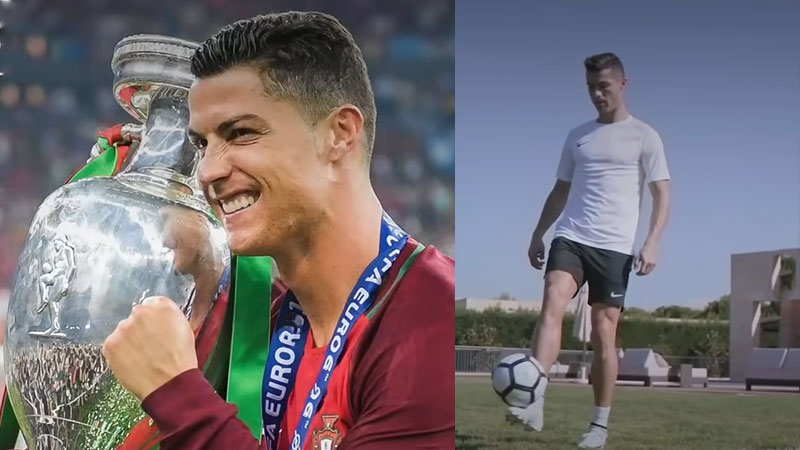
Cristiano Ronaldo’s rise is a masterclass in professional discipline. While many recognize him as a global superstar, his journey began in 1992 on the island of Madeira.
At just seven years old, Ronaldo joined the amateur club Andorinha, marking the official start of a youth career that would redefine modern athletics.
This early exposure to structured football, facilitated by his father’s role as a kit man, laid the foundation for his professional debut a decade later.
Understanding his timeline offers critical insights into the development of elite sporting talent through rigorous academy systems.
The Formative Years in Madeira (1992–1995)
The genesis of Cristiano Ronaldo’s career is rooted in the local landscape of Funchal, Madeira. Unlike many contemporary stars who are scouted via digital highlights, Ronaldo’s entry into the sport was organic and deeply tied to his community.
CF Andorinha: The First Step
In 1992, at the age of seven, Ronaldo was enrolled in CF Andorinha. This period was vital for his technical foundation.
Because his father worked as the kit man for the club, Ronaldo spent an inordinate amount of time around the pitch, absorbing the tactical nuances of the game at an age when most children are focused on recreational play.
This immersion allowed him to develop a competitive edge and a comfort level with the ball that would soon attract larger regional clubs.
CD Nacional: The 20-Ball Transfer
By 1995, it was clear that Ronaldo had outgrown the amateur level of Andorinha. At age 10, he made a move to CD Nacional, one of the most prominent clubs on the island.
The logistics of this transfer have become legendary in football history; the deal was finalized for a fee consisting merely of 20 soccer balls and team kits. This highlight illustrates the humble beginnings of a player whose later transfers would break world records.
At Nacional, he began to understand the pressures of representing a larger institution, preparing him for the mainland scouting networks.
The Move to Lisbon: Sporting CP Academy (1997–2002)
The transition from Madeira to the mainland was perhaps the most difficult and significant hurdle in Ronaldo’s early life. At age 12, he left his family to join the Sporting CP Academy in Lisbon. This move marked his transition from a local talent to a national prospect.
The Trial That Changed Football History
In 1997, Sporting CP offered Ronaldo a three-day trial. The academy staff were immediately impressed by his pace, footwork, and confidence. Consequently, they signed him for a fee of £1,500, a notable investment for a child of that age at the time.
This period at the academy was transformative. Sporting CP is renowned for its development programs, having produced several Ballon d’Or winners.
Ronaldo’s time here focused on physical conditioning and tactical discipline, molding him into a versatile attacking threat.
Developing the Physical Blueprint
During his five years at the academy, Ronaldo underwent a significant physical transformation. He worked tirelessly to improve his frame and endurance, realizing that technical skill alone would not suffice at the professional level.
The academy provided a structured environment where he could test his skills against the best youth players in Portugal. This competitive atmosphere was essential for building the mental resilience that characterizes his later career.
The Professional Breakthrough (2002)
The year 2002 served as the official bridge between Ronaldo’s youth development and his status as a professional athlete.
His progression through the ranks at Sporting CP was so rapid that he became the first player in the club’s history to play for the under-16, under-17, under-18, B-team, and first team all within a single season.
Debut Against Inter Milan
On August 14, 2002, at the age of 17, Cristiano Ronaldo made his official professional debut. The setting could not have been more prestigious: a UEFA Champions League qualifying match against the Italian giants, Inter Milan.
Although he entered as a substitute, his performance showed glimpses of the explosive winger he would become. This match confirmed to the European scouting community that Ronaldo was ready for the highest level of competition.
Scoring Milestones: The Moreirense Match
Ronaldo’s goal-scoring prowess was first officially recorded on October 7, 2002. During a league match against Moreirense, he scored twice, showcasing both his ability to finish from distance and his aerial threat.
These goals were a statement of intent, signaling that he was no longer just a developmental prospect but a primary offensive weapon for Sporting CP.
Global Ascension: The Manchester United Record (2003)
The trajectory of Ronaldo’s career shifted permanently in 2003. After a standout performance in a pre-season friendly against Manchester United, where he dazzled the opposing defenders, Sir Alex Ferguson insisted on securing his signature immediately.
| Milestone | Year | Age | Details |
|---|---|---|---|
| First Youth Club | 1992 | 7 | Joined Andorinha (father was kit man) |
| Move to Nacional | 1995 | 10 | Transferred for 20 soccer balls/kits |
| Sporting Academy | 1997 | 12 | Signed for £1,500 after a 3-day trial |
| Professional Debut | 2002 | 17 | Played against Inter Milan in UCL |
| First Pro Goals | 2002 | 17 | Scored twice against Moreirense |
| Manchester United | 2003 | 18 | Record £12.24 million transfer |
Analyzing the £12.24 Million Valuation
In the summer of 2003, Manchester United paid £12.24 million for the 18-year-old. At the time, this was a record transfer fee for a teenager in English football history. Critics initially questioned the high valuation for an unproven youngster from the Portuguese league.
However, the investment proved to be one of the most successful in sports history, as Ronaldo’s market value and on-pitch contributions escalated exponentially over the following years.
Technical Analysis of Early Development
Ronaldo’s early years were characterized by a style of play that focused heavily on dribbling and flair. During his time at Sporting CP, he was primarily utilized as a traditional winger, tasked with stretching the pitch and delivering crosses.
However, his physical growth allowed him to evolve into a “wide forward,” a role that combined the speed of a winger with the finishing ability of a striker.
His time at the Sporting academy also emphasized “bilateralism”—the ability to use both feet with equal proficiency. This training is evident in his career statistics, where he has scored a significant percentage of goals with his non-dominant foot.
Furthermore, his early exposure to various age groups at Sporting forced him to adapt to different physical intensities, which accelerated his tactical maturity.
Frequently Asked Questions
What was Cristiano Ronaldo’s first club?
Cristiano Ronaldo’s first official youth club was CF Andorinha, an amateur team based in Madeira, which he joined in 1992 at the age of seven.
How much was Ronaldo’s first professional transfer fee?
When he moved from Nacional to the Sporting CP Academy at age 12, the fee was approximately £1,500. Later, when he moved from Sporting to Manchester United, the fee was a record-breaking £12.24 million.
When did Ronaldo score his first professional goal?
His first professional goals were scored on October 7, 2002, while playing for Sporting CP against Moreirense; he scored twice in that match.
How old was Ronaldo when he made his professional debut?
Ronaldo was 17 years old when he made his professional debut on August 14, 2002, in a match against Inter Milan.
The Impact of a Decade of Preparation
When reviewing the timeline from 1992 to 2002, it becomes clear that Ronaldo’s success was not an overnight phenomenon. It was the result of a meticulously managed decade of development.
By the time he reached the global stage at Manchester United, he had already spent ten years in structured football environments, ranging from local amateur pitches to a world-class professional academy.
The transition from a child playing for “20 soccer balls” to a teenager commanding a multi-million-pound fee is a testament to the efficacy of the Portuguese youth system and Ronaldo’s own unparalleled work ethic.
His story serves as a blueprint for identifying and nurturing talent, highlighting the importance of early immersion, strategic club transitions, and physical readiness.
Cristiano Ronaldo’s career path demonstrates that the “start” of a journey is often humble, but the foundation laid in those early years determines the ultimate height of the ceiling.
For Ronaldo, that journey began in 1992, and it has not ceased its upward trajectory since.