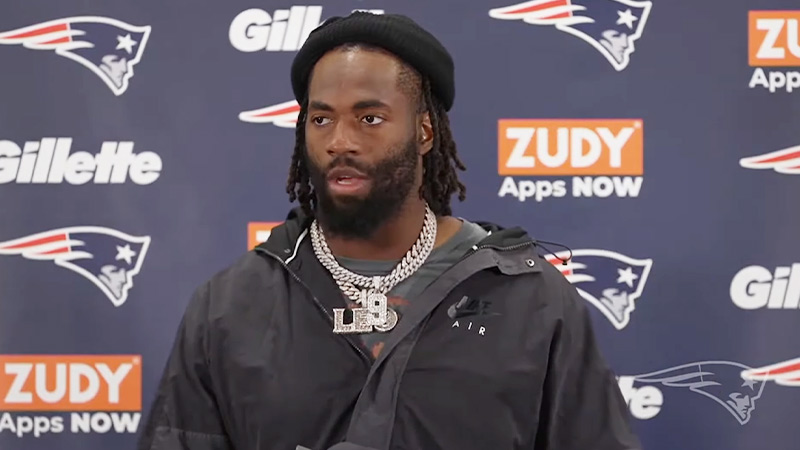
The evolution of the modern defensive front has necessitated a new breed of athlete—one who defies traditional positional labels.
In the high-stakes environment of professional football, few players embody this shift more effectively than Matthew Judon.
To understand what type of linebacker Judon is, one must look past the simple designation on a depth chart and examine the intricate, multi-dimensional role he plays within a defensive unit.
The Hybrid Identity: Beyond the Depth Chart
At his core, Matthew Judon is an outside linebacker and a primary edge rusher. However, applying a single label to his playing style fails to capture the complexity of his contribution.
In contemporary defensive schemes, Judon operates as a hybrid defender, specifically occupying a role often referred to in technical circles as the “Elephant” linebacker.
This role is a unique synthesis of two distinct disciplines. On one hand, Judon possesses the raw size and power typically reserved for a 4-3 defensive end.
On the other, he maintains the flexibility and lateral mobility required to “stand up” and operate from a two-point stance like a traditional linebacker.
This duality allows him to remain on the field for all three downs, as he does not need to be substituted when an offense shifts from a power-run formation to a spread-pass look.
The Primary Objective: Elite Pass Rush Utility
The most critical aspect of Judon’s role is his ability to pressure the quarterback from the outside.
As a primary edge rusher, he is the tip of the spear for the defensive front. His positioning on the line of scrimmage is a constant point of stress for offensive tackles and coordinators.
Judon’s pass-rushing efficiency is not merely a product of speed; it is a calculated application of physical leverage and technical precision.
By lining up on the edge, he forces the offensive line to account for his presence on every snap, often drawing double teams or specialized chip blocks from tight ends and running backs.
This gravity creates opportunities for interior defensive linemen to find one-on-one matchups, illustrating how Judon’s specific “type” of linebacker play elevates the entire unit.
The Mechanics of the “Elephant” Role
To appreciate why Judon is categorized as an “Elephant” or hybrid linebacker, we must look at the technical advantages of his physical profile.
The “Elephant” role was popularized in defensive systems that prioritize versatility and disguise.
- The Stand-Up Advantage: Unlike a traditional defensive end who often plays with a hand in the dirt (a three-point stance), Judon frequently stands up. This higher eye level provides him with a superior view of the backfield, allowing him to diagnose play-action passes, pulls by offensive linemen, and screen plays more quickly than a player anchored to the turf.
- Size-to-Speed Ratio: Judon’s frame allows him to hold his ground against 300-pound offensive tackles. He uses this power to transition from a speed rush to a bull rush, essentially turning his momentum into a weapon that collapses the pocket from the perimeter.
- Schematic Flexibility: Because he is a hybrid, coaches can move him along the line of scrimmage. He may line up over the left tackle on one play and then shift to a wide-nine alignment on the next, keeping the offense in a state of constant reactionary flux.
The Art of “Setting the Edge”
While pass rushing generates the headlines, Judon’s value as a run defender is what cements his status as an elite hybrid.
A common weakness for speed-based outside linebackers is their inability to withstand the physical toll of a power-running game. Judon avoids this pitfall through a combination of strength and specialized technique.
His primary tool in this department is the use of his long arms. By engaging offensive blockers with full extension, Judon prevents them from getting into his chest.
This “long-arm” technique allows him to set the edge, effectively creating a physical wall that prevents a running back from turning the corner and getting to the outside.
When a linebacker “sets the edge,” they are funneling the ball carrier back toward the middle of the field, where the rest of the defense is waiting.
Judon’s ability to use his natural strength to stop outside runs ensures that the defense remains disciplined and difficult to outflank.
Why the “Hybrid” Label Matters for Modern Strategy
The rise of the “positionless” defense is a direct response to the “positionless” offense. As NFL teams utilize more “11 personnel” (three wide receivers) and mobile quarterbacks, the defense must counter with players who are too fast for tackles to block and too strong for tight ends to move.
Judon is the personification of this counter-strategy. He represents a “type” of linebacker that is increasingly sought after by Fortune 500-level sports organizations: the highly specialized generalist.
He is specialized in his ability to reach the quarterback, yet he is a generalist in his ability to defend the run and occasionally drop into short-zone coverage.
Technical Breakdown: Size, Power, and Flexibility
Analyzing Judon’s physical components reveals why he fits this hybrid mold so perfectly:
- Size: He possesses the “length” that scouts covet. Long arms are not just a physical trait; they are a functional tool for leverage.
- Power: His power allows him to play “heavy” at the point of attack, meaning he doesn’t get washed away by double teams.
- Flexibility: This is the “linebacker” half of his identity. He can bend his knees and hips to “dip” under the arms of a blocker, a trait usually reserved for smaller, lighter players.
Conclusion: The Definitive Edge
In summary, Matthew Judon is a hybrid outside linebacker who serves as a primary edge rusher and a dominant run stopper. He is the rare defensive asset that provides the power of a lineman with the vision and movement of a linebacker.
For any organization looking to build a resilient and adaptable front, Judon’s “Elephant” profile serves as the gold standard.
He is not just a linebacker; he is a scheme-defining force who uses his unique physical gifts to dictate the terms of engagement on the field.