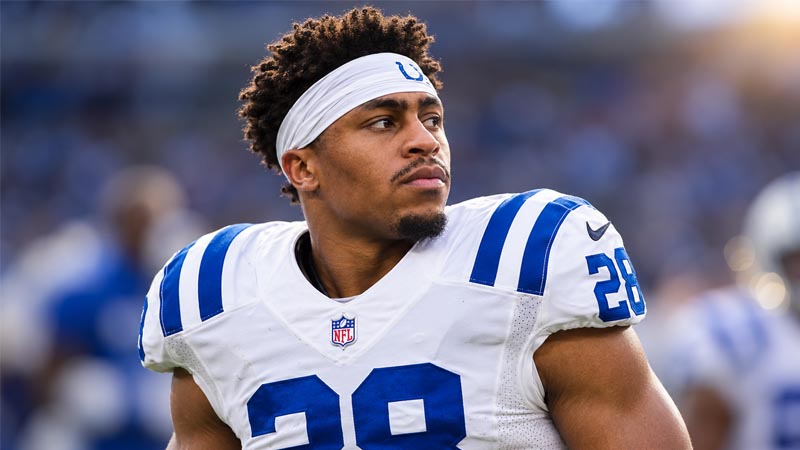
The landscape of the professional football market is often defined by volatility, particularly at the running back position.
However, the recent announcement regarding the Indianapolis Colts and their star playmaker, Jonathan Taylor, offers a masterclass in strategic roster construction and corporate-level negotiation.
By finalizing a two-year, $44 million contract extension that includes $39 million in guaranteed compensation, the franchise has not only secured a cornerstone of its offense through the 2028 season but has also signaled a significant shift in its organizational philosophy.
This agreement represents more than a mere financial transaction; it is a calculated move to ensure long-term stability within an offensive unit that has recently seen substantial investment.
In an era where the value of the running back is frequently debated in executive offices, the Colts have chosen to prioritize elite talent, rewarding high-level production while maintaining the flexibility necessary to remain competitive in a capped environment.
Strategic Capital Allocation: Deconstructing the $44 Million Extension
The extension carries an annual average value (AAV) of $22 million, positioning Taylor at the absolute summit of the current market.
This valuation is not arbitrary; it aligns Taylor with top-tier peers such as Bijan Robinson, establishing a clear benchmark for elite performance compensation.
1. The Power of Guarantees
The inclusion of $39 million in guaranteed money is perhaps the most telling aspect of the contract. In a high-risk industry, guarantees serve as the ultimate signal of trust and commitment.
By guaranteeing nearly 90% of the total contract value, the organization has mitigated the player’s long-term risk, thereby fostering a “drama-free” environment that allows the athlete to focus entirely on on-field execution.
2. The Logic of the Two-Year Window
From a strategic planning perspective, the two-year duration of the extension is a sophisticated choice. It allows the franchise to capitalize on Taylor’s prime years—rewarding his status as an elite producer—while simultaneously providing essential “cap flexibility”.
This structure prevents the organization from being over-extended into the player’s late twenties, a period often associated with diminishing returns in high-impact positions. It is a balance of rewarding past performance while hedging against future physical depreciation.
Stabilizing the Offensive Core: A Multi-Year Investment Strategy
The decision to retain Taylor must be viewed through the lens of the team’s broader offensive roadmap. A franchise is only as strong as its core components, and the Colts have been methodical in locking down their primary assets.
- Synergy with the Passing Game: By securing Taylor, the organization ensures a balanced attack. This move follows other significant investments in the offensive core, most notably the extensions for quarterback Daniel Jones and wide receiver Alec Pierce.
- The Foundation of Continuity: In professional sports, chemistry and continuity are often undervalued assets. By tying these three key players—Jones, Pierce, and Taylor—to multi-year commitments, the leadership has created a stable environment where a young offensive unit can mature together through the 2028 season.
- Risk Mitigation: Roster stability is a form of risk management. Knowing that the primary playmakers are under contract for the foreseeable future allows the scouting and coaching departments to focus on incremental improvements rather than catastrophic gaps in the depth chart.
The Psychology of the Peaceful Resolution
Perhaps the most significant takeaway from this negotiation is the manner in which it was conducted. The history between elite athletes and their respective franchises is often fraught with public friction, trade requests, and contentious hold-outs.
This transition from friction to “mutual trust” is a testament to the maturing relationship between the player’s representation and the front office.
In a corporate sense, this represents a successful alignment of interests, where both parties recognized that their long-term success was inextricably linked.
Market Leadership and Brand Identity
For a franchise like the Indianapolis Colts, identity is everything. For years, the team has been defined by a physical, reliable ground game complemented by precise passing. Securing an “elite producer” like Taylor reinforces this brand identity to both the fanbase and the rest of the league.
Setting the Market Standard
When an organization pays a premium for a position that others view as replaceable, it sends a message. The Colts are asserting that they value “star power” and “offensive core security” over the trend of commoditizing the backfield.
By matching the market high of $22 million annually, they have established themselves as a destination that rewards excellence, which is a powerful recruiting tool for future free agents.
A Comparative Analysis: The Macro View of the NFL Backfield
To understand the weight of this extension, one must look at the broader economic trends of the industry.
The running back market has faced significant downward pressure in recent years. Many teams have moved toward a “committee” approach, utilizing multiple lower-cost players rather than one high-value star.
The Colts’ decision to buck this trend suggests a belief in the “multiplier effect” of a player like Taylor. An elite running back does not just gain yards; he changes how a defense aligns, creates space for wide receivers like Alec Pierce, and reduces the pressure on the quarterback. By investing in Taylor, the Colts are essentially investing in the efficiency of the entire 11-man unit.
Future Outlook: Navigating the Path to 2028
As the organization looks toward the horizon of 2028, the path is clear. They have a stabilized backfield, a locked-in receiving threat, and a settled situation under center. The focus now shifts from “acquisition and retention” to “optimization and execution.”
The “cap flexibility” mentioned in the deal is the key to this future. Because the commitment is strategic rather than indefinite, the front office retains the ability to pivot if necessary, while Taylor enjoys the security of being one of the highest-paid individuals in his profession.
The Competitive Advantage of Commitment
In conclusion, the Indianapolis Colts have executed a strategy that aligns perfectly with modern executive leadership principles.
They identified a core asset, valued it according to the highest market standards, and structured a deal that provides both immediate reward and future flexibility.
By securing Jonathan Taylor through 2028, the franchise has effectively closed the door on a period of uncertainty and opened a window of opportunity.
This is not just a contract; it is a foundation. With Taylor, Jones, and Pierce now forming a solidified offensive trio, the Colts have successfully navigated the complexities of talent retention to emerge as a more stable, focused, and dangerous contender in the years to come.