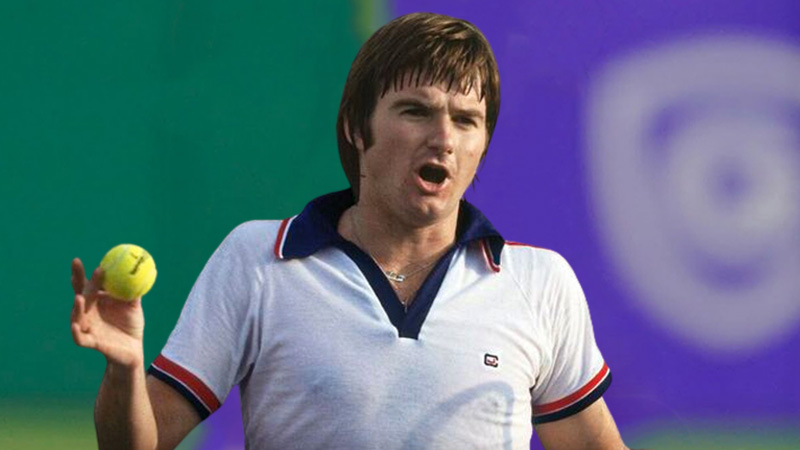
Jimmy Connors is a legendary American tennis icon celebrated for his unmatched longevity and intense competitive fire that redefined the sport. He is most famously known for holding the Open Era men’s records for 109 singles titles and 1,274 match wins.
Beyond the statistics, Connors is recognized for popularizing the two-handed backhand and his “Street Fighter” persona, which transformed tennis from a polite game into high-stakes entertainment.
As the only player to win the US Open on three different surfaces—grass, clay, and hard court—his versatility remains unparalleled. This legacy of excellence continues to inspire professional tennis today.
Statistical Dominance: Jimmy Connors’ Open Era Records
The statistical footprint left by Jimmy Connors is perhaps the most resilient in the history of the Association of Tennis Professionals (ATP) Tour.
For decades, his benchmarks have served as the ultimate standard for consistency and durability in a physically demanding sport.
His ability to maintain a high level of play across multiple decades allowed him to amass numbers that even the most celebrated modern “Big Three” athletes struggle to eclipse.
| Record Category | Statistic Detail |
|---|---|
| Most Career Singles Titles | 109 Titles (Open Era Record) |
| Total Match Victories | 1,274 Wins |
| Total Matches Played | 1,557 Matches |
| Consecutive Weeks at No. 1 | 160 Weeks (1974–1977) |
| Career Win Percentage | 81.8% (1,274–283) |
| Total Weeks at No. 1 | 268 Weeks |
These figures highlight a level of productivity that defines his historical standing. By playing 1,557 matches, Connors demonstrated a physical resilience that few players in the modern era can replicate, especially considering the wooden rackets and changing technology he navigated during his tenure.
How Did Jimmy Connors Change the Game of Tennis?
Jimmy Connors was not merely a winner; he was a disruptor who altered the technical and cultural fabric of the game. Before his arrival, tennis was often viewed as a refined, quiet pursuit.
Connors injected a level of grit and raw emotion that earned him the nickname “The Street Fighter,” effectively bridging the gap between traditional athletics and modern sports entertainment.
The Revolution of the Two-Handed Backhand
One of the most significant technical contributions Connors made was the popularization of the aggressive, flat two-handed backhand.
At a time when the one-handed slice or drive was the standard, his two-handed approach provided more stability and power, particularly when returning high-velocity serves.
This style became a fundamental building block for future generations, making the two-handed backhand a staple of the modern professional circuit.
Redefining the Aggressive Return of Serve
Connors is widely regarded as one of the greatest returners in the history of the game, often mentioned in the same breath as Andre Agassi. His return was not a defensive chip; it was a weapon used to neutralize the server’s advantage immediately.
By taking the ball early and hitting it flat, he put immense pressure on opponents, forcing them into defensive positions from the very first strike of the rally.
The “Street Fighter” Persona and On-Court Intensity
Beyond his racket skills, Connors was known for his vocal outbursts, theatrical displays, and an unmatched competitive fire. He treated the tennis court like a boxing ring, often engaging with the crowd to create an electric atmosphere.
This approach made him a polarizing but undeniably magnetic figure, helping to draw massive television audiences and transitioning tennis into a high-stakes arena of public spectacle.
The Historic US Open Surface Slam and Major Success
While many players excel on a specific type of court, Connors proved his elite status by winning across every major environment.
His adaptability is most famously displayed in his performance at the US Open, a tournament where he achieved a feat that no other male player has ever matched.
Winning on Three Distinct Surfaces
Jimmy Connors is the only male player to win the US Open on three entirely different surfaces: grass, clay, and hard court.
He captured the title on grass in 1974, transitioned to victory on the green clay of Forest Hills in 1976, and then dominated on the hard courts of Flushing Meadows in 1978, 1982, and 1983.
This unique “Surface Slam” at a single Grand Slam event underscores his tactical flexibility and mastery of varying ball speeds and bounce heights.
A Career Built on Grand Slam Titles
Over the course of his career, Connors secured 8 Grand Slam singles titles. His 1974 season remains one of the most dominant in history, as he won the Australian Open, Wimbledon, and the US Open in a single calendar year.
He followed these successes with another Wimbledon title in 1982, proving his longevity by winning majors nearly a decade apart against different generations of competitors.
Legendary Longevity: The Miracle Run of 1991
The story of Jimmy Connors is incomplete without discussing his remarkable ability to compete at the highest level well into his late thirties.
While most players of his era retired in their early thirties, Connors continued to challenge the world’s best, culminating in a performance that remains a cornerstone of sports lore.
The 1991 US Open Semifinal Run
At 39 years old, Connors entered the 1991 US Open as a wildcard, ranked 174th in the world. What followed was a fortnight of “electric, crowd-frenzied” matches that captured the imagination of the global sporting public.
He fought his way through grueling matches to reach the semifinals, a feat that defied age and conventional athletic expectations. This run is often cited as the ultimate testament to his “unmatched longevity” and “intense determination”.
Staying Power Across Two Decades
His career spanned more than twenty years, allowing him to bridge the gap between the era of Rod Laver and the rise of Pete Sampras.
This staying power is reflected in his 268 total weeks at World No. 1, including a staggering 160 consecutive weeks at the top of the rankings from 1974 to 1977.
His career win percentage of over 81% across such a long period is a data point that solidifies his status as a perennial contender.
Defining the Golden Era: Iconic Rivalries and Battles
The prestige of Jimmy Connors’ career was forged in the fire of legendary rivalries. He was a central figure in the “golden age” of tennis, engaging in fierce, often personal battles that elevated the sport’s profile worldwide.
Fire vs. Ice: The Connors and Borg Rivalry
The contrast between Connors’ explosive temperament and Björn Borg’s cool, detached demeanor created one of the most compelling narratives in sports history. The two met in four Grand Slam finals, representing a clash of both styles and personalities.
These matches were not just athletic competitions but psychological wars that defined the top tier of the ATP rankings for years.
The All-American Feud with John McEnroe
Connors engaged in a volatile and purely American rivalry with John McEnroe, characterized by “bad blood” and high-intensity shot-making.
Both players were known for their tempers and competitive spirits, making their head-to-head encounters must-watch television. This rivalry helped cement the popularity of tennis in the United States during the late 70s and 80s.
The Baseline War with Ivan Lendl
Connors also faced a brutal baseline rivalry with Ivan Lendl, spanning 35 professional matches.
Lendl represented a shift toward the power-baseline game of the 1980s, and Connors’ ability to remain competitive against Lendl’s heavy topspin and physical conditioning further proved his own adaptability and grit.
Life After the Court: Coaching, Media, and Hall of Fame
After retiring from professional competition, Connors transitioned into roles that allowed him to share his expertise and remain an influential figure in the tennis community.
His contributions post-retirement have helped shape the careers of newer athletes and provided fans with deeper insights into the game.
Induction into the International Tennis Hall of Fame
In 1998, Connors was officially inducted into the International Tennis Hall of Fame, a formal recognition of his status as one of the greatest to ever play the sport.
This honor reflects not just his 109 titles, but his overall impact on the visibility and professionalization of tennis globally.
Mentorship and Television Analysis
Connors has remained in the public eye as a high-profile coach, most notably working with former World No. 1 Andy Roddick. His experience in high-pressure situations made him a valuable asset for Roddick during his time on tour.
Additionally, Connors has worked as a television analyst, offering his sharp, often unfiltered perspective on modern matches.
Engaging Fans Through “Advantage Connors”
Today, he continues to connect with the tennis world as the host of his own podcast, Advantage Connors.
Through this medium, he discusses current trends in the sport, shares stories from his playing days, and maintains his role as a prominent voice in the global tennis conversation.
Frequently Asked Questions About Jimmy Connors
How many titles did Jimmy Connors win in his career?
Jimmy Connors won a record-breaking 109 men’s singles titles during the Open Era. In addition to his singles success, he also secured 16 doubles titles, bringing his total trophy count even higher.
Is Jimmy Connors still the record holder for most match wins?
Yes, he holds the all-time record for the most match victories in men’s professional tennis with 1,274 wins. He also holds the record for the most matches played at ,557.
Which Grand Slam tournaments did Jimmy Connors win?
He won a total of 8 Grand Slam singles titles: 5 US Opens, 2 Wimbledons, and 1 Australian Open. He is particularly famous for winning the US Open on grass, clay, and hard court surfaces.
What was Jimmy Connors’ highest ranking?
Jimmy Connors reached the World No. 1 ranking, holding the position for a total of 268 weeks. Most impressively, he held the top spot for 160 consecutive weeks between 1974 and 1977.
When did Jimmy Connors retire?
While he remained active in various capacities, his legendary run at the 1991 US Open at age 39 is considered the final great chapter of his professional playing career. He was later inducted into the Hall of Fame in 1998.
Conclusion: The Enduring Impact of a Tennis Legend
The legacy of Jimmy Connors is defined by more than just a list of records; it is defined by a relentless spirit and a refusal to back down from any challenge.
From his 109 titles to his transformative playstyle, he paved the way for the modern era of professional tennis.
Whether it was the “Street Fighter” persona or the technical brilliance of his return of serve, his influence is seen in every player who steps onto the court with a two-handed backhand or a fiery will to win.
As we look at the history of the sport, Connors remains an unmatched benchmark for excellence and longevity.