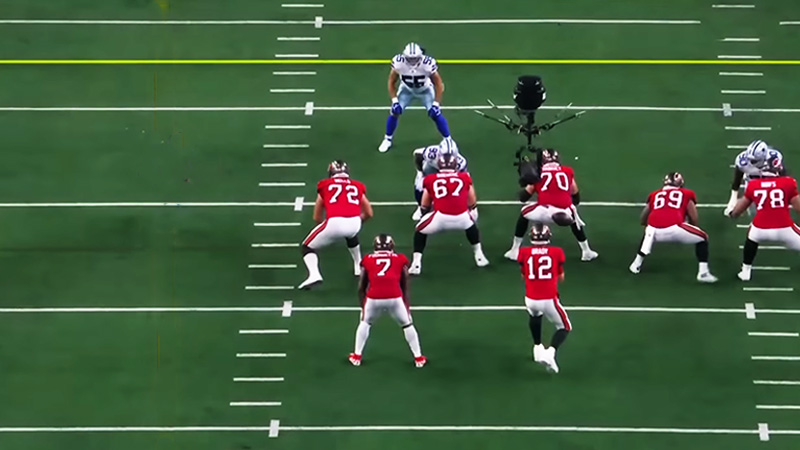
In the professional landscape of the National Football League, terminology often carries multiple, highly technical meanings that can shift depending on which side of the ball is being analyzed.
One of the most ubiquitous yet misunderstood terms is “chipping.” To the uninitiated, it might sound like a minor interaction.
Still, in elite athletic competition, a “chip” is a strategic maneuver designed to disrupt the delicate timing and rhythm of a modern passing offense.
Whether it involves a running back assisting a tackle against an elite edge rusher or a cornerback jabbing a receiver at the line of scrimmage, chipping is a fundamental component of NFL strategy.
Understanding its nuances provides a window into how coaches at the highest level manipulate contact to gain a competitive advantage.
The Offensive Chip Block: A Masterclass in Pass Protection
At its core, the offensive chip block is a high-impact, low-duration contact event. It is primarily executed by tight ends or running backs who are transitioning from the backfield or the line of scrimmage into a passing route.
Instead of heading directly to their destination downfield, these players deliver a quick, forceful hit on a defensive pass rusher—typically a defensive end or an outside linebacker—before releasing into the secondary.
Strategic Objectives of the Chip
The primary goal of an offensive chip is not to neutralize the defender entirely, but to disrupt their momentum and timing. In a league where the difference between a sack and a touchdown is often measured in tenths of a second, an effective chip can be the deciding factor.
- Assisting the Offensive Tackle: Elite pass rushers like T.J. Watt often face a high volume of chip blocks. Because these defenders are frequently faster and more agile than the offensive tackles assigned to block them, the chip provides a “pseudo-double team” that knocks the rusher off-balance for a split second.
- Timing Disruption: Modern pass rushes are built on “get-off”—the speed at which a defender leaves the line of scrimmage. A chip disrupts this rhythm, forcing the defender to reset their feet and hands, which allows the tackle to gain better positioning.
- Preserving Personnel Versatility: Chipping allows an offense to provide help to a tackle without committing two full-time blockers to one defender. Because the chipper eventually releases into a route, the quarterback still has the full complement of receivers available.
Mechanics and Execution
Execution is critical. If a tight end lingers too long on the chip, they fail to reach their spot in the passing progression, potentially leading to a coverage sack. Conversely, a weak chip fails to hinder the defender.
The “perfect” chip is an unexpected, physical jab that redirects the defender’s path just enough to widen the pocket for the quarterback.
Defensive Chipping: The Art of the Redirect
On the opposite side of the ball, “chipping” refers to a disruptive hit delivered by a defender to a receiver at the beginning of a play.
This is most common in zone coverage schemes, such as Cover 2, where defenders are assigned to specific areas rather than specific players.
Disrupting the “Greatest Show on Turf”
The historical significance of defensive chipping is best illustrated by Bill Belichick’s defensive game plan in Super Bowl XXXVI. To counter the St. Louis Rams’ high-powered offense, the Patriots utilized “chipping” to neutralize the Rams’ precision-based passing game.
By hitting receivers immediately at the line of scrimmage, the defense forced the Rams’ timing-based routes to fall out of sync.
In this context, the chip serves several purposes:
- Messing with the Path: By bumping a receiver, a defender can move them off their intended line, forcing them to take a longer path to their destination.
- Buying Time for the Pass Rush: Every millisecond a receiver is delayed at the line is another millisecond the defensive line has to reach the quarterback.
- Physical Deterrent: For smaller, speed-based receivers, consistent chipping can be physically exhausting and mentally taxing, reducing their effectiveness over the course of four quarters.
The Five-Yard Rule and Tactical Legalities
In the modern NFL, defenders must be precise with their contact. While players were historically allowed more leeway to be physical downfield, current rules strictly enforce the five-yard illegal contact rule.
A defensive chip must occur within the first five yards of the line of scrimmage. Beyond that point, any significant contact can result in a penalty. This has evolved the defensive chip into a more refined “bump or jab” rather than a sustained block.
Distinguishing the Chip from the Jam
A common point of confusion among fans is the difference between a “chip” and a “jam.” While they share the goal of disruption, their execution and intent differ:
- The Chip: A brief, transient hit where the defender (or offensive player) makes contact and then immediately moves to their next assignment, such as dropping into a zone or running a route.
- The Jam: A more sustained engagement. In “press-man” coverage, a defender will attempt to “jam” a receiver by staying in their face and using their hands to mirror the receiver’s movements for as long as legally possible.
Essentially, a chip is a “hit and run,” while a jam is an attempt to stay engaged and physically dominate the opponent’s release.
The Technological Evolution: Chips Inside the Ball
Beyond the physical mechanics on the field, the word “chip” has taken on a literal meaning in the modern NFL through the integration of electronic tracking sensors. Every official NFL game ball now contains a microchip designed to record real-time telemetry.
Data-Driven Insights
These sensors are the engine behind “Next Gen Stats,” providing a level of transparency into the game that was previously impossible. The chips track:
- Velocity and Spin Rate: How fast the ball is traveling and how many revolutions per second it is spinning.
- Location Tracking: Precisely where the ball is on the field at any given moment.
The Debate Over Ball Spotting
While these chips provide incredible data for broadcasts and coaching clinics, their use in officiating remains a topic of debate.
Some argue that the NFL should move toward a fully automated system for “spotting” the ball or determining if it crossed the goal line, similar to the Hawk-Eye technology used in tennis.
Currently, the league uses the chips primarily for data collection rather than as a definitive officiating tool for ball placement.
Special Teams: The “Chip Shot”
Finally, the term appears in the lexicon of special teams. A “chip shot” is an informal term borrowed from golf to describe an exceptionally short and easy field goal attempt.
While not a technical football maneuver, it highlights the perceived simplicity of the task—though, as any NFL kicker will attest, no points are guaranteed until the ball passes through the uprights.
The Strategic Importance of the “Game of Inches”
Why does such a seemingly minor action garner so much attention from professional coaching staffs? Because the NFL is a league of marginal gains.
For an offensive coordinator, the decision to have a running back chip an edge rusher is a calculated risk. It protects the franchise quarterback but might delay the running back’s availability as a check-down option.
For a defensive coordinator, chipping a star wide receiver is a way to “cloud” the coverage and force the quarterback to hold the ball just a fraction longer.
These interactions are the “hidden” part of the game. While the highlights often focus on the deep touchdown pass or the crushing sack, those plays are frequently set up—or prevented—by the success or failure of a chip at the line of scrimmage.
Conclusion: Mastering the Fundamentals
Chipping in the NFL is a testament to the complexity of the sport. It is a term that encompasses physical grit, tactical brilliance, and cutting-edge technology.
Whether it is a tight end protecting his quarterback, a linebacker disrupting a receiver’s route, or a sensor tracking the flight of the ball, “chipping” is essential to the modern game.
As the league continues to evolve, the mechanics of these interactions will likely become even more specialized. However, the fundamental goal will remain the same: to use contact, timing, and data to tip the scales of victory in a high-stakes environment.