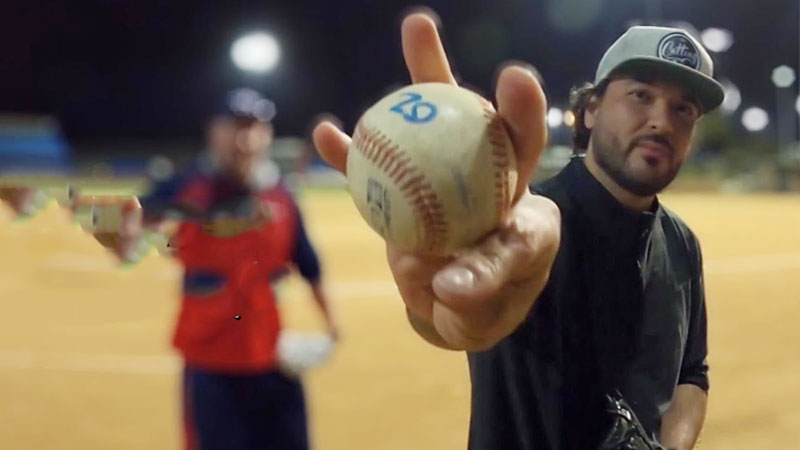
In modern elite baseball, victory at the plate is governed by fractions of a second. A major league batter possesses approximately 400 milliseconds to recognize a pitch, decide whether to swing, and execute a swing path that intersects with a 2.9-inch leather sphere traveling at speeds approaching or exceeding 100 miles per hour.
While high-velocity fastballs command headlines, the most lethal countermeasure in a pitcher’s arsenal is often not raw speed, but the masterfully executed changeup pitch.
Predicated entirely on deception, the changeup is engineered to replicate the identical arm motion, release point, and trajectory of a fastball while arriving at the plate significantly slower.
This comprehensive analysis delves into the underlying biomechanics, historical evolution, trajectory physics, finger grip variations, tactical tunneling strategies, and training protocols required to master baseball’s ultimate off-speed delivery.
Defining the Changeup – The Psychology of Speed Manipulation
At its core, a changeup is an off-speed pitch thrown with a fast delivery motion that travels at a substantially reduced velocity.
Unlike breaking balls—such as sliders or curveballs—which rely on distinct lateral or vertical spin axis alterations to alter directional movement, a changeup achieves its primary effect through velocity manipulation.
The Biomechanical Illusion
The effectiveness of the pitch rests on a fundamental psychological principle: visual deception. When a pitcher begins their delivery, the batter’s cognitive processing system immediately scans early visual cues, including:
- Arm Speed and Kinematic Chain: The rapid acceleration of the shoulder, elbow, and forearm.
- Release Height and Extension: The exact spatial window where the ball leaves the fingertips.
- Initial Flight Path: The initial trajectory straight toward the strike zone.
Because the pitcher utilizes identical full-effort body motion and arm speed to their fastball delivery, the batter’s brain calculates an aggressive timing rhythm and commits to a swing path prematurely.
However, because the ball arrives approximately 8 to 15 miles per hour slower than expected, the hitter’s swing completes before the ball even reaches the hitting zone, resulting in a swing-and-miss, a weak grounder, or an off-balance pop-up.
Historical Evolution – From “Unfair” Play to Modern Pillar
To appreciate the role of the changeup in contemporary pitching strategy, one must examine its historical origins within the game.
The Early Era of “Straight” Pitching
In the 19th century, during the infancy of organized baseball, breaking pitches were frequently viewed with skepticism, sometimes characterized as unfair or unauthentic moves by traditionalists who favored direct contests of strength between pitcher and batter. Consequently, early pitchers relied almost exclusively on straight throwing mechanics.
To gain a competitive edge within these constraints, pioneering pitchers began experimenting with speed variation—alternating between maximum-effort deliveries and intentionally slower throws.
Colloquially dubbed the “slowball,” “change of pace,” or simply “the change,” this tactic established the foundational blueprint for modern off-speed pitching.
Evolution into a Fundamental Requirement
As hitting mechanics advanced and batters adapted to consistent speed profiles, mixing speeds evolved from a novelty into an essential discipline.
Over time, baseball commentators and players adopted colorful nomenclature for the pitch, referring to it as “the dreaded equalizer” or the “Bugs Bunny changeup” due to its ability to make elite hitters look completely out of rhythm. Today, the pitch stands alongside the fastball as a mandatory staple for starting pitchers navigating multi-turn lineups.
Trajectory Dynamics and Pitch Physics
While velocity reduction is the primary driver of the pitch, a top-tier changeup possesses distinct aerodynamic characteristics that separate it from a mere “slow fastball”.
The Mechanics of “Fade” and Vertical Drop
In baseball terminology, a premium changeup is frequently described as having the ability to “fade” or “fall off the table”. This visual phenomenon is caused by a combination of gravity and fluid dynamics:
- Downward Vertical Drop: Because the pitch travels at a slower forward velocity, gravity acts upon the ball for a longer period during its flight to the plate compared to a fastball, causing it to drop beneath the hitter’s bat plane.
- Horizontal Arm-Side Run (Fade): Due to the finger placement and natural pronation of the forearm at release, the ball acquires a side-spin component. This causes the pitch to break laterally toward the pitcher’s arm side (e.g., breaking down and away from an opposite-handed batter).
Disruption of Contact Dynamics
When executed effectively, the changeup forces two primary defensive outcomes:
- Whiffs (Swings-and-Misses): The batter swings entirely ahead of the ball, missing it vertically or horizontally.
- Sub-Optimal Launch Parameters: Even if the hitter manages to make contact, their front foot has usually already landed, transferring their weight forward too early. This eliminates lower-body power, producing weak exit velocity and easy ground ball or pop-up outs.
Comprehensive Master Class on Grips and Variations
The friction and palm contact applied to the baseball dictate how much velocity is removed while preserving an identical arm stroke. Pitchers employ several distinct grip techniques depending on hand size, comfort, and existing fastball seams.
1. The Circle Changeup (The Standard)
The circle change is widely recognized as the most popular and effective variation across all levels of competition.
- Finger Placement: The pitcher forms a circle with the index finger and thumb on the side/inside of the baseball. The middle, ring, and pinky fingers rest across the top and side seams.
- Release Mechanics: The ball rests deeper in the hand, closer to the palm. At release, the pressure exerted by the outer fingers, combined with natural forearm pronation (turning the palm outward), strips off 8 to 15 mph while imparting arm-side fade.
2. The Four-Seam Circle Changeup
For pitchers who primarily rely on a four-seam fastball, matching the visual spin profile of the fastball is paramount.
- Finger Placement: The middle and ring fingers are positioned directly across the wide four-seam horseshoe loops, while the index finger and thumb form the characteristic circle on the side.
- Visual Synergy: As the ball rotates in flight, the four-seam spin orientation mimics the backspin visual signature of a four-seam fastball, making pitch identification nearly impossible for the batter until it is too late.
3. The Three-Finger (Straight) Changeup
Often taught to youth players with smaller hands who cannot comfortably form a circle grip.
- Finger Placement: The index, middle, and ring fingers are placed evenly across the top seams, with the thumb positioned directly underneath the ball.
- Mechanical Action: Spreading three fingers across the top creates additional surface friction and distributes force evenly, taking off velocity while generating a clean, straight downward break.
4. Specialized Variations: Palmball, Vulcan, and Splitter Hybrids
- The Palmball: The ball is wedged deep into the crook of the palm, eliminating finger-flexion force at release to maximize speed reduction.
- The Vulcan Changeup: The ball is held between the middle and ring fingers (resembling a split-fingered V-shape), imparting aggressive downward tumbling action.
- The Split-Finger Style: Utilizes wide finger separation to reduce spin rate significantly, causing the ball to drop abruptly upon reaching the home plate collision zone.
Tactical Usage, Pitch Tunneling, and Risk Mitigation
Starting Pitchers vs. Relief Pitchers
There is a clear tactical divergence in how different pitching roles deploy off-speed pitches:
- Starting Pitchers: A changeup is a virtual necessity for starters. Because starting pitchers must face the same batting lineup three or four times in a single game, relying solely on velocity or single-plane breaking balls leads to hitter adaptation. The changeup provides an indispensable third or fourth pitch to disrupt timing across multiple plate appearances.
- Relief Pitchers: High-leverage relievers frequently omit the changeup from their repertoire. Since relievers usually face hitters only once per outing, they tend to maximize extreme fastball velocity combined with a single sharp breaking pitch, reducing the immediate strategic necessity for deceptive speed reduction.
Pitch Tunneling Execution
Modern pitching strategy leverages pitch tunneling—releasing different pitch types through the same spatial “tunnel” for the first 15 to 20 feet of flight.
When a fastball and a changeup travel along an identical trajectory out of the hand, a batter’s decision-making timeline is completely compromised.
Risk Management: The Cost of Exposure
Despite its immense utility, the changeup carries a sharp structural downside:
- Consequence of Early Identification: Because the ball travels at a lower velocity and lacks the extreme multi-directional movement of a slider or curveball, a changeup that is recognized early by a hitter becomes one of the easiest pitches in baseball to hit for extra bases.
- Location Sensitivity: A changeup left high in the strike zone (“hanging”) strips away the advantage of downward vertical drop, placing the pitch directly in the sweet spot of a hitter’s swing plane.
Key Takeaways and Development Protocol
Mastering this deceptive pitch requires deliberate, repetitive practice to build comfort, touch, and spatial awareness.
Actionable Training Roadmap:
- Incorporate into Daily Catch: Integrate the circle change or three-finger grip directly into routine warm-up catch sessions at distances of 45 to 60 feet to build natural grip familiarity.
- Focus on Full Arm Acceleration: Train with the explicit objective of accelerating the arm at 100% effort while letting the ball placement in the palm handle velocity reduction naturally.
- Master Pitch Tunneling: Practice throwing fastballs and changeups back-to-back aimed at the lower third of the strike zone to ensure identical release presentation.
- Develop Pronation Feel: Work on finishing the delivery with the thumb pointing downward and palm facing outward to maximize downward sink and arm-side run.
By mastering speed manipulation, maintaining arm speed consistency, and committing to daily grip maintenance, pitchers can transform the changeup into an unhittable cornerstone of their pitching repertoire.