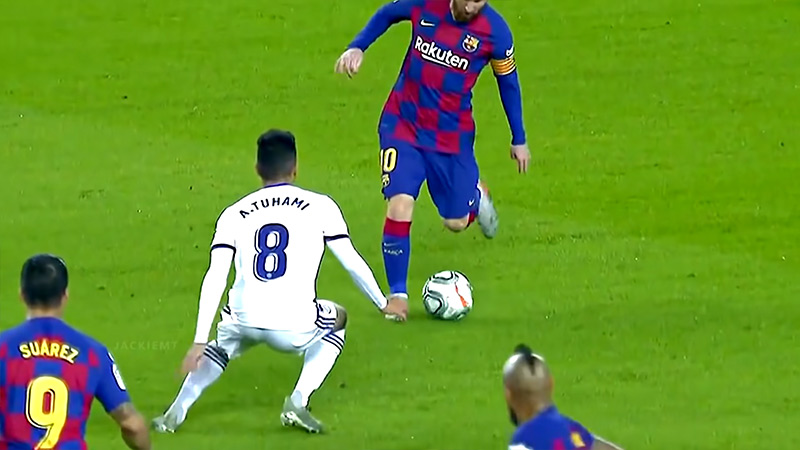
In the world of elite athletics, simplicity often masks sophistication. Few maneuvers illustrate this better than the wall pass.
While it is one of the first combinations taught to youth players, it remains a cornerstone of tactical execution at the highest professional levels.
Whether observed in the intricate patterns of a UEFA Champions League final or the fluid transitions of a World Cup knockout stage, the wall pass is the definitive tool for dismantling a compact defensive structure.
This comprehensive guide examines the technical mechanics, psychological timing, and tactical applications of the wall pass—officially known in various coaching circles as the “one-two,” “give-and-go,” or the “pared”.
Defining the Wall Pass: Beyond the One-Two
At its most fundamental level, a wall pass is a two-player passing combination designed to bypass an individual defender or a localized defensive line. The maneuver involves two distinct participants: the initiator (the runner) and the pivot (the wall).
The sequence begins when Player A (the runner) passes the ball to Teammate B (the wall). Instead of controlling the ball to set up a new play, Teammate B immediately returns the ball into the space that Player A has sprinted into.
By using just one or two touches, the pair creates a bypass that renders the defender’s positioning obsolete.
This movement is more than a simple exchange of possession; it is a rapid-fire geometric puzzle. The goal is to use the defender’s own momentum and commitment against them, effectively “deleting” them from the current phase of play.
The Architecture of the Play: Roles and Responsibilities
To execute a successful wall pass at a professional standard, both participants must understand their specific technical requirements.
1. The Runner (The Initiator)
The runner dictates the tempo of the play. Their primary objective is to engage the defender and then exploit the space behind them. According to established mechanics, the runner must:
- Draw the Pressure: Dribble toward the defender to force a commitment.
- Trigger the Sequence: Execute a precise pass to a teammate positioned at an angle.
- The Immediate Transition: The most critical failure point in amateur play is hesitation. A professional runner must sprint into open space the moment the ball leaves their foot.
2. The Wall (The Pivot)
The teammate receiving the first pass acts as a “wall,” providing a firm, predictable surface for the ball to rebound off.
- One-Touch Mentality: To maintain the speed of the attack, the wall player often returns the ball with a single touch.
- Body Orientation: The wall must be positioned at an angle to the runner, ensuring they can see both the incoming ball and the space the runner is attacking.
- Weight of Pass: The return ball must be weighted perfectly into the runner’s path—not behind them, which kills momentum, and not too far ahead, which invites the goalkeeper or a secondary defender to intervene.
The Four-Step Blueprint for Execution
Consistency in high-pressure environments requires a disciplined adherence to the “1-2” blueprint. Mastering this kinetic sequence ensures that the move remains effective even against disciplined defensive blocks.
- The Dribble: The player in possession approaches the defender. This is not a passive approach; it is a calculated provocation designed to make the defender plant their feet or lean in for a tackle.
- The Initial Pass: The ball is released to a teammate. The angle of this teammate is vital—if they are directly in front, the return pass is easily intercepted. If they are at a 45-degree angle, the passing lanes remain open.
- The Explosive Move: As the pass is made, the runner must accelerate past the defender. This sudden change of pace is what creates the separation needed to receive the return.
- The Return: The runner receives the quick return pass in stride, now positioned behind the defensive line and ready to cross, shoot, or continue the build-up.
The Science of Timing: Exploiting the Defender’s Reaction
Elite soccer is a game of milliseconds. The wall pass relies heavily on the “engagement point”—the exact moment a defender decides to challenge for the ball.
The pass should be initiated precisely as the defender is engaging. When a defender commits to a challenge or shifts their weight to block a dribble, their ability to change direction is momentarily compromised.
By passing at this exact moment and sprinting past them, the runner exploits the defender’s “recovery lag.”
The defender must stop their forward momentum, turn 180 degrees, and attempt to catch a player who is already at top speed. In professional play, this half-second advantage is usually insurmountable.
Strategic Utility: Where the Wall Pass Wins Games
The wall pass is not merely a flashy trick; it is a high-utility tool used to solve specific tactical problems.
- Breaking Low Blocks: Against teams that “park the bus” or sit deep, traditional long balls and dribbles often fail. The wall pass thrives in these tight spaces, allowing attackers to navigate through a crowded penalty area.
- Maintaining Attacking Momentum: Unlike a cross or a long switch, the wall pass keeps the ball moving forward at high velocity. This prevents the defense from resetting their shape.
- Midfield Transition: It is frequently used to bypass a high-pressing midfielder, turning a defensive situation into an immediate counter-attack.
FAQs
How can I improve the accuracy of my “wall” passes?
Focus on your standing foot. Your non-kicking foot should point exactly where you want the return ball to go. Additionally, keep your ankle locked to ensure the ball doesn’t “bobble” upon contact.
Why does my wall pass often get intercepted?
The most common reason is “telegraphing.” If you stare at your teammate for three seconds before passing, the defender will read the play. Look at the defender or the goal, and use your peripheral vision to find your “wall” teammate.
Is the wall pass only for attacking midfielders?
No. In modern football, center-backs often use wall passes with defensive midfielders to bypass a striker’s press. It is a universal skill required for every position on the pitch.
Elevating Team Performance
The wall pass is the ultimate expression of teamwork. It proves that two players working in synchronization can achieve what a single world-class dribbler often cannot.
By mastering the mechanics of the 1-2—the approach, the angled pass, the explosive sprint, and the weighted return, teams can maintain momentum and break through even the most disciplined defensive lines.
For organizations and coaches looking to implement these standards, the focus must remain on the speed of thought and the elimination of unnecessary touches.
In the modern game, the ball will always move faster than the player; the wall pass is simply the most efficient way to prove it.