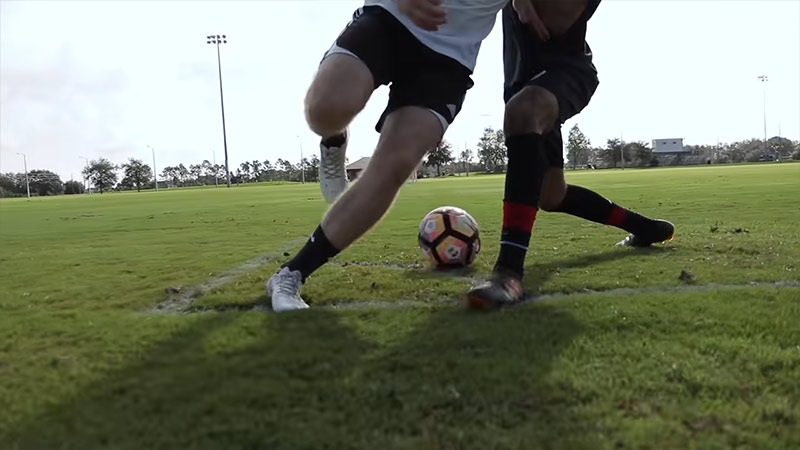
In the modern landscape of global soccer, few maneuvers possess the unique ability to simultaneously electrify a stadium and psychologically dismantle an opponent like the nutmeg.
Often referred to colloquially as a “meg” or “panna,” this high-risk, high-reward skill represents the pinnacle of technical flair and tactical audacity.
At its core, the nutmeg is a dribbling execution where a player intentionally passes the ball through an opponent’s legs, regaining possession on the other side to continue the attack.
While the principle appears straightforward, the successful application of a nutmeg requires a sophisticated blend of perfect timing, spatial awareness, and psychological manipulation.
This analysis explores the multifaceted nature of the nutmeg, ranging from its disputed Victorian origins to the advanced mechanics utilized by the world’s elite professionals.
Whether you are a dedicated coach looking to refine defensive stances or an aspiring winger seeking to add this elite tool to your repertoire, understanding the nutmeg is essential to mastering the intricacies of the beautiful game.
The Etymology of Excellence: From Victorian Fraud to Field Dominance
The term “nutmeg” is a linguistic anomaly in the world of sports, often leaving fans and players alike questioning how a spice became synonymous with technical brilliance.
Historians and etymologists have identified several competing theories, each adding a layer of depth to the move’s legacy.
The Victorian “Wooden Nutmeg” Theory
The most widely accepted historical explanation dates back to the 18th and 19th centuries during the height of the global spice trade. Nutmeg was an incredibly valuable commodity, often leading to unscrupulous practices among traders.
To maximize profits, some exporters in North America—specifically those from Connecticut, which later became known as the “Nutmeg State”—would mix carved wooden replicas into sacks of real nutmeg.
When a buyer was “nutmegged,” it implied they had been duped or conned by a clever trickster.
In the context of soccer, this etymological root perfectly mirrors the relationship between the attacker and the defender; the attacker acts as the trickster, while the defender is the “duped” victim who realizes too late that they have been outmaneuvered.
Linguistic Evolution and “Documentary Gaps”
Despite the strength of the “wooden nutmeg” theory, linguists point to a significant “documentary gap” in the word’s transition to the pitch.
The association with trickery seemed to fade for nearly a century before reappearing in English soccer literature during the late 1960s.
The first recorded usage in a soccer context is often attributed to Rodney Marsh’s 1968 book, Shooting to the Top.
Alternative theories suggest the term may have evolved from Cockney rhyming slang, where “nutmeg” serves as a surrogate for “leg”.
Others point to more lewd interpretations, suggesting the term refers to the ball passing near a player’s testicles, or “nuts”.
Regardless of the precise origin, the term has become a permanent fixture in the soccer lexicon, representing a “beautiful disrespect” that resonates across cultures.
A Global Language: The International Identity of the Nutmeg
While “nutmeg” is the standard term in English-speaking regions, the move is a global phenomenon with culturally specific names that reflect local humor and imagery.
Analyzing these terms provides a fascinating look at how different nations perceive this act of technical skill.
- Latin America and Spain (El Caño or Túnel): In Spanish-speaking countries, the move is most commonly called a caño (meaning pipe or spout) or a túnel (tunnel), referencing the ball’s passage through the “pipe” created by the defender’s legs.
- The Netherlands (Panna): The Dutch term panna has become so influential that it birthed an entire subculture of street football. The game of Panna focuses entirely on nutmegging opponents, turning the skill into the primary objective rather than a means to a goal.
- France and Egypt (Petit Pont and Kobry): In French, the move is a petit pont, or “little bridge”. Similarly, in Arabic-speaking regions like Egypt and Saudi Arabia, it is known as a kobry, which also translates to “bridge”.
- South Korea (Alggagi): One of the most creative names comes from Korea, where the move is called alggagi, literally translating to “egg-hatching”.
- The Caribbean and Beyond: In Jamaica, players call it a “salad,” while in Austria, the term gurkerl (little pickle) is frequently used. In Hungary, the term kötény means “apron,” signifying that the defender has been “covered up” or dressed down.
This diversity of terminology highlights that while the name changes, the feeling of shared excitement—and the “humiliation” of the defender—is universal.
The Anatomy of Execution: How to Master the Nutmeg
Executing a successful nutmeg is far more complex than simply kicking the ball through an opening. It is a calculated maneuver that relies on the principles of deception, timing, and an explosive exit strategy.
To transition from a standard dribbler to a “nutmeg master,” one must adhere to a rigorous technical framework.
Step 1: The Angle of Engagement
A successful nutmeg begins long before the ball leaves the foot. You must approach the defender at an angle that encourages them to compromise their stance.
A defender standing “square-on” to the attacker is the ideal target, as this position naturally creates a larger visible gap between their legs.
Step 2: The Art of the Lull
Elite players rarely attempt a nutmeg as their first move. Instead, they use a process of “lulling” the defender into a false sense of security.
By beating a defender using traditional lateral dribbles or simple passes several times, you condition them to expect a certain pattern of play. This sets the stage for the surprise element necessary for a nutmeg.
Step 3: Triggering the Stance
The optimal moment to execute the nutmeg is when the defender is off-balance or overcommitted. This often occurs when they attempt a lunging tackle or are forced to backpedal rapidly.
Using feints—such as acting as if you are about to cross the ball or cut inside—can trick the defender into widening their stance to block the perceived path, thereby opening the “tunnel”.
Step 4: Precision and Power
The weight of the touch is the most critical technical component. The ball must be kicked with enough power to pass cleanly through the legs but with sufficient finesse to ensure it does not run too far away.
If the touch is too heavy, a secondary defender or the goalkeeper will intercept it; if it is too soft, the original defender can recover or “pinch” the ball.
Step 5: The Exit Strategy
A nutmeg is incomplete until the attacker regains possession on the other side. Because defenders often feel a sense of embarrassment after being nutmegged, they may react aggressively or attempt to foul.
A quick burst of acceleration to navigate around the opponent’s body is vital to finalizing the move and maintaining the offensive momentum.
Strategic Application: When to Deploy (and When to Avoid)
Despite its aesthetic appeal, the nutmeg is an advanced and inherently risky move. From a coaching perspective, its use must be governed by tactical discipline.
Ideal Scenarios for a Nutmeg:
- One-on-One with the Keeper: When a goalkeeper charges out to close down an angle, their legs are often wide apart, providing a prime opportunity to slip the ball through for a goal.
- On the Wing: Fullbacks often overcommit when trying to block a cross, leaving them vulnerable to a well-timed nutmeg that allows the winger to drive into the box.
- Transitioning Against an Off-Balance Defense: If a defender is running toward you too fast and cannot adjust their feet in time, the nutmeg becomes a highly effective tool for bypassing them.
When to Avoid the Nutmeg:
- Defensive Third: Attempting a nutmeg near your own penalty box is considered a cardinal sin by coaches. A loss of possession in this area can lead to an immediate scoring opportunity for the opposition.
- High-Traffic Areas: In a crowded midfield where multiple defenders are present, the ball is likely to be intercepted even if the initial nutmeg is successful.
- Simple Passing Options: If an easy pass to a teammate is available, it is statistically the preferred option over a high-risk nutmeg.
The Tactical Counter: How to Defend the Nutmeg
For defenders, being nutmegged is often cited as one of the most humiliating experiences on the pitch, leaving them “hanging their head in shame” while spectators cheer. However, preventing the nutmeg is a matter of disciplined positioning and patience.
The Staggered Position
The primary mistake defenders make is standing “square” to the attacker with their feet parallel. To neutralize the threat, a defender must adopt a “jockeying” or staggered stance—one foot in front of the other with knees bent. This stance naturally reduces the gap between the legs and allows for better lateral movement.
The “Ball’s Width” Rule
A professional defensive standard is to keep the feet approximately one ball’s width apart. This creates a gap small enough that the ball cannot pass through cleanly, yet wide enough to maintain the balance required to react to the attacker’s feints.
Jockeying and Staying on Toes
Defenders must avoid “diving in” or lunging at the ball prematurely. By staying on their toes and maintaining a consistent distance from the attacker, they can close the “tunnel” the moment the attacker attempts the move. Defensive success in these situations is defined by patience rather than aggression.
The Psychology of the Nutmeg: Warfare on the Pitch
The impact of a nutmeg extends far beyond the tactical scoreboard; it is a form of psychological warfare. Players have described the experience of being nutmegged as “actually psychologically damaging”.
Boosting Team Morale
A successful nutmeg is capable of “injecting fresh energy” into a team. It serves as a visual demonstration of confidence and technical superiority, which can “hype up” both teammates and the crowd. This surge in momentum can often be the catalyst for a breakthrough in a stagnant match.
Destabilizing the Opponent
Conversely, the victim of a nutmeg often suffers a loss of composure. The “humiliation” of the move can cause a defender to lose their cool, potentially leading them to commit reckless fouls in dangerous areas or abandon their tactical positioning out of a desire for “revenge”. In this sense, the nutmeg is a tool for mental disruption as much as it is a physical skill.
The Masters of the Craft
While many players can perform a nutmeg in training, only a select few have mastered the ability to execute it under the intense pressure of professional matches.
- Lionel Messi: Known for his “dazzlingly intricate” dribbling, Messi uses the nutmeg with surgical precision, often utilizing it when defenders think they have finally cornered him.
- Luis Suárez: Perhaps the most prolific advocate of the skill, Suárez’s ability to find the gap between a defender’s legs is so renowned that Liverpool fans famously boasted he “could nutmeg a mermaid”.
- Ronaldo (O Fenômeno): The Brazilian legend regularly integrated nutmegs into his “mazy dribbles,” using them to spice up his legendary attacking runs.
- Ronaldinho and Neymar: Both players represent the pinnacle of the Brazilian Joga Bonito style, where the nutmeg is used not just for efficiency but for artistic expression.
Enhanced FAQ: Mastering the Essentials
Q: Is a nutmeg always intentional?
A: While “accidental” nutmegs occur, a true nutmeg in the professional sense is a “deceptive soccer trick” where the player intentionally targets the space between the legs to bypass a defender.
Q: Is the nutmeg considered disrespectful?
A: In some soccer cultures, it is viewed as “disrespectful yet beautiful”. While it can humiliate an opponent, it is also celebrated as a high-level display of technical skill.
Q: What is the best way to practice this skill?
A: Practice begins with ball control and timing. Drills like the rondo—a classic training exercise—help players recognize the passing lanes between opponents’ legs in tight spaces.
Q: Can a nutmeg be done with one touch?
A: Absolutely. While some nutmegs involve complex feints, they can be as simple as a well-timed, one-touch knock through the opposition’s legs.
Conclusion: The Legacy of the “Little Bridge”
The nutmeg remains one of the most captivating elements of soccer because it distills the essence of the sport into a single second: the triumph of intelligence and skill over brute force.
From its murky origins in the spice trade of Connecticut to the neon lights of the World Cup, the “meg” continues to be the ultimate benchmark of a player’s confidence.
Mastering this skill requires more than just footwork; it requires the audacity to attempt the “ambitious” and the wisdom to know when the moment is right.
Whether you are performing a panna on a concrete street pitch or a caño in a professional stadium, you are participating in a global tradition of technical artistry that defines the very spirit of the game.