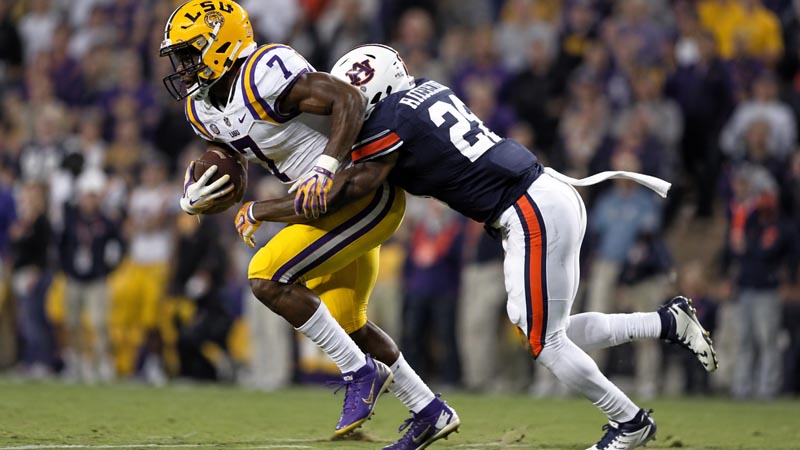
The sound of a stadium falling silent for a split second, followed by a thunderous roar, is a phenomenon every football fan knows.
It usually happens after a collision so perfectly timed and powerful that it changes the entire trajectory of a game. In the modern lexicon of the sport, we call this the Hit Stick.
While the term might feel as old as the game itself, its journey from a digital innovation to a standard for defensive excellence is one of the most fascinating crossovers in sports history.
A hit stick is defined as a hard, high-impact defensive tackle that has become a benchmark for physicality on the gridiron.
Understanding the hit stick requires more than just watching a highlight reel; it requires looking at the intersection of gaming culture, physics, and the evolving safety standards of the professional game.
The Digital Genesis: Madden NFL 2005
To understand where the hit stick came from, we have to travel back to the mid-2000s. Before 2004, defensive gameplay in sports titles was often seen as a secondary experience to the thrill of scoring touchdowns.
That changed with the release of Madden NFL 2005. For the first time, developers introduced a dedicated mechanic that allowed players to do more than just “wrap up” a ball carrier.
By pushing or flicking the right analog stick on a controller upward just before the moment of contact, players could trigger a devastating, aggressive tackle animation.
This was a departure from the traditional gameplay where a single button press resulted in a standard tackle.
The “Hit Stick” gave the player agency over the intensity of the collision. It wasn’t just about stopping the runner; it was about making a statement.
This mechanic popularized the term, embedding it into the minds of a generation of fans and future athletes who grew up with a controller in their hands.
The Philosophy of Risk and Reward
What made the hit stick so iconic in the digital space—and what makes it so relevant in real-life analysis—is the inherent gamble involved. In a video game, the hit stick is a high-risk, high-reward maneuver.
When a player successfully times the flick of the analog stick, the results are game-changing.
The impact is designed to jar the ball loose, forcing a fumble, or to hit a receiver so hard that they drop an otherwise catchable pass. However, if the timing is off or the angle is incorrect, the mechanic backfires.
A missed hit-stick attempt causes the defender to stumble, losing their balance and often allowing the ball carrier to sprint past for a significant gain or a touchdown.
This digital reality mirrors the physical reality of the NFL. A defender who “goes for the big hit” instead of using a traditional wrap-up technique is putting everything on the line. If they miss, they are out of the play.
If they connect, they can change the scoreboard. This psychological element is what elevated the hit stick from a simple game feature to a legitimate football strategy.
From the Living Room to the Sidelines
As the generation that grew up playing these games entered the professional ranks, the language of the game began to shift. You started hearing commentators, players, and coaches use the term to describe real-world occurrences.
Today, fans use the term “hit stick” to describe a massive, perfectly timed collision where a defender manages to stop an offensive player’s momentum instantly.
In the real world, the hit stick serves as a massive momentum shifter. It is a psychological tool as much as a physical one.
When a safety comes downhill and levels a wide receiver across the middle, or a linebacker stops a running back in the hole with a loud crack of the pads, it fires up the defense and the home crowd.
It creates a “ripple effect” of energy that can be felt throughout the stadium. These plays often lead to the same results seen in the games: forced fumbles, incomplete passes, and a sudden shift in the emotional weight of the contest.
The Physics of Power: Momentum and Leverage
At its core, a real-world hit stick is a masterclass in physics. To stop a 220-pound athlete running at full speed, a defender must generate an equal or greater amount of force and apply it precisely. This isn’t about “running into” someone; it’s about neutralizing momentum.
When a defender executes a hit stick, they are essentially using their body as a blunt force instrument to negate the kinetic energy of the ball carrier. This requires a combination of:
- Closing Speed: The ability to accelerate toward the target to maximize force.
- Timing: Striking at the exact moment the ball carrier is most vulnerable or has the least amount of stability.
- Point of Impact: Targeting the center of gravity to ensure the runner is stopped in their tracks rather than falling forward for extra yardage.
Navigating the Modern Era: Safety and Technique
While the “hit stick” of the early 2000s was often associated with “reckless launching,” the modern game has demanded a more refined approach.
As the NFL and lower levels of football have moved toward prioritizing player safety, the definition of a “clean” hit stick has evolved.
Modern rules heavily penalize dangerous forms of tackling, particularly helmet-to-helmet hits or “targeting”. Because of these regulations, the reckless “launching” of the body that was once celebrated is now a liability that leads to 15-yard penalties, ejections, and fines.
Consequently, the real-world hit stick has become a display of precise shoulder-first leverage.
Today’s elite defenders are taught to keep their heads out of the contact zone. They use their shoulders to deliver the blow, driving through the opponent’s torso while maintaining control of their own body.
This evolution proves that a tackle can be both devastating and legal. The “hit stick” isn’t about being dangerous; it’s about being technically superior and physically dominant without compromising safety.
The Cultural Legacy of the Hit Stick
The hit stick is more than just a tackle; it is a bridge between two worlds. It represents the first time a video game didn’t just simulate sports but actually provided the vocabulary for how we discuss it. It changed the expectations of the fans, who now look for that “hit stick” moment in every game.
Furthermore, it has influenced how players view their own highlights. In an era of social media, a “hit stick” tackle is the defensive equivalent of a 50-yard touchdown pass. It is the play that goes viral, the play that gets a player noticed, and the play that defines a “hard-nosed” defensive identity.
Conclusion: A Lasting Impact
The hit stick is a rare example of how technology can influence the culture of a legacy sport. What started as a clever way to make a video game more engaging has turned into a shorthand for defensive excellence.
It reminds us that football, at its heart, is a game of momentum, and there is no better way to control that momentum than with a perfectly executed, high-impact tackle.
Whether you are flicking an analog stick on a Sunday morning or watching a linebacker deliver a clean, shoulder-first strike on a Sunday night, the “Hit Stick” remains the ultimate symbol of defensive power.
It is the moment where strategy, physics, and sheer will collide to create the most exciting play in sports.