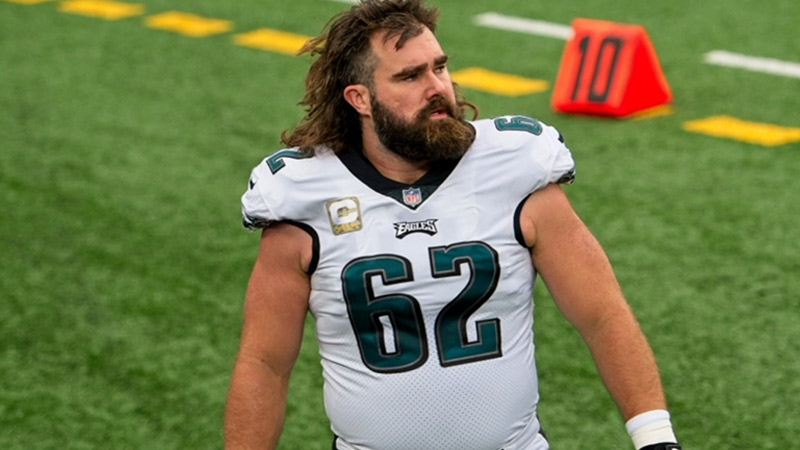
Jason Kelce’s thirteen-year tenure in the National Football League is often characterized by his unparalleled athleticism at the center position, his intellectual mastery of defensive schemes, and an almost mythical level of durability.
However, the narrative of the “Iron Man” often obscures the heavy physical toll required to maintain such a high level of performance.
To understand the true legacy of Kelce is to examine the extensive medical history that parallels his Hall of Fame-caliber statistics.
The physical demands of an offensive lineman are unique; they involve repeated high-impact collisions, the management of massive external loads, and the necessity for extreme joint stability under duress.
Kelce’s career serves as a masterclass in pain management and surgical recovery, revealing the hidden “bill” that elite athletes eventually have to pay.
The Foundational Injuries: Navigating Early Career Setbacks
Every legendary career faces a defining moment of adversity. For Kelce, this occurred during his second professional season. In 2012, he suffered a torn anterior cruciate ligament (ACL) and a partial medial collateral ligament (MCL) in his right knee.
This injury is historically a turning point for many athletes, requiring a complex reconstruction and a grueling rehabilitation process that often takes a full calendar year.
For a center whose game relied on lateral agility and “pulling” into space, a compromised knee could have been career-ending.
Instead, Kelce utilized this period to refine his understanding of the game, returning to the field with a reconstructed base that would support him for the next decade.
Shortly after his return to elite form, Kelce faced another significant mechanical hurdle. In 2014, he developed a sports hernia, a condition involving the tearing of soft tissues in the lower abdomen or groin area.
For an offensive lineman, core stability is the bridge between the power generated by the legs and the force delivered through the arms.
The resulting core muscle surgery sidelined him early in the 2014 season, yet his ability to return and maintain his All-Pro trajectory further solidified his reputation for resilience.
The 2018 Gauntlet: Defining “Iron Man” Status
While many players might sit out a season to recover from one major ailment, the 2018 season highlighted Kelce’s extraordinary pain tolerance and dedication to his team.
During this single campaign, he managed a staggering trio of injuries simultaneously: a grade II MCL sprain, a broken foot, and a torn/broken elbow.
The mechanics of playing center with these specific injuries are nearly unfathomable:
- The Broken Foot: Every snap begins with a drive-block or a step into a pass-set. A broken foot compromises the very foundation of an offensive lineman’s power.
- The MCL Sprain: This affects the lateral stability of the knee, making it difficult to anchor against 320-pound defensive tackles.
- The Elbow Injury: Kelce was forced to wear a specialized brace to protect the torn and broken structures in his arm. As the player responsible for the initial “snap” of the ball, his arm health was paramount to the offense’s synchronization.
Despite this accumulation of trauma, Kelce did not miss a game that season, a feat that remains one of the most respected displays of toughness in modern sports history.
Late Career Resilience and the Transition to Retirement
As Kelce entered the twilight of his playing days, the injuries became more about managing chronic instability. In 2022, he played through a torn ligament in his ankle.
Ankle stability is critical for a “zone-blocking” center who must move horizontally at high speeds. His ability to mask this pain and perform at an All-Pro level contributed significantly to his team’s championship aspirations that year.
Even after stepping away from the professional gridiron, the physical challenges did not cease. In early 2026, Kelce made headlines for a significant training injury. While attempting a massive 635-pound squat, he suffered a torn quadriceps tendon.
This injury is particularly severe, as the quadriceps tendon is the primary structure responsible for extending the knee.
This incident serves as a reminder that the high-intensity training required to maintain an NFL physique carries inherent risks long after the final whistle blows.
The Cumulative Cost: Chronic Conditions and Daily Realities
The “physical bill” for a 13-year career is not just paid in surgeries, but in the daily maintenance of a deteriorating frame. Kelce has been transparent about the ongoing physical toll of his career, which includes:
- Chronic Ankle Inflammation: A result of repeated sprains and the torn ligament suffered in 2022.
- Back Stiffness: The result of over a decade of “leveraging” heavy opponents and absorbing thousands of sub-concussive and high-impact hits.
- Strained Pectorals: Likely a byproduct of the heavy upper-body strength training and the “punching” techniques required in pass protection.
These conditions represent the invisible reality of the retired athlete—a life where simple movements are often accompanied by the reminders of past Sundays.
Conclusion: The Legacy of a Warrior
The history of Jason Kelce is not merely a collection of accolades, but a testament to human endurance.
From the reconstructive surgery of 2012 to the “Iron Man” performance of 2018 and the post-career quad tear of 2026, his journey illustrates the extreme sacrifices made by elite athletes.
While the scars and chronic pain remain, they serve as the permanent markers of a career defined by an refusal to be sidelined.