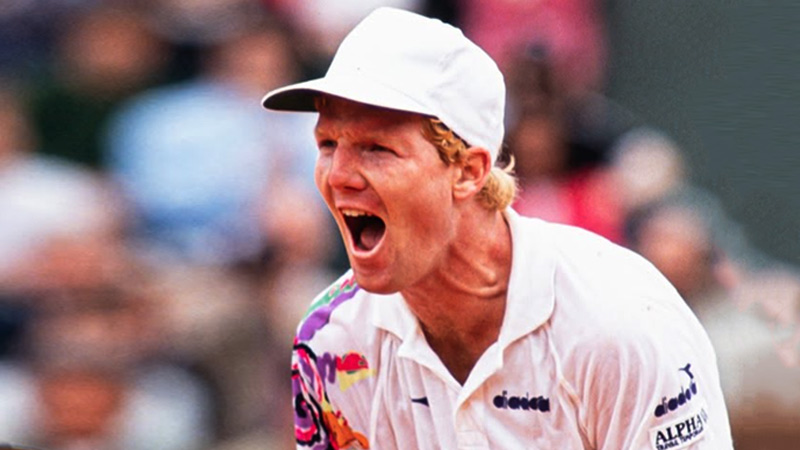
Jim Courier, the former world No. 1 and four-time Grand Slam champion, retired from professional tennis in May 2000 at the age of 30 due to physical and emotional burnout.
Since stepping away from the court as a player, Courier has successfully transitioned into a premier global television analyst, sports entrepreneur, and philanthropist.
He is a primary commentator for the Tennis Channel and the Nine Network, famously pioneering post-match on-court interviews.
Today, he resides in Orlando, Florida, managing his firm InsideOut Sport & Entertainment while maintaining a prestigious legacy as one of the sport’s most insightful modern voices.
Why Did Jim Courier Retire from Professional Tennis?
The departure of Jim Courier from the professional circuit was not a sudden disappearance but a calculated response to the immense physical and mental demands of his playing style.
As a player who defined the early 1990s with his “Baseline Warrior” persona, the transition away from competition was driven by a combination of physical wear and a fading competitive edge.
By the time he reached his late twenties, the relentless schedule and his specific mechanical approach to the game had created a situation where continued peak performance was no longer sustainable.
The Toll of the “Baseline Warrior” Style
Jim Courier was renowned for a hyper-physical, grinding style of play that centered on a powerful, baseball-swing baseline game.
Unlike many of his contemporaries who incorporated more variety, Courier relied on a relentless inside-out forehand and pure physical endurance to outlast his opponents.
This approach required him to push his body to its absolute limits for 13 years with practically zero off-seasons for rest and recovery.
By 1994, rivals began to successfully neutralize his predictable patterns, forcing him into even longer, more grueling matches that accelerated the physical breakdown of his body.
Signs of Emotional and Physical Burnout
The first major indicators of Courier’s eventual retirement appeared long before he officially stepped away in 2000.
A defining moment occurred during the 1993 ATP Championships when Courier, overwhelmed by mental fatigue and stress, famously read a fiction novel during changeovers in a live match.
He later admitted that this bizarre incident was an expression of severe exhaustion, illustrating that his mental drive was fracturing under the weight of constant competition.
Despite helping the United States win the 1995 Davis Cup and capturing a final ATP singles title in 1998, the spark that had fueled his rise to world No. 1 was rapidly dimming.
The Decision to Walk Away at Age 30
The final decision to retire on May 9, 2000, came when Courier realized he no longer possessed the daily motivation required to maintain an elite level.
He reached a point where he no longer woke up with the desire to put in the work necessary to get better, marking the end of a career that saw him win four Grand Slam titles and spend 58 weeks at the top of the rankings.
At just 30 years old, he chose to preserve his long-term health and legacy rather than continue a downward slide in the rankings, having fallen out of the top tier by the late 1990s.
How Jim Courier Transformed Tennis Media and Broadcasting
Rather than fading into obscurity after his playing days, Jim Courier immediately pivoted into a media career that has arguably made him more visible to modern fans than his playing career did.
His transition into the broadcast booth was seamless, as he utilized the same tactical mind that made him a champion to break down the game for global audiences.
He is now widely considered one of the most respected and insightful voices in sports media, holding major roles across multiple continents.
Pioneering the On-Court Interview Format
One of Courier’s most significant contributions to the modern tennis experience is the development of the post-match, on-court interview.
He revolutionized tennis broadcasts by conducting these live interviews at the Australian Open, a format that allowed fans to see the immediate emotional and tactical reactions of players following a victory.
This interview style proved so successful and engaging that it has since become a global standard across nearly all professional sports broadcasts, bridging the gap between the athletes and the viewing public.
Tactical Analysis for Global Networks
Courier serves as a leading tactical analyst for several major networks, including the Tennis Channel in the United States and the Nine Network in Australia during the Australian Open.
Known for offering sharp, candid tactical breakdowns, he regularly critiques modern stars and analyzes complex match strategies with a level of depth that draws on his experience as a former world No. 1.
His presence in the booth during major Grand Slam tournaments ensures that viewers receive high-level expertise, cementing his role as a premier sports media consultant.
Business Ventures and Professional Leadership
Beyond the microphone, Jim Courier has established himself as a savvy businessman and a leader within the tennis community.
His “second act” includes the founding of successful enterprises and a significant tenure leading the national team, showing a diverse range of professional capabilities that extend far beyond his physical prowess on the court.
InsideOut Sport & Entertainment and the Champions Series
As a co-founder of InsideOut Sport & Entertainment, Courier moved into the world of event production and management.
His firm is responsible for managing the Champions Series, which brings together legendary tennis players for exhibition matches, allowing retired icons to continue engaging with fans in a competitive yet celebratory environment.
This venture has allowed him to remain a high-profile figure in the sports industry while building a sustainable corporate career that leverages his deep connections within the tennis world.
Leading the U.S. Davis Cup Team
Courier’s leadership skills were further demonstrated during his eight-year tenure as the U.S. Davis Cup Captain from 2010 to 2018.
During this period, he was responsible for mentoring a new generation of American talent, including players like John Isner and Frances Tiafoe.
Having won two Davis Cup titles as a player in 1992 and 1995, his transition to captaincy was a natural fit, and he is credited with providing steady, expert guidance to the national team for nearly a decade.
Personal Life, Wealth, and Current Residence
Jim Courier’s life today is characterized by a balance of family, philanthropy, and continued professional relevance.
While he spent much of his youth traveling the globe, his post-retirement life is centered in Florida, where he has built a stable and successful domestic life away from the high-pressure environment of the professional tour.
Marriage to Susanna Lingman and Family Life
In 2010, Courier married Susanna Lingman, a fellow athlete with a distinguished tennis background.
Susanna played collegiate tennis for Harvard University, where she was eventually inducted into the Harvard Varsity Club Hall of Fame, and also competed briefly on the ITF circuit.
Today, she works in marketing, and the couple lives in Orlando, Florida, where they are raising their two sons. This shared athletic background has likely contributed to the stability of their life together after the intense demands of professional sports.
Financial Success and Brand Partnerships
Jim Courier has managed his finances with the same precision he applied to his baseline game, resulting in an estimated net worth of approximately $18 million. This wealth is supported by several diverse revenue streams, including:
- Career Prize Money: He earned $14 million in official prize money during his active years on the ATP tour.
- Media Salary: He commands a top-tier salary as a global television analyst for major networks.
- Business Income: Revenue from his corporate events business, InsideOut Sport & Entertainment.
- Luxury Endorsements: He maintains high-profile, long-term brand partnerships, notably serving as a global ambassador for Rolex.
Philanthropy and Public Appearances
Courier is also deeply involved in charitable work, primarily through his organization, Courier’s Kids. Based in St. Petersburg, Florida, this non-profit is dedicated to supporting youth tennis programs and providing opportunities for children to excel through the sport.
His commitment to giving back was also on display during a special “Sports Superstars Edition” of Who Wants to Be a Millionaire in 2001, where he won $32,000 for the Tim & Tom Gullickson Foundation after navigating a series of difficult questions.
Key Career Statistics and Milestones
To understand what happened to Jim Courier, one must first appreciate the heights from which he transitioned. His career is marked by historic achievements that ensured his induction into the International Tennis Hall of Fame in 2005.
| Metric / Achievement | Stat / Detail |
|---|---|
| Grand Slam Singles Titles | 4 (1991 & 1992 French Open; 1992 & 1993 Australian Open) |
| Total Career Titles | 23 Singles, 6 Doubles |
| Weeks at World No. 1 | 58 Weeks |
| Historical Milestone | Youngest man to reach finals of all four Grand Slams (Age 22) |
| Davis Cup Trophies | 2 Wins as a player (1992, 1995) |
| Hall of Fame Induction | Class of 2005 |
Frequently Asked Questions About Jim Courier’s Legacy
Where does Jim Courier live now?
Jim Courier currently resides in Orlando, Florida. He owns a spacious 4,500-square-foot estate that he originally purchased in the late 1990s and maintains additional real estate ties in Tampa, Florida.
Is Jim Courier still involved in tennis?
Yes, he is highly active in the sport as a leading tactical analyst for the Tennis Channel and the Nine Network. He also continues to conduct iconic on-court interviews at major tournaments and manages tennis-related events through his firm.
Why was the “Yarra River” jump significant?
The Yarra River jump became a famous tradition after Courier won his Australian Open titles.
He celebrated by jumping fully clothed into the polluted river with his coach, Brad Stine, a move that cemented his status as a fan favorite in Australia and showed a lighter side to his intense competitive persona.
What is Jim Courier’s net worth today?
His estimated net worth is $18 million, driven by his career earnings, business ventures, and high-end sponsorship deals with brands like Rolex.
Conclusion: The Blueprint for a Successful Second Act
The story of Jim Courier is one of successful reinvention. While his playing career ended relatively early at age 30 due to the physical and mental toll of his “Baseline Warrior” style, he did not allow that retirement to be a conclusion.
Instead, he used his deep understanding of the game to become one of the most influential figures in sports media and business.
From pioneering on-court interviews to leading the U.S. Davis Cup team, Courier has demonstrated that a professional athlete’s most significant contributions to their sport can often come after they have put down the racket.
Today, he stands as a primary example of how to leverage a legendary playing career into a lasting and multifaceted professional legacy.