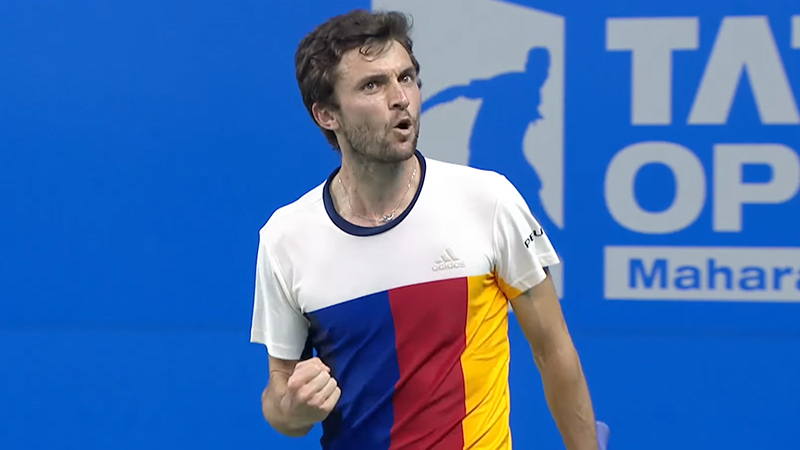
Gilles Simon, the French tennis legend known as “The Professor,” officially retired from professional tennis in November 2022 after a storied 20-year career.
Since hanging up his racket, Simon has transitioned into a prominent tactical coach, most notably serving as a consultant for Daniil Medvedev from 2024 to 2025.
Today, he remains a highly respected voice in the tennis community through filter-free punditry and his insightful book, Ce Sport Qui Rend Fou.
His departure from the ATP tour was ultimately driven by natural physical wear and aging rather than a single catastrophic injury.
Why Did Gilles Simon Retire from Professional Tennis?
The decision to retire was not a sudden reaction to a career-ending moment but rather a calculated conclusion to a long and physically demanding tenure on the global circuit.
Simon’s style of play, which prioritized endurance and tactical maneuvering over raw power, meant that every match was a grueling test of his physical limits.
By the time he reached his late thirties, the cumulative effect of two decades of high-intensity competition had become undeniable.
A Gritty Finale at the 2022 Paris Masters
Gilles Simon chose to conclude his professional journey on home soil, selecting the 2022 Rolex Paris Masters as his final stage. True to the “Professor” moniker, he did not simply fade away; he produced one of the most memorable final runs in recent memory.
At 37 years old, he managed to secure dramatic upsets over high-ranked opponents Andy Murray and Taylor Fritz.
These victories served as a final masterclass in his signature counterpunching style, proving that his tactical mind remained sharp even as his physical speed began to wane. His final match against Felix Auger-Aliassime marked the end of an era for French tennis.
The Natural Conclusion of a Twenty-Year Journey
Simon’s retirement in November 2022 was the result of natural “wear and tear” accumulated over 500 career wins and 14 ATP singles titles. Throughout his career, he reached a peak ranking of World No. 6, a testament to his consistency and resilience.
In his final interviews, he noted a lack of motivation to continue the relentless year-round travel required to stay competitive at the elite level.
He walked away from the sport with his health relatively intact, choosing to preserve his well-being for a second act in the game rather than pushing until a major injury forced his hand.
Analyzing the Physical Toll: a Timeline of Injuries
To understand what happened to Gilles Simon’s physical capabilities, one must look at the specific medical hurdles he cleared throughout his two decades on tour. His defensive style of play took a significant toll on his joints and respiratory system.
| Period | Condition/Injury | Impact on Career |
|---|---|---|
| 2009–2010 | Chronic Right Knee Injury | Forced him to miss the 2010 Australian and French Opens. |
| 2013–2014 | Whooping Cough (Pertussis) | Severely diminished lung capacity; required hospitalization. |
| 2015 | Acute Neck and Back Ailments | Suffered cervical strain during the clay-court season. |
| 2021 | Mental Health Sabbatical | Two-month break following burnout during the pandemic. |
| 2022 | Professional Retirement | Retired at age 37 due to general wear and tear. |
The Mental Health Sabbatical of 2021
In February 2021, Gilles Simon made headlines for a reason other than his tactical prowess: he took an indefinite sabbatical to address his mental well-being. This was a pivotal moment that signaled the beginning of the end of his playing days.
Following a heavy defeat at the Australian Open, Simon candidly admitted that his “heart was not there to travel”. The rigorous COVID-19 pandemic protocols and the isolation of the tour had led to severe burnout and mental exhaustion.
He spent two months completely detached from the competitive environment, a move that allowed him to return for one final season with a renewed sense of morale.
This period of reflection was essential for Simon, as it highlighted the psychological burden that professional athletes carry—a theme he would later explore in his literary work.
His willingness to speak openly about mental health established him as a leader in player-advocacy circles before he even left the court.
What Was Gilles Simon’s Role with Daniil Medvedev?
After retirement, Simon did not stay away from the tour for long. In February 2024, he made a high-profile return as a tactical consultant for former World No. 1 Daniil Medvedev.
This partnership was viewed by many as a “meeting of the minds,” as both players were known for their analytical approach and defensive wizardry.
Simon’s mission was to help Medvedev break down the strategies of his toughest rivals, using the same “Professor” logic that had frustrated opponents for years.
Tactical Consulting and Internal Team Friction
The partnership with Medvedev was productive but marred by internal complications. It was later revealed that Medvedev had secretly hired Simon without initially informing his long-time head coach, Gilles Cervara.
This lack of transparency caused significant “static” and friction within the coaching camp. While Simon was brought in to provide a fresh tactical perspective, the administrative and interpersonal disruptions eventually took a toll on the team’s cohesion.
Despite the wealth of knowledge exchanged, the pairing failed to secure a title during their twelve months together.
Navigating the Emotional Toll of Elite Coaching
Beyond the tactical side of the game, Simon later opened up about the “brutal emotional toll” of managing a player as intense as Daniil Medvedev.
Coaching at the highest level requires more than just drawing up game plans; it involves managing the psychological state of the athlete during high-pressure moments.
Simon found himself navigating Medvedev’s frequent on-court outbursts, which required a different kind of endurance than he had practiced as a player.
The partnership ended mutually in February 2025, and shortly thereafter, the friction within the camp led to the split between Medvedev and Cervara as well.
Gilles Simon as a Pundit: Decoding the Modern Game
Since moving away from full-time coaching, Gilles Simon has cemented his status as one of the most respected analysts in tennis media.
He is frequently sought out for his “filter-free” interviews, where he provides deep dives into the mechanics of the sport’s greatest stars.
Unlike traditional commentators who may rely on clichés, Simon utilizes his analytical background to explain exactly how players like Novak Djokovic, Rafael Nadal, and Carlos Alcaraz manipulate their opponents.
He has become a bridge between the old guard and the new generation, offering insights that are both technical and accessible. His commentary often focuses on the “chess match” aspect of tennis, emphasizing that physical power is only one part of the equation.
For fans looking to understand the “why” behind a match’s outcome, Simon’s analysis has become an essential guide.
He also stays active on social media, frequently offering public praise and tactical breakdowns for rising talents like Arthur Fils, signaling his continued investment in the future of French tennis.
The Literary Impact of “Ce Sport Qui Rend Fou”
A major part of what happened to Gilles Simon involves his transition into a thought leader through his book, Ce Sport Qui Rend Fou (“This Sport That Makes You Crazy”).
Published toward the end of his career, the book has become a benchmark text in Europe for its honest look at player development.
Simon uses the platform to critique the modern training systems that he believes often prioritize physical attributes over tactical intelligence and mental health.
The book continues to influence conversations about how young players are coached in France and beyond.
By sharing his personal experiences with burnout and the “madness” of the tour, Simon has provided a roadmap for a more sustainable approach to professional athletics.
This literary contribution ensures that his legacy is not just about match wins, but about improving the culture of the sport for the next generation.
Frequently Asked Questions
Did a specific injury force Gilles Simon to retire?
No, he did not retire due to a single, sudden injury. Instead, he retired in November 2022 at age 37 due to the natural wear and tear of a 20-year career and a desire to stop the grueling travel schedule.
Is Gilles Simon still coaching Daniil Medvedev?
No, the partnership ended in February 2025 after exactly one year. While the pairing was tactically significant, it was complicated by internal team friction and failed to produce a title.
What is Gilles Simon’s highest career ranking?
Gilles Simon reached a career-high ranking of World No. 6. He retired with 14 ATP singles titles and over 500 career match victories.
Does Gilles Simon still play tennis?
While he has retired from the professional ATP tour, he occasionally competes in exhibition and legends events, such as the French Open Legends tournament.
Conclusion: the Professor’s Enduring Legacy
Gilles Simon’s transition from a gritty on-court “grinder” to a tactical mastermind behind the scenes is a rare success story in professional sports.
Though his body eventually succumbed to the natural fatigue of two decades of elite competition, his mind remains one of the most valuable assets in the tennis world today.
Whether through his coaching of world-class athletes, his sharp media punditry, or his influential writing, Simon continues to shape the way we understand and play the game.
His journey serves as a reminder that the end of a playing career is often just the beginning of a new chapter.
For those wondering “what happened to Gilles Simon,” the answer is clear: he has evolved from a player who solved problems on the court to an educator who teaches others how to do the same.
As the sport continues to move toward a more analytical and data-driven future, the expertise of “The Professor” will undoubtedly remain in high demand.