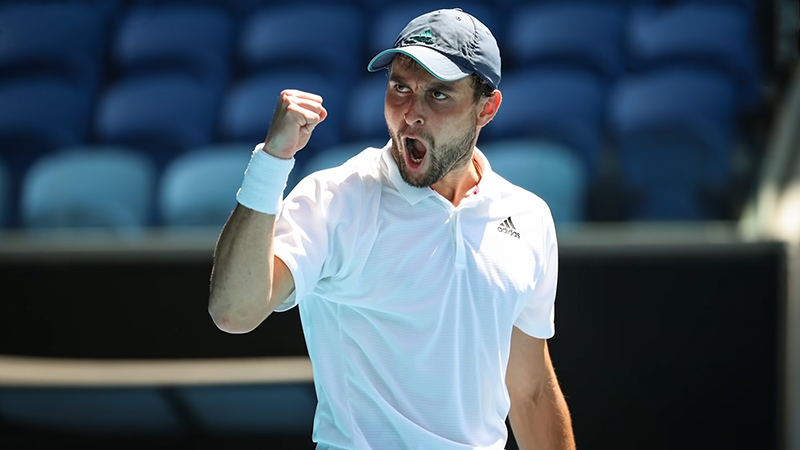
Aslan Karatsev has experienced a staggering professional decline, plummeting from a career-high of World No. 14 in 2022 to No. 1,290 by July 2026.
This collapse is primarily due to a catastrophic ACL tear suffered at the 2024 Brisbane International and a subsequent pattern of premature returns that sabotaged his physical stability.
After chronic back issues forced an eight-month hiatus in late 2025, Karatsev is currently attempting a painstaking rebuild on the ITF Futures circuit.
This article explores his injury timeline, the “recovery-readiness mismatch,” and his current status as he fights to return to the ATP Tour.
The Historic Rise and Peak of a Late-Bloomer
The professional trajectory of Karatsev is one of the most unique stories in modern athletics, characterized by a sudden explosion of elite performance after years of obscurity.
Before understanding the current state of his career, one must recognize the height from which he fell.
The 2021 Australian Open Breakthrough
In early 2021, the tennis world was stunned when a qualifier from Russia reached the semifinals of the Australian Open in his Grand Slam debut.
This historic run was not a fluke; it showcased a player with immense baseline power and a fearless “first-strike” mentality.
His performance in Melbourne served as a catalyst, propelling him into the upper echelons of the sport and proving that he could compete with the world’s best athletes on any given day.
Reaching a Career-High World No. 14
Following his success in Australia, he maintained a high level of play throughout 2021 and early 2022. By February 2022, he achieved a career-high ranking of World No. 14, cementing his status as a legitimate threat in major tournaments.
During this period, his physical conditioning and explosive leg power were his greatest assets, allowing him to dictate rallies against top-ten opponents and secure ATP titles.
The 2015 Injury: A Hidden Precursor to Hardship
While his recent decline is often attributed to a 2024 incident, his career has long been shadowed by physical fragility. The foundations of his current struggles were actually laid nearly a decade ago during his early prime.
The Spanish Training Trial Disaster
In 2015, just as he was gaining momentum on the Challenger circuit, he sustained a severe knee injury during a training trial in Spain.
This injury was not a minor tweak; it deeply damaged his joint stability and required a complex recovery process that he was not financially or medically prepared for at the time.
This initial blow established a pattern of knee-related instability that would haunt him for the rest of his professional life.
Financial and Professional Stagnation
The aftermath of the 2015 injury was devastating, costing him nearly two full years of his early prime. Because he rushed back to the court in early 2017 before his body was ready, his knee flared up almost immediately, forcing another three-month hiatus.
This “botched recovery loop” left him financially broke and trapped on the low-level Challenger tour for years, delaying his arrival on the world stage until his late twenties.
What Happened to Aslan Karatsev in Brisbane 2024?
The most critical turning point in his recent downfall occurred during the 2024 Brisbane International. This event served as the definitive moment where his physical capacity to compete at the elite level was fundamentally compromised.
The Catastrophic ACL Tear Against Jason Kubler
On January 2, 2024, during a first-round match against Jason Kubler, his knee catastrophically buckled mid-rally. The injury was immediate and visible to spectators, resulting in a tear of his anterior cruciate ligament (ACL) and other major structural ligaments.
This was not just a season-ending injury; for a player in his thirties whose game relied on explosive movement, it was a threat to his entire livelihood.
Specialized Surgery and the German Rehabilitation
Following the injury, he traveled to Germany for complex reconstructive surgery on January 16, 2024. The surgery was successful from a clinical standpoint, but the projected recovery timeline was a minimum of six months.
This forced absence meant he was unable to defend his ranking points, leading to the beginning of a rapid descent down the ATP leaderboards while he focused on regaining the ability to walk and run without pain.
The Recovery-Readiness Mismatch: Why Rushing Back Failed
One of the most significant lessons from this period is the difference between being medically cleared to play and being competitively fit for the ATP Tour. His return to competition is a case study in the dangers of the “recovery-readiness mismatch.”
Medical Clearance vs. Competitive Fitness
Although he managed to return to the ATP Tour by late April 2024 at the Madrid Open—roughly four months after surgery—the timeline was far too aggressive.
While doctors may have cleared the ligament as stable, his body had not yet regained the specific neuromuscular adaptations required for high-intensity tennis.
This mismatch between his medical status and the demands of top-tier play resulted in a catastrophic drop in form almost immediately upon his return.
The Erosion of Elite Lateral Movement
The most visible casualty of his premature return was the loss of his legendary explosive leg power. On the ATP Tour, where matches are won in the margins of lateral movement and defensive transitions, he found himself constantly a half-step slow.
Unable to push off his reconstructed knee with the same force as before, his “first-strike” game collapsed, leading to a string of early-round losses and a complete loss of confidence on court.
The Ranking Domino Effect: From Top 20 to Top 1,000
The financial and logistical structure of professional tennis is unforgiving to injured players. As he struggled to win matches, the “ranking domino effect” took hold, stripping him of the privileges he had worked a decade to earn.
| Year/Period | Ranking Status | Tour Level | Impact |
|---|---|---|---|
| Feb 2022 | World No. 14 | Main ATP Tour | Peak of career; seeded at Grand Slams |
| Late 2024 | Outside Top 200 | Challenger Level | Lost direct entry to most ATP 250 events |
| April 2026 | World No. 976 | Falling off the Grid | Unable to enter most Challenger events directly |
| July 2026 | World No. 1,290 | ITF Futures Circuit | Rebuilding from scratch in low-level qualifiers |
The 2025 Breakdown and the Extended Hiatus
By 2025, it became clear that his body was protesting the intense strain of trying to return to form. This period was marked by secondary injuries that were a direct result of overcompensating for his reconstructed knee.
Chronic Back Issues and Physical Overcompensation
As he attempted to drop down to the ATP Challenger tour to rebuild his match toughness, his body began to break down in new ways. Chronic back issues emerged as he subconsciously altered his service motion and movement patterns to protect his knee.
This led to frequent mid-match retirements and withdrawals, such as his exit from the Cranbrook Tennis Classic in July 2025.
Walking Away for Eight Months
Exhausted by the cycle of injury and failed comebacks, he made the difficult decision in August 2025 to walk away from the sport entirely for an extended period.
This eight-month hiatus was dedicated to a full-body rehabilitation block, moving away from the “rush-back” mentality of 2024. During this time, he completely fell off the professional tennis map, losing nearly all his remaining ranking points.
Rebuilding from Scratch: The 2026 Return to Tennis
In April 2026, he finally attempted another return to competitive tennis. However, the landscape he returned to was vastly different from the one he occupied as World No. 14.
The ITF Futures Circuit and Sharm El Sheikh
Stripped of his elite ranking, he can no longer enter ATP or even Challenger-level events. He is currently relegated to playing low-level qualifiers on the ITF Futures circuit, with recent appearances in Sharm El Sheikh, Egypt.
Playing in these environments, often in front of minimal crowds and for very little prize money, is a humbling reality for a former Grand Slam semifinalist.
The Psychological Toll of Starting Over
The mental resilience required to compete at the ITF level after reaching the top of the sport is immense.
His return in April 2026 was already marred by a mid-match retirement in the second round of an ITF M25 event, suggesting that his physical limitations are still present.
The road back to the top 100 is now a vertical climb, requiring a body that can withstand weeks of consecutive matches—a feat his anatomy has struggled to achieve since 2024.
Frequently Asked Questions
Is Aslan Karatsev retired?
No, he is not officially retired. As of July 2026, he is actively attempting a comeback on the ITF Futures Circuit. However, his frequent injuries and long hiatuses have led to significant periods of inactivity.
What is Aslan Karatsev’s current ranking?
His current ranking has plummeted to World No. 1,290 as of July 2026. This is a massive drop from his peak of World No. 14 in 2022.
Why did his ranking drop so quickly?
The ATP ranking system is based on defending points from the previous year. Because he was unable to compete or win matches due to his ACL surgery and subsequent back issues, he lost the thousands of points he had accumulated during his peak years.
Can he get back to the ATP Tour?
While mathematically possible, it is physically and logistically difficult. At his current ranking, he must win through multiple rounds of qualifiers just to enter the lowest-level professional tournaments, all while managing a body that has suffered two major knee reconstructions.
Conclusion: The Reality of Professional Longevity
The story of Karatsev serves as a poignant reminder of how fragile success is at the highest levels of athletics. His decline was not a result of a lack of talent or effort, but rather a series of catastrophic physical failures that occurred at the worst possible times.
From the peak of the 2021 Australian Open to the qualifiers in Sharm El Sheikh, his journey highlights the “recovery-readiness mismatch” that can end even the most promising careers.
Whether he can pull off one final miracle and return to the main tour remains the biggest question in his professional life, but his legacy as one of the sport’s most explosive late-bloomers is already secure.