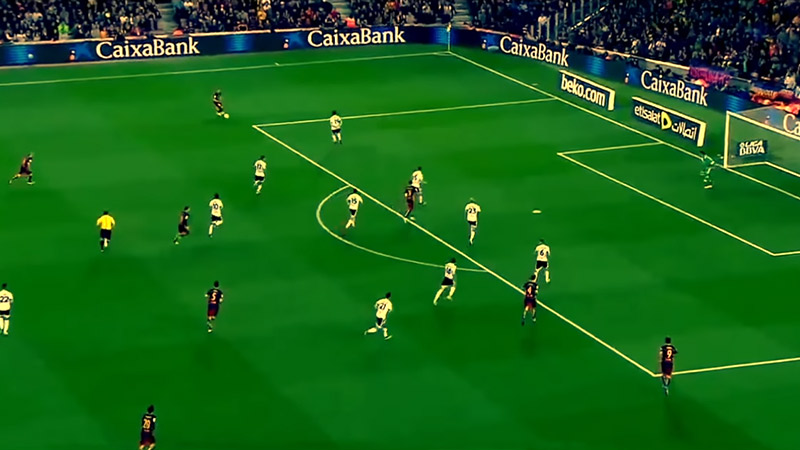
In the complex architecture of modern soccer, few tactical maneuvers are as effective or as visually striking as the switch.
Often referred to as “switching the play,” this movement serves as the ultimate tool for elite teams to dismantle organized defensive blocks and find a path to the goal.
While it may appear as a simple long pass to the casual observer, the switch is a sophisticated strategic operation that requires vision, technical precision, and a deep understanding of spatial dynamics.
The Tactical Architecture of the Soccer Switch
At its most fundamental level, a switch is a tactical move where a team rapidly transitions the ball from one side of the pitch to the other. This isn’t merely about changing the direction of play; it is a calculated effort to reconfigure the geometry of the game.
In a typical match, the defending team operates on a principle of compactness. As the attacking team moves down one flank—for example, the right wing—the defensive unit naturally shifts toward that side to minimize space and create a “crowding” effect.
By doing so, they aim to trap the ball in a congested area where the likelihood of a turnover is high.
The switch serves as the antidote to this congestion. By identifying that the defense has over-committed to one side, the attacking team utilizes a switch to bypass the defensive wall and find teammates in the vacant space on the opposite wing.
This forces the defenders to sprint across the width of the field to reorganize, often leading to defensive lapses, individual errors, and the opening of passing lanes that did not previously exist.
The Strategic Logic: Why Teams Must Switch the Play
The logic behind the switch is rooted in the concept of exploiting open space. In high-level soccer, space is the most valuable currency.
When a team successfully switches the play, they are essentially “buying” time and space for their creative players on the “weak side” (the side furthest from the ball).
1. Stretching the Defensive Line
When a ball is switched effectively, the defending backline is forced to stretch horizontally. Because defenders cannot travel as fast as a well-struck pass, the attacking winger on the opposite side often receives the ball in a “1v1” situation.
This is a primary objective for coaches who want their most skillful dribblers to face isolated defenders rather than a double-team.
2. Creating New Attacking Channels
By moving the point of attack, the offense creates fresh angles for penetration. A defense that was perfectly set to block a cross from the right is suddenly scrambling to adjust to a ball coming from the left.
This moment of transition—the seconds it takes for the defense to shift—is when most goals are scored.
3. Fatigue and Psychological Pressure
While not explicitly detailed in your provided text, it is a common professional insight that constant switching of the play has a cumulative effect on a defense’s physical and mental stamina.
Forcing a backline to shuttle back and forth across 70 yards of turf eventually leads to physical exhaustion, which in turn leads to the mental fatigue that causes missed headers or late tackles.
Technical Execution: Methods of Implementation
The effectiveness of a switch is entirely dependent on the speed and accuracy of the delivery. If the ball moves too slowly, the defense has time to shift and maintain their shape, rendering the move useless. According to the tactical dynamics of the game, there are two primary ways to execute this:
- The Long Diagonal Ball: This is the most direct method. Often executed by a deep-lying playmaker or a center-back with exceptional range, this involves a single, lofted pass that travels 40 to 60 yards through the air. The goal is to drop the ball precisely at the feet of a winger or overlapping fullback on the far side.
- The Rapid Build-Up: A switch can also be achieved through a quick series of short, sharp passes. This often involves playing the ball from the wing into a central “pivot” player (usually a defensive midfielder) who immediately relays it to the opposite side. This method is often more controlled and keeps the ball on the ground, making it easier for the receiver to transition into an immediate attack.
The Secondary Meanings of “The Switch”
In the broader lexicon of soccer, the term “switch” is not limited to the movement of the ball. It also encompasses critical player movements and match logistics.
Tactical Position Interchanging
Beyond passing, a “switch” can refer to tactical rotation. This occurs when two offensive players—most commonly a winger and a striker—run diagonally past one another to trade positions on the field.
This movement is designed to confuse defenders, particularly those playing in a “man-marking” system.
When players switch positions dynamically, defenders must decide whether to follow their original mark (which drags them out of position) or pass the mark off to a teammate (which requires perfect communication).
Any hesitation during this player switch creates an opening for a through-ball or a clear shot on goal.
Halftime Side Transitions
Finally, the most literal use of the term occurs at the end of the first 45 minutes of play. Teams “switch” sides of the pitch at halftime.
While this might seem like a mere formality, it is a crucial rule rooted in environmental fairness.
Factors such as the direction of the wind or the glare of the sun can provide a significant advantage to one side of the field; switching ends ensures that neither team is unfairly disadvantaged for the duration of the entire match.
Positional Responsibilities in the Switch
To execute a world-class switch, specific roles on the pitch must be synchronized. While the following insights draw upon broader football expertise not contained in your provided texts.
- The Architect (The Passer): Usually a center-back or a “number 6,” this player must possess the vision to see the far-side space before it is even fully vacated. They must have the technical ability to strike a “driven” ball that cuts through the air quickly.
- The Outlet (The Receiver): This is usually a winger or an attacking fullback. Their job is to stay “wide and high,” hugging the touchline to provide the maximum possible width. This forces the opposing fullback to stay wide, creating gaps between the defenders.
- The Pivot: Often the most underrated part of the switch, the central midfielder must be constantly available to receive the ball and “turn” play. If the long diagonal is blocked, the pivot is the engine that facilitates the switch through short passing.
Coaching Applications: How to Train the Switch
For those looking to implement these strategies on the training ground, the focus must be on spatial awareness and technical consistency.
- Possession Drills with Width: Coaches often use “rondo” drills with “jokers” stationed on the wings. The objective is for the central players to keep possession until the defense is sucked into one side, then quickly find the wide player to score a point.
- Vision Training: Players should be taught to “scan” the field before receiving the ball. Knowing where the space is before the ball arrives is the difference between a successful switch and a turnover.
- Accuracy Under Pressure: Developing the ability to hit a 50-yard diagonal ball while an opponent is closing you down is a hallmark of elite-level play.
FAQ: Mastering Soccer Switch Terminology
What is the difference between a “switch” and a “cross”?
A switch is a lateral move designed to change the side of the attack, usually occurring in the middle or defensive thirds of the field. A cross is a specific type of pass aimed into the opponent’s penalty area to create an immediate scoring chance.
Why do commentators call it “Switching the Point of Attack”?
This phrase emphasizes the strategic intent behind the move. By “switching the point,” the team is essentially declaring that the current path to the goal is blocked and they are establishing a new “front” elsewhere on the field.
Does a switch have to be a long ball?
No. While long diagonal balls are common, a switch can be executed through three or four very fast, short passes that move the ball across the central axis of the pitch.
Why do teams switch sides at halftime?
It is primarily for fairness regarding the sun and wind. If one team had the wind at their back or the sun out of their eyes for the whole game, it would be an unfair competitive advantage.
Conclusion: The Impact of the Switch on Modern Play
The soccer switch is far more than a technical skill; it is a manifestation of tactical intelligence. Whether it is a quarterback-style diagonal ball that lands perfectly on a winger’s foot or two strikers trading positions to baffle a center-back, the switch is about one thing: control.
By mastering the switch, a team takes control of the pitch’s dimensions. They decide where the game is played, who is isolated, and when the defense is allowed to rest. In a sport often decided by the finest of margins, the ability to rapidly shift the point of attack is what separates great teams from the elite.
For players and coaches alike, the switch remains one of the most powerful tools for turning a stalemate into a breakthrough.