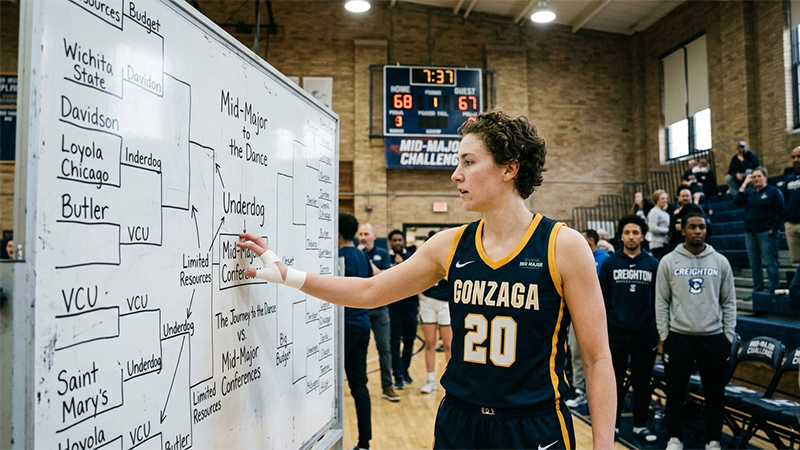
The term “mid-major” is one of the most widely used, yet frequently misunderstood, descriptors in American college sports.
While it serves as a convenient shorthand for fans, media, and analysts, the definition of what constitutes a mid-major program is a moving target, shifting depending on the sport, the era, and even the financial resources of the school in question.
The Origins and Official Status of the Term
Despite its ubiquity in sports broadcasting, the term “mid-major” has no official standing. The NCAA neither acknowledges nor uses the terms “major” or “mid-major” to differentiate between its Division I athletic conferences.
Instead, the term was born out of the coaching ranks. It was coined in 1977 by Jack Kvancz, who was then the head men’s basketball coach at the Catholic University of America.
Since its inception, the label has been a source of contention. Some athletic departments and fanbases embrace the “mid-major” identity as a badge of “underdog” honor, while others find the term offensive and derogatory, viewing it as a way to permanently relegate successful programs to a lower tier regardless of their on-court performance.
The Basketball Definition: High-Majors vs. The Rest
In the world of college basketball, the term is most strictly defined by conference affiliation. Generally, a “high-major” or “power” conference includes the Atlantic Coast Conference (ACC), Big 12, Big Ten, and the Southeastern Conference (SEC).
Crucially, the Big East Conference is also universally considered a power conference in basketball, even though it does not sponsor FBS football.
Basketball “mid-majors” typically belong to one of the approximately 24 to 25 other conferences. However, analysts often further subdivide these into two categories:
- Mid-Majors: Conferences like the Atlantic 10 (A-10) or the Mountain West (MW) that consistently produce quality teams, often receive multiple “at-large” bids to the NCAA Tournament, and have high attendance.
- Low-Majors: Conferences that typically only receive a single automatic bid for their conference tournament winner and rarely garner significant television revenue or national media attention.
The “Gonzaga Exception”
The most prominent challenge to the mid-major label is Gonzaga University. While Gonzaga competes in the West Coast Conference (WCC)—traditionally a mid-major league—the program has achieved such sustained success that many major media outlets, including ESPN and CBS Sports, no longer consider them a mid-major.
Analysts argue that because Gonzaga recruits at a high level and consistently earns top tournament seeds, they are a “power program” regardless of their conference affiliation.
The Football Divide: Group of Six vs. Power Four
In college football, the terminology shifts away from “mid-major” toward a structure defined by the College Football Playoff (CFP) and the former Bowl Championship Series (BCS).
The demarcation line is much clearer in football because of guaranteed access to high-revenue bowl games.
Today, the landscape is divided between the “Power Four” (ACC, Big 12, Big Ten, SEC) and the “Group of Six” (G6). The Group of Six includes:
- The American Athletic Conference (AAC)
- Conference USA (CUSA)
- The Mid-American Conference (MAC)
- The Mountain West Conference (MW)
- The Sun Belt Conference (SBC)
- The Pac-12 Conference (which was relegated to G6 status following the 2024 departure of most of its members).
Historically, only one team from a non-power conference has won a modern national championship: BYU in 1984, then a member of the WAC. In the CFP era, Cincinnati (2021) became the first and only G6 team to make the four-team playoff field.
Under the new 12-team playoff format established in 2024, at least one berth is guaranteed to the highest-ranked G6 conference champion.
The Swimming Model: A Financial Definition
Interestingly, the sport of swimming offers a more objective, data-driven definition of “mid-major.” Since 2002, CollegeSwimming.com has ranked programs based on a financial model. In this context, a mid-major program is defined as one that:
- Is not a member of a “Power Five” or major football-playing conference.
- Provides fewer than one-half of the allowable scholarships under NCAA rules.
This highlights a key difference between “head-count” sports like basketball (where every scholarship is a full ride) and “equivalency” sports like swimming, where scholarships can be divided among multiple athletes.
The “Glass Ceiling”: Issues Facing Mid-Major Programs
Mid-major programs face systemic hurdles that make it difficult to compete with power-conference giants.
1. The Scheduling Trap
Major conference teams are often reluctant to schedule high-quality mid-majors, especially on the mid-major’s home court.
For a “power” school, losing to a mid-major is a significant blow to their rankings, while winning provides little media exposure or “quality win” credit.
Consequently, power schools often “buy” games against lower-ranked mid-majors to pad their records while ignoring requests from elite mid-major programs.
2. Strength of Schedule (SOS) and Seeding
Because mid-majors struggle to schedule “major” opponents, their Strength of Schedule (SOS) often suffers. The NCAA Tournament Selection Committee heavily weights SOS and metrics like the NET or RPI.
This often results in mid-majors with excellent records being passed over for “at-large” bids in favor of power-conference teams with mediocre records.
Furthermore, mid-majors that do qualify are often given lower seeds, forcing them to play top-ranked teams in the first round.
3. Resource Disparities
There is a massive financial gap in athletic spending. Mid-major programs often have significantly less to spend on recruiting, marketing, and coaching salaries.
One analysis defines mid-majors as programs where the average spending on men’s basketball is less than $2 million, compared to the tens of millions spent by major programs.
The Path to the Top: Realignment and Success
Despite these barriers, many mid-majors have “crashed the party.” In basketball, George Mason (2006), Butler (2010, 2011), and VCU (2011) all made historic Final Four runs that proved mid-majors could compete at the highest level.
Success, however, often leads to conference realignment. When a mid-major program becomes too successful, it is frequently “poached” by a power conference:
- Utah moved from the MW to the Pac-12 (now Big 12).
- TCU moved from the MW to the Big 12.
- Cincinnati, Houston, and UCF moved from the American to the Big 12 in 2023.
- Butler and Creighton joined the reconfigured Big East in 2013.
Conclusion: A Label in Flux
The term “mid-major” remains a “convenient shorthand,” but it is increasingly inadequate to describe the complexities of modern college sports.
As programs like Gonzaga prove they can act as “majors” while in “minor” conferences, and as realignment continues to shift the goalposts, the line between “major” and “mid” continues to blur.
Whether viewed as a derogatory label or a badge of underdog pride, the mid-major remains the heartbeat of the “Cinderella” stories that define the spirit of college athletics.