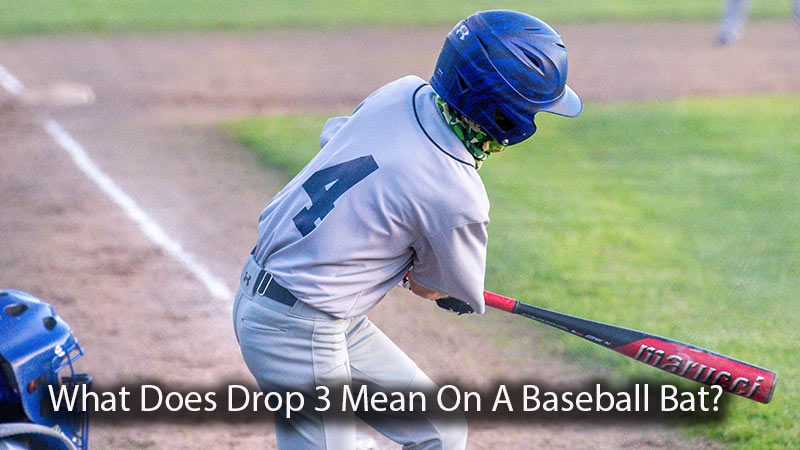
Moving to a drop 3 baseball bat is a big step for any young player. It often marks the move from youth bats to the heavier bats used at higher levels of play. Drop 3 bats are common in high school, college, and adult baseball.
The right bat can make a big difference at the plate. A bat that is too heavy may slow the swing and make it hard to control the barrel. It can also hurt good swing form.
For this reason, players should move up in bat weight over time. A slow and steady change can help keep good bat speed and control. It may also help a hitter drive the ball harder as the level of play goes up.
Demystifying Bat Drop: The Math Behind Bat Weight
The Simple Bat Drop Formula
Bat drop tells you how light or heavy a bat is for its length. It is easy to find.
Subtract the bat’s weight in ounces from its length in inches:
Bat Length − Bat Weight = Bat Drop
The drop is shown as a minus number, such as -3, -5, -8, or -10.
Here are a few examples:
- 33-inch bat, 30 ounces: 33 − 30 = 3, so it is a drop 3 (-3) bat.
- 32-inch bat, 29 ounces: 32 − 29 = 3, so it is also a drop 3 (-3) bat.
- 30-inch bat, 20 ounces: 30 − 20 = 10, so it is a drop 10 (-10) bat.
What the Drop Number Means
The drop number can seem a bit odd at first. A bigger drop means a lighter bat.
Bats with a -13, -11, or -10 drop are light for their length. Young players often use these bats. The lower weight can make the bat easier to swing. It can also help a young hitter keep good bat speed and control.
Bats with a -5 or -3 drop are much heavier for their length. A drop 3 bat has only a small gap between its length and weight. This makes it one of the heavier types of non-wood bats.
For example, a 33-inch drop 3 bat weighs 30 ounces. A 30-inch drop 10 bat weighs 20 ounces.
That means the drop 3 bat weighs 10 ounces more.
The extra weight can help the bat carry more force into the ball. But the hitter must be strong enough to swing the bat fast and stay in control.
BBCOR Rules and Drop 3 Bat Standards
What Is BBCOR Certification?
Most metal and composite drop 3 bats used in high school and college must have a BBCOR stamp. BBCOR means Batted Ball Coefficient of Restitution.
BBCOR rules help control how fast the ball comes off the bat.
Older metal and composite bats could give the ball a strong bounce off the barrel. This is often called the trampoline effect. It could send the ball off the bat at very high speeds.
BBCOR rules limit this effect. The goal is to make metal and composite bats perform more like wood bats.
BBCOR bats used in these leagues are also drop 3. This means the bat’s weight is three ounces less than its length in inches. For example, a 33-inch drop 3 bat weighs 30 ounces.
These rules help make sure that hitting power comes from the player. Strength, timing, and a good swing still matter most.
| League Level | Common Bat Rule |
|---|---|
| NFHS High School | Drop 3 BBCOR |
| NCAA / NAIA College | Drop 3 BBCOR |
| Adult Amateur / Semi-Pro | BBCOR or wood, based on league rules |
| 14U Travel / Middle School | Rules may require BBCOR or allow other bat types |
| 13U Travel Ball | Rules vary by league and event |
The “USA Drop 3” Question
Some buyers search for a USA drop 3 bat. Yet these bats are hard to find. USA Baseball bats are mainly made for younger players. Common drops include -11, -10, -8, and -5.
Young players often need a lighter bat. A lighter bat can be easier to swing and control. Older players may move to a drop 3 bat as they grow. At that point, many also move into leagues that use BBCOR rules.
For this reason, most non-wood drop 3 bats on the market use the BBCOR standard instead of the USA Baseball standard.
Why Do BBCOR Bats Cost More?
BBCOR bats can cost more than youth bats. A youth bat may cost about $249, while a BBCOR model from the same brand line may cost $399 or more.
There are several reasons for this price gap.
1. Fewer Players Buy BBCOR Bats
Many young children play baseball. This creates a large market for youth bats. As players get older, fewer stay in the sport. The number of players may fall as the game gets harder and field sizes grow.
This means brands may sell fewer BBCOR bats than youth bats. Lower sales volume can raise the cost of each bat.
2. BBCOR Bats Must Handle More Force
Older players can swing harder. They also face much faster pitches. A BBCOR bat must handle this force over many hits. The barrel needs to stay strong and keep its shape.
Brands may use strong alloys, layered barrel designs, tough resins, and firm end caps. These parts help the bat last through hard use. The extra design work and materials can add to the final price.
The Career Pathway: Moving Up the Bat Drop Ladder
Step-by-Step Bat Drop Progression
Moving to a drop 3 bat takes time. Players should not make the change all at once. A bat that is too heavy can slow the swing and hurt good form.
A slow change in bat weight can make the move much easier.
- Ages 5–7 (Tee Ball and Coach Pitch) | Drop -13 to -11: These light bats are easy to swing. Young players can work on hand-eye skill and learn a smooth swing.
- Ages 8–11 (Rec League and Little League) | Drop -10: Drop 10 is common for young players. It is light and easy to control. It also helps players learn to hit with more force.
- Ages 10–12 (11U–12U Travel Ball) | Drop -8: A drop 8 bat adds more weight. This can help build strength in the hands, arms, and body. It also helps prepare players for heavier bats.
- Ages 12–14 (13U–14U) | Drop -5: A drop 5 bat is a key step. It helps close the gap between a drop 8 and a drop 3. For example, a 31-inch drop 5 bat weighs 26 ounces.
- Ages 14+ (High School and College) | Drop -3 BBCOR: Players at this level move to the heavier drop 3 BBCOR bat where league rules require it.
BAT DROP PATH

[ Drop -13 / -11 ] → [ Drop -10 ] → [ Drop -8 ] → [ Drop -5 ] → [ Drop -3 BBCOR ]

   Tee Ball / Youth      Rec / 10U      11U–12U      13U Bridge      High School / College
Avoid the High School Bat Weight Trap
One common mistake is using a light drop 10 bat for too long. Some players still use one during 13U ball.
A light bat is easy to swing fast. It may also work well on small youth fields. But it can make the move to a drop 3 much harder.
At age 14, some players may need to use a much heavier bat. This big jump can cause several problems.
- Bat Drag: The barrel may fall below the hands. This can make the swing long and slow.
- Late Contact: A heavier bat takes more strength to move fast. The hitter may be late on fast pitches. This can lead to weak hits or pop-ups.
- Poor Swing Form: A player may try to force the bat through the zone. The arms may cast out. The front shoulder may open too soon. The back side may also lose its form.
A slow move to heavier bats can help. A player may move to a drop 8 around 11U and a drop 5 around 13U. During 14U practice, the player can also start to train with a drop 3 wood or BBCOR bat.
This step-by-step path gives the body time to adjust. It can help the player keep good bat speed, control, and swing form.
Physical Readiness & Fitting: Testing Field Capability
Age guidelines offer a useful starting point, but an athlete’s physical strength and swing mechanics dictate whether they can manage a drop 3 bat effectively.
Simple Field Tests for Proper Fit
1. The 30-Second Hold Test
Ask the player to hold the bat with their main hitting hand. Have them hold one arm straight out to the side. Keep the arm level with the ground.
- Pass: The player can hold the bat still for 30 seconds. The bat should not shake or drop. The shoulder should stay level. If they can do this, the bat may be a good weight for them.
- Fail: The bat starts to drop after 15 to 20 seconds. This may mean the bat is too heavy. A heavy bat can slow the swing and make it harder to control.
                 30-SECOND HOLD TEST

                    o  /  (Hold straight out parallel to floor)
                   /|/
                  / |
                   / \
       [========================>]  (Must stay level 30 secs)
2. The Hip & Chest-to-Fingertip Length Tests
Check the bat length before you pick the right weight.
- Hip Test: Stand the bat up next to the player’s leg. The knob should reach the middle of the hip. If it goes past the waist, the bat may be too long.
- Chest Test: Put the knob at the center of the player’s chest. Point the bat out to the side. Have the player reach one arm toward the bat. Their fingertips should reach the end of the bat with ease.
Warning Signs: Bat Speed vs. Weight
Bat speed and control are more important than bat weight. A heavy bat will not help if it slows the swing.
Watch the player during batting practice. These signs may mean a drop 3 bat is too heavy:
- Hands Move Out: The hands move far from the body during the swing. They should stay close to the body.
- Back Shoulder Drops: The back shoulder dips too much. This can make the bat swing too far up.
- Weak Ground Balls: The player is late with the bat. This can lead to soft ground balls to the pull side.
- Poor Balance: The player loses balance after the swing. They may even step or fall out of the batter’s box.
Equipment Selection: Choosing the Right Drop 3 Bat
Once a player is ready for a drop 3 BBCOR bat, it is time to pick the right one. Focus on the bat’s material, balance, and feel.
Bat Materials: Alloy, Composite, and Hybrid
| Bat Type | Main Benefit | Best For |
|---|---|---|
| 1-Piece Alloy | Firm feel and quick feedback. Ready to use right away. | Strong hitters who like a stiff bat. |
| 2-Piece Composite | Helps cut down hand sting and shock. Has a softer feel. | Contact hitters and players who want more comfort. |
| Hybrid | Mixes an alloy barrel with a composite handle. Helps reduce hand sting. | Players who want a firm barrel with a softer feel in the hands. |
BBCOR rules limit how much bounce a bat can have. So, the best bat is not just the one with the most pop. A player should choose a bat that feels right and fits their swing.
Balanced vs. End-Loaded Bats
Two drop 3 bats can have the same weight but feel very different when swung. This is due to where the weight sits in the bat.
- Balanced BBCOR Bats: The weight is spread more evenly across the bat. This makes the bat feel light and easy to swing. Balanced bats are a good choice for players moving from a drop 5 to a drop 3. They also work well for contact hitters who want good bat speed and control.
- End-Loaded BBCOR Bats: More weight sits near the end of the barrel. This gives the bat a heavier feel during the swing. It can add more force at contact. These bats are best for strong power hitters who can control the extra barrel weight without hurting their swing.
Conclusion
Moving to a drop 3 bat is a big step for a young player. It helps prepare hitters for high school, college, and adult play. A drop 3 bat is heavier than most youth bats. So, a player needs good strength, bat speed, and swing control.
Do not rush the move to a drop 3 bat. A player can first use a drop 8 bat and then move to a drop 5. This slow change helps build strength and keeps the swing smooth.
Simple hold tests can also show if a player is ready. Bat control should always come before added weight. With time and steady practice, a hitter can make the move to a drop 3 bat with ease.