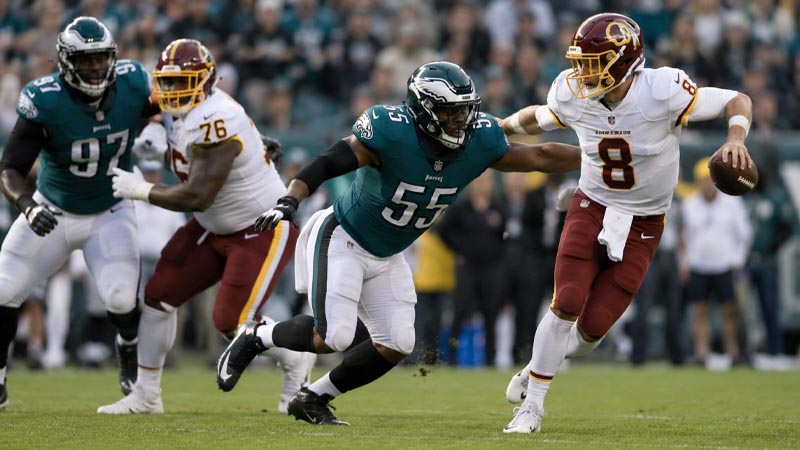
The modern game of football is won and lost in the trenches. While quarterbacks and skill-position players often capture the public’s attention, football experts understand that the structural integrity of any elite defense rests upon the defensive line.
At the outer limits of this line stands the defensive end—a position requiring a rare, near-impossible combination of massive physical size, explosive speed, peripheral vision, and relentless competitive drive.
A premier defensive end does not merely react to the offensive play; they actively dictate its boundaries.
By balancing the aggressive pursuit of the quarterback with the disciplined containment of the running game, these athletes serve as the primary anchors of defensive game plans.
To truly understand the mechanics of elite defensive play, one must analyze the specific responsibilities, schematic alignments, and physiological traits that define the position.
The Dual Responsibilities: Passing Downs vs. Running Downs
The core responsibility of the defensive end is split into two distinct operational phases: rushing the passer and defending the run.
While casual viewers focus primarily on sack statistics, a defensive end’s overall effectiveness is measured by their ability to execute both roles with equal discipline.
| Operational Phase | Tactical Objective | Core Defensive End Mechanics |
|---|---|---|
| Rushing the Passer | Disrupt the passing pocket and pressure the quarterback | Speed rush, power moves, hand-to-hand combat, pocket collapse |
| Defending the Run | Prevent perimeter runs and choke inside rushing lanes | Setting the edge, gap containment, lateral shifting |
| Containment | Keep the ball carrier from escaping outside | Maintaining outside leverage, disciplined pursuit angles |
| Play Recognition | Identify run, pass, screen, or play-action quickly | Reading offensive tackle behavior, keys, and backfield movement |
| Pass Coverage | Support coverage responsibilities when required | Flat drops, zone awareness, reading the quarterback |
| Tackling | Stop ball carriers efficiently and limit yards after contact | Proper leverage, wrap-up technique, pursuit, finishing |
| Stunt & Games | Create defensive-line movement and confusion | Twists, stunts, coordinated rush lanes, gap exchanges |
| Turnover Creation | Force mistakes and regain possession | Strip attempts, quarterback hits, fumble recovery awareness |
Rushing the Passer: Speed, Power, and Disruption
On passing plays, the defensive end’s primary mission is to breach the pocket and disrupt the quarterback’s rhythm. This is accomplished through several tactical pathways:
- The Pursuit of the Sack: The most visible measure of success, a sack halts offensive momentum and inflicts significant yardage losses.
- Forcing the Early Release: Even when a sack is not completed, consistent pressure forces quarterbacks to throw before their receivers can break open, leading to incomplete passes or interceptions.
- Blind-Side Pressure: Defensive coordinators strategically position their premier pass rushers on the weak side of the defensive line. Lined up opposite the quarterback’s blind side, these defenders can attack from an angle where the quarterback’s back is turned, making physical evasion exceptionally difficult.
Defending the Run: Setting the Edge and Gap Control
Against the run, the defensive end’s physical priorities shift from penetration to boundary control.
- Setting the Edge: The defensive end must hold the outer boundary of the play, preventing the ball carrier from bouncing the run outward toward the sideline. By maintaining this lateral wall, they protect the defense from giving up massive chunk plays on the perimeter.
- Forcing Plays Inside: Rather than overcommitting to a direct tackle, the end must position their body between the runner and the sideline. This lateral positioning channels the ball carrier back toward the interior of the field, where waiting linebackers and tackles can execute the stop.
- Gap Control: Ends must guard their designated gap within the defensive front, neutralizing pulling guards and tight ends to seal off escape lanes before the play can mature.
Schema Fits: The Defensive End in 4-3 vs. 3-4 Alignments
The specific duties of a defensive end are highly dependent on the defensive system implemented by the coaching staff.
The two most prominent defensive fronts in professional football—the 4-3 and the 3-4—utilize defensive ends in fundamentally different ways.
| System Characteristic | 4-3 Defensive Front | 3-4 Defensive Front |
|---|---|---|
| Primary Role | Direct pass rush & edge control | Block absorption & run stuffing |
| Average Physical Build | Lighter, faster, highly athletic | Heavier, longer, high strength |
| Typical Alignment | Outside the offensive tackles | Across from offensive tackles |
| Stance Variation | 3-point or 2-point stance | Heavy 3-point or 4-point stance |
The 4-3 Defensive Front: The Focal Point of the Pass Rush
In a 4-3 defense, there are four down linemen and three linebackers. This structure places the defensive line at the absolute center of the defensive game plan.
- Because there are two defensive tackles occupying the interior, the defensive ends are freed up to attack the outer shoulders of the offensive tackles.
- In this system, defensive ends are generally lighter and faster, relying heavily on a quick first step to bypass blockers.
- These ends regularly switch between a three-point stance (one hand on the ground) and a two-point stance (a standing crouch) to optimize their initial leverage and vision.
The 3-4 Defensive Front: The Unsung Wall
In a 3-4 defense, the front features three down linemen and four linebackers. The center of this line is occupied by a massive nose tackle, flanked by two defensive ends.
- Because there are only three down linemen, the defensive ends must play a much heavier, physical brand of football. They are tasked with taking on double teams from offensive tackles and guards to keep the linebackers behind them clean and free to run.
- Defensive ends in a 3-4 system are typically larger, often matching the physical profile of interior tackles in a 4-3.
- In this scheme, the direct pass-rushing burden is frequently transferred to outside linebackers who act as hybrid pass rushers, while the defensive ends focus on squeezing the pocket and clogging run lanes.
The Art of Outside Contain and Space Creation
To play defensive end at a professional level, a player must transition their mindset from that of an individual defender to that of a complementary team player.
An undisciplined defender who chases personal glory will quickly find their defense exploited by clever offensive play-callers.
The Philosophy of Boundary Control
The concept of “control” is paramount for any edge defender. When rushing the passer or defending the run, overcommitting to an inside angle can have catastrophic consequences. For example:
- On a designed run play, if the defensive end bites hard on an interior fake, they surrender the sideline. This allows the running back to bounce outside, turning a potential short gain into an explosive play.
- On passing downs, an out-of-control speed rush can create massive lanes for quarterback scrambles or leave the defense highly vulnerable to draw plays and screen passes.
Therefore, the defensive end must play with calculated restraint. By maintaining their lateral relationship with the sideline, they force the offense to play in a condensed, high-traffic environment.
The Unsung Impact of Backfield Penetration
Even when a defensive end does not register a tackle or a sack, their physical presence in the backfield can dictate the outcome of a play.
By penetrating the line of scrimmage, the end “gobbles up” blockers—often drawing double teams from the offensive tackle and a tight end or guard.
This displacement of offensive blockers creates a clean pathway for linebackers to trigger downhill and make tackles at or behind the line of scrimmage.
A dominant defensive end is thus the ultimate facilitator, sacrificing their personal stat line to maximize the efficiency of the entire defensive unit.
Operational Preparation: Drills and Game Study
Developing into an elite edge defender is an active process that requires structured, daily practice. Aspiring defensive ends must focus their development on three key areas:
Physical Footwork Drills
Because footwork is the foundation of all defensive line play, ends must engage in drills designed to build lateral quickness and change of direction.
- Agility Ladder Work: Focuses on high-speed foot placement and maintaining a low, balanced center of gravity.
- Burst-and-Chop Drills: Teaches players to explode forward off the snap, quickly chop their feet to match a blocker’s counter-move, and then redirect instantly toward the ball carrier.
Technical Hand Drills
A defensive end’s hands are their primary weapons for neutralizing offensive blockers.
- The Karate Drill: A specialized practice routine where defensive linemen work on hand speed, focusing on slapping, swatting, and swimming past the extended arms of blockers.
- Wall Ball Work: An individual coordination drill designed to improve hand-eye reaction speed and grip strength, allowing ends to quickly secure blocks or bat down passing attempts at the line of scrimmage.
Tactical Film Study
Football intelligence is built in the classroom. Working closely with coaching staffs, defensive ends must break down game film to analyze their opponents’ design.
- By studying the stance, weight distribution, and hand placement of opposing offensive tackles, defensive ends can anticipate run or pass plays before the ball is even snapped.
- Analyzing individual blocker tendencies allows defensive ends to plan specific counter-moves (such as a spin, a bull rush, or a swim move) tailored to exploit a specific tackle’s physical limitations.
The Pantheon of Defensive End Greats
Throughout NFL history, several legendary players have set the standard for what it means to play the defensive end position. These athletes combined elite athleticism with a cerebral understanding of the game to completely dominate their respective eras:
- Reggie White: Known as “The Minister of Defense,” White used an unstoppable “hump move” and unparalleled physical power to dominate offensive lines.
- Deacon Jones: The man who coined the term “sack,” Jones revolutionized the position with his explosive speed off the ball and his signature head-slap move.
- Bruce Smith: The NFL’s all-time official sack leader, Smith combined elite technical precision with unmatched longevity.
- J.J. Watt: A multi-time Defensive Player of the Year who epitomized the modern hybrid end, dominating both as a pass rusher and a run stopper with sheer physical intensity.
- Julius Peppers: A freakish athlete who combined basketball-like agility with elite size to play effectively in multiple defensive schemes.
- Michael Strahan: A master of setting the edge and a relentless pass rusher who set single-season sack records through flawless leverage and physical conditioning.
Summary: The Foundation of Championship Defenses
The ancient football maxim remains true: “defense wins championships,” and the most dominant defensive systems are anchored by stellar play upfront.
The defensive end is a cornerstone of this structure. By mastering the technical nuances of hand fighting, executing disciplined perimeter containment, and unleashing an explosive pass rush, these athletes completely disrupt offensive game plans.
Ultimately, a disciplined, elite defensive end remains one of the most valuable assets any franchise can acquire on their journey to a championship.