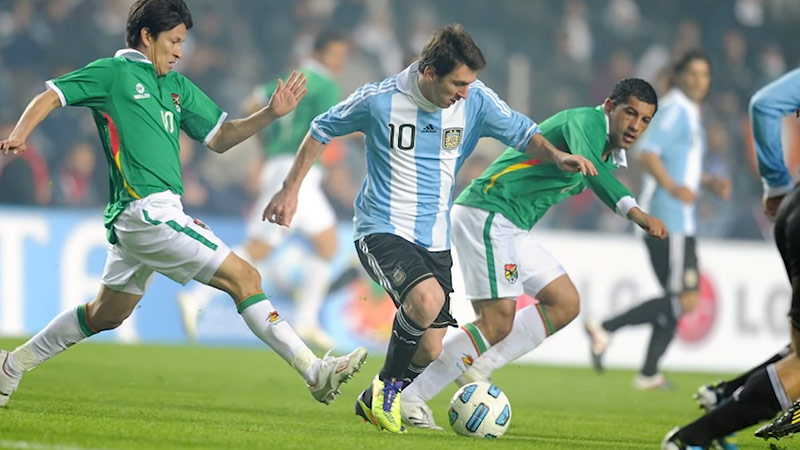
The image of Lionel Messi lifting the World Cup trophy in Qatar is one of the most iconic moments in sporting history.
To the casual observer, Messi appears as a supernatural talent, a player for whom football comes as naturally as breathing.
However, the path to the pinnacle of football was not paved with ease. Behind the dribbles and the Ballon d’Or awards lies a narrative defined by physical adversity, financial instability, and immense psychological pressure.
To truly understand the greatness of “La Pulga,” one must look beyond the pitch and examine the significant hurdles he had to clear to even step onto a professional field.
The Medical Crisis: Growth Hormone Deficiency (GHD)
The first and perhaps most daunting struggle Messi faced began long before he became a household name. At the age of 11, Messi was diagnosed with Growth Hormone Deficiency (GHD).
This condition meant that his body was not producing the necessary hormones to grow at a normal rate, leaving him significantly smaller than his peers.
The Daily Battle for Growth
For a young boy dreaming of a career in a physically demanding sport like football, this diagnosis was potentially career-ending.
Treatment was available, but it was grueling. Messi was required to undergo daily hormone injections to stimulate growth. This wasn’t a short-term fix; it was a persistent, painful necessity that he had to manage while trying to focus on his development as a player.
The Financial Barrier
Beyond the physical pain of the injections was the staggering cost. The treatment was priced at approximately $1,000 per month.
In the late 1990s in Argentina, this was a small fortune. His local club, Newell’s Old Boys, despite recognizing his talent, found itself unable to sustain the financial burden of his medical needs.
This left Messi’s future in a state of terrifying uncertainty, as his dream of playing professionally hinged entirely on his ability to afford medical care.
Skepticism and Physical Doubts: The “Small” Player Problem
Because of his height and slight frame, Messi faced a wall of skepticism from coaches and scouts. There was a prevailing fear among many in the football world that he simply could not handle the physical demands of professional football.
The primary concerns included:
- Injury Risk: Critics argued that his small stature made him more susceptible to being “bullied” or seriously injured by much larger defenders.
- Sustainability: Doubts lingered over whether a player of his size could maintain the stamina required for the elite European leagues.
Messi had to work twice as hard to prove that his low center of gravity and agility were assets that could counteract his lack of traditional “footballing” height.
The Emotional Sacrifice: Leaving Home at Thirteen
When FC Barcelona offered to pay for Messi’s GHD treatment, it was a lifeline, but it came with a heavy emotional price. At just 13 years old, Messi had to leave his home in Rosario, Argentina, to join the La Masia academy in Spain.
The Loneliness of La Masia
This transition was far from smooth. Moving across the world meant a total separation from his childhood friends and a significant portion of his family.
The young Messi suffered from intense homesickness, often feeling isolated and lonely in a foreign country.
This emotional hardship is a side of his story often overlooked—the young boy who cried in his room because he missed the streets of Rosario, even as he was becoming the star of Barcelona’s youth ranks.
The Weight of a Nation: Criticism with the Albiceleste
Perhaps the most public and prolonged struggle of Messi’s career was his relationship with the Argentina national team.
Despite his astronomical success at the club level with Barcelona, he spent years under the microscope of his home country’s fans and media.
The Comparison Trap
For a long time, Messi was unfairly compared to Diego Maradona. Because he hadn’t secured a major international trophy for Argentina early in his career, critics frequently accused him of not caring about the national team or of underperforming when wearing the blue and white stripes.
The Breaking Point
The pressure became so immense that Messi faced years of intense criticism. He was the face of Argentina’s near-misses, including several lost finals in the Copa America and the 2014 World Cup.
It was only through incredible resilience that he managed to push through this period of national vitriol to finally lead his country to victory in the 2021 Copa America and the 2022 World Cup.
The Mental Strain: The Battle from the Penalty Spot
Even a “god” of football has technical vulnerabilities that lead to mental stress. For Messi, penalty kicks have historically been a point of struggle.
While he is nearly flawless in open play, his conversion rate from the spot has occasionally dipped to around 60%.
In high-stakes matches where the margin for error is razor-thin, these misses caused significant mental strain.
The psychological burden of knowing that a single dead-ball situation could define his legacy—or cost his team a title—was a recurring internal battle he had to master throughout his career.
Conclusion: A Legacy of Defiance
Lionel Messi’s career is a testament to the fact that greatness is rarely a straight line. He struggled with a debilitating medical condition, survived the heartbreak of relocation, and endured decades of national pressure and skepticism regarding his physical limits.
His story is not just about goals and trophies; it is about a “Small Giant” who refused to let his circumstances define his ceiling.
By overcoming GHD and the emotional tolls of his youth, Messi proved that resilience is the most important skill in any athlete’s toolkit.