In the hyper-competitive world of modern athletics, elite performance is increasingly defined by marginal gains—the small, technical adjustments that optimize a player’s output.
Among these innovations, soccer grip socks have transitioned from a niche accessory to a foundational component of the professional kit.
These specialized garments are engineered to solve a fundamental flaw in traditional footwear: the lack of internal traction.
By creating a secure interface between the foot and the boot, grip socks ensure that every movement is deliberate, powerful, and safe. This guide examines the mechanics, benefits, and professional application of this essential performance technology.
The Technical Anatomy of High-Performance Grip Socks
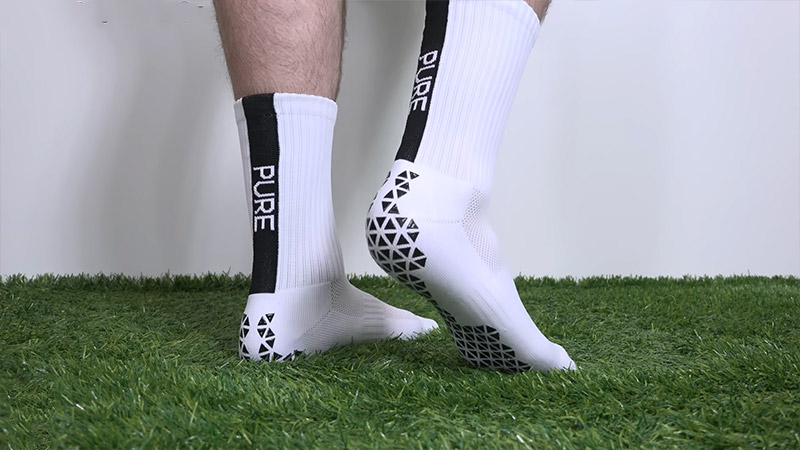
To understand the impact of this gear, one must first define what these garments are. Grip socks are specialized performance socks designed with rubberized or silicone pads on the soles to provide superior traction inside soccer cleats.
Unlike standard athletic socks, which often rely on simple cotton or synthetic blends that become slippery when exposed to moisture, grip socks utilize a high-friction material on the exterior of the sole to “lock” the foot in place.
Material Engineering and Friction Co-efficients
The core innovation lies in the placement and composition of the grip elements. Most manufacturers use medical-grade silicone or high-density rubber pads that maintain their tactile properties even under extreme pressure or in wet conditions.
These pads are strategically distributed across the heel, the arch, and the ball of the foot—the primary contact points used for sprinting and pivoting.
This design addresses the common issue of internal sliding, which is a major contributor to energy loss in traditional hosiery.
Compression and Moisture Management
Beyond the external grip, these socks are often built with advanced compression zones. These zones provide arch support and ensure the sock remains taut against the skin, further reducing the chance of the sock itself bunching up inside the boot.
High-quality variants also incorporate moisture-wicking fibers that move sweat away from the skin, ensuring the silicone pads maintain a dry, high-friction environment against the boot’s insole.
Biomechanical Advantages in High-Intensity Play
The primary objective of using grip socks is the enhancement of on-pitch performance through improved stability. When a soccer player engages in multi-directional movement, the foot naturally attempts to shift within the shoe.
Grip socks mitigate this by providing a “locked-in” feel that ensures the energy from the legs is transferred directly to the ground or the ball.
| Performance Metric | Impact of Standard Socks | Impact of Grip Socks |
|---|---|---|
| Power Transfer | Significant loss due to micro-movements | Optimized through direct energy transmission |
| Agility | Delayed response during sharp turns | Enhanced via immediate traction |
| Acceleration | Energy wasted on internal slippage | Explosive start with no internal sliding |
| Deceleration | Risk of foot sliding forward in the boot | Stable and controlled stopping power |
Optimizing Agility and Directional Change
In a sport where a fraction of a second determines whether a player beats a defender, agility is paramount. Grip socks allow for sharper turns and quicker acceleration by eliminating the lag time caused by the foot sliding within the cleat.
This immediate response is critical during high-speed dribbling or reactive defending. When the brain sends a signal to pivot, the foot remains anchored, allowing the athlete to execute the movement with maximum efficiency.
Energy Conservation and Power Output
A “locked-in” feel ensures that kinetic energy is not wasted on micro-movements inside the shoe. Over the course of a 90-minute match, these micro-slips accumulate, leading to increased fatigue and decreased explosive power.
By stabilizing the foot, grip socks allow the athlete to conserve energy for the final minutes of the game, maintaining a higher level of performance for longer durations.
Mitigating Injury Risks and Foot Trauma
The benefits of grip technology extend beyond performance into the realm of sports medicine and player longevity. Foot and ankle injuries are common in soccer, often exacerbated by footwear that does not provide adequate internal support.
Grip socks act as a preventative tool by stabilizing the foot’s position relative to the ground.
The Science of Blister Prevention
Most blisters in soccer are the direct result of friction caused by the foot sliding against the interior of the boot. When skin rubs repeatedly against a surface, heat and moisture lead to the separation of skin layers.
Because grip socks eliminate this movement, they are widely considered the most effective tool for blister prevention.
For a professional athlete, avoiding even minor skin irritation is vital to maintaining a consistent training and match schedule.
Ankle Stability and Ligament Protection
Greater stability helps prevent common soccer injuries like rolled ankles or strained ligaments. When a player makes an unexpected slip inside their boot—often referred to as “the foot giving way”—the ankle is placed under extreme lateral stress.
By securing the foot firmly within the cleat, grip socks provide an additional layer of proprioceptive feedback and structural stability, reducing the likelihood of non-contact injuries caused by internal instability.
Reducing Toenail Trauma and “Black Toe”
A frequent issue for strikers is “black toe,” caused by the foot sliding forward and hitting the front of the boot during sudden stops. This repetitive impact can lead to bruising under the nail.
Grip socks prevent the foot from sliding forward toward the toe box, protecting the distal part of the foot from unnecessary impact and trauma.
Tactical Compliance: The Professional Protocol
Despite their performance benefits, many professional and club-level players face a challenge: kit regulations. Official league rules typically require that players wear team-colored socks that match their uniforms.
Since many high-end grip socks are produced by independent brands, players have developed a specific “sock-cutting” protocol to integrate this technology while remaining compliant with match-day aesthetics.
The Step-By-Step Integration Process
The process of preparing for a match with grip socks involves several precise steps to ensure both performance and a professional look:
- Modification: The athlete cuts the foot portion off their official team-issue socks, essentially turning the remaining fabric into a leg sleeve.
- Base Layer: The player puts on the grip socks first, ensuring the traction pads are properly aligned with the pressure points of their feet.
- Over-Layering: The cut team-colored sleeves are pulled over the shins and layered over the top part of the grip socks.
- Securing the Joint: To create the appearance of a single, continuous sock, the joint at the ankle is secured with high-quality athletic tape, such as Mueller M-Tape.
Regulatory Aesthetics and Referee Approval
In elite competitions, referees are instructed to check that a player’s equipment is uniform. Using color-matched athletic tape is essential to ensure the transition between the grip sock and the sleeve is invisible to the casual observer.
This protocol has become so standard that it is now common to see professional players in the English Premier League or Champions League with taped ankles, signaling their use of specialized grip technology.
Financial and Performance ROI for Organizations
From a corporate and organizational perspective, the adoption of grip socks is a strategic decision rooted in risk management.
Professional clubs invest millions in player contracts; therefore, any tool that reduces the risk of injury or increases the probability of on-field success offers a significant Return on Investment (ROI).
Longevity and Player Availability
In a long season, player availability is the most critical factor for success. By preventing blisters and minor ligament strains, grip socks keep players on the pitch.
This availability translates to better team cohesion and more consistent results, directly impacting the club’s bottom line through prize money, broadcasting rights, and ticket sales.
Competitive Differentiation
At the highest levels of the game, every team has access to elite coaching and data analytics. Competitive differentiation is found in the physical preparation of the athletes.
Providing players with the best possible equipment—including grip technology—ensures that an organization is not leaving any potential performance gain on the table.
Future Trends in Soccer Footwear Technology
The rise of grip socks is likely just the beginning of a larger trend toward “modular footwear.” We are moving away from a world where a single shoe and a single sock are expected to do everything. Instead, we are seeing a shift toward specialized layers that work in harmony.
Smart Fabric Integration
The next generation of grip socks may include sensors designed to track foot pressure and gait analysis in real-time. This data could be wirelessly transmitted to coaching staffs, allowing for immediate adjustments in training loads or identifying potential injury risks before they manifest physically.
Customization and Biometric Mapping
We are approaching an era where grip socks could be 3D-knitted to match the exact contours of an individual player’s foot. By mapping the specific pressure points of a star athlete, manufacturers can place grip pads with millimeter precision, creating a truly bespoke performance interface.
Enhanced Frequently Asked Questions
Can I wear grip socks with any type of soccer cleat?
Yes. Grip socks are compatible with all types of footwear, including firm ground (FG), soft ground (SG), and turf shoes. Their function is independent of the boot’s external stud pattern, as they focus entirely on the internal friction between the foot and the insole.
Do grip socks require special care?
To preserve the silicone or rubber pads, it is recommended to wash them inside out in cold water. High-heat drying can cause the adhesive on the grip pads to degrade over time. Air drying is the preferred method for maintaining the longevity of the traction elements.
Is the “sock-cutting” technique allowed in amateur leagues?
Most local and amateur leagues follow FIFA guidelines regarding kit uniformity. As long as the tape used to secure the socks is the same color as the sock sleeve, it is generally permitted. However, it is always wise to check with league officials if you are playing in a strictly regulated tournament.
How many pairs does a player need?
For a serious player, a rotation of 3–5 pairs is ideal. This ensures that the grip pads are not overworked and that the player always has a fresh, high-friction pair ready for match days.
Conclusion: Elevating the Standard of Play
The transition to grip socks represents a maturation of soccer equipment philosophy. No longer is the sock viewed as a passive piece of fabric; it is now a dynamic performance tool that addresses the kinetic chain from the ground up. B
y providing superior traction, preventing injuries, and enabling efficient power transfer, grip socks have become a non-negotiable asset for the modern athlete.
For players at any level—from youth academies to the professional stage—the decision to adopt grip technology is an investment in their own potential.
As the game continues to get faster and more physically demanding, the stability provided by these specialized garments will remain a critical factor in achieving and sustaining elite performance.