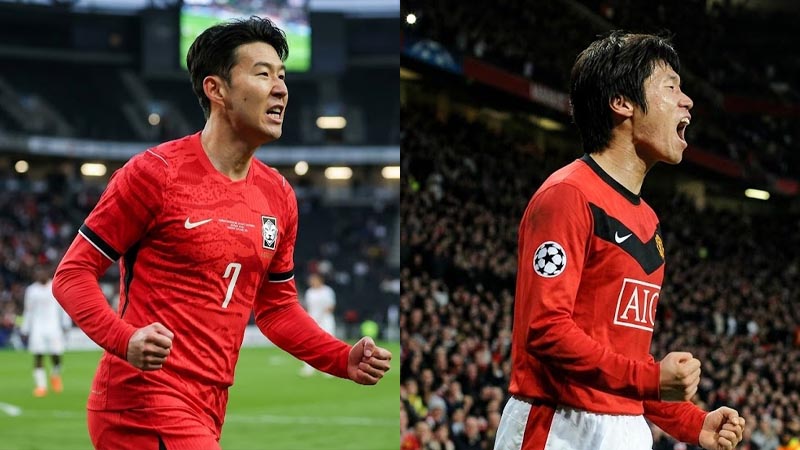
The debate regarding the greatest South Korean footballer of all time remains a polarizing topic among fans, centered on two legendary figures: Park Ji-sung and Son Heung-min.
This discussion transcends simple goal tallies, representing a shift in how Asian players are perceived in global football.
While Park pioneered the path as a selfless tactical engine for Manchester United, Son has evolved into a clinical, world-class scoring machine for Tottenham Hotspur.
Understanding their respective legacies requires an analysis of their tactical roles, individual accolades, and the distinct eras of the Premier League they each defined.
The Tactical Evolution of South Korean Stars
Comparing these two athletes often feels like comparing “apples and oranges” because their roles on the pitch were fundamentally different.
Park was a tactical utility player who thrived on defensive discipline and work rate, while Son is a prolific forward who carries the offensive burden of his team.
The Role of the Tactical Workhorse
Park Ji-sung was famously described as having “three lungs” due to his relentless stamina and energy. His primary function under Sir Alex Ferguson was often to neutralize the opposition’s most dangerous creative threats.
His football intelligence allowed him to execute complex defensive assignments, such as his legendary man-marking of Andrea Pirlo, which effectively shut down AC Milan’s offensive flow.
Unlike modern wingers who focus on goal output, Park was a “big-game engine” who provided the structural balance necessary for a star-studded Manchester United team to succeed.
The Emergence of the Elite Finisher
In contrast, Son Heung-min represents the modern archetype of an elite wide forward. He is recognized as one of the most clinical finishers in European football, possessing the rare ability to score with both feet with equal precision.
His impact is measured through his direct contribution to winning matches single-handedly, exemplified by his 71-yard solo run against Burnley that earned him the 2019 FIFA Puskás Award.
While Park was a vital piece of a larger machine, Son is often the engine itself, with some observers noting that his presence accounts for a staggering 80% of his team’s offensive threat.
Defining the “Three Lungs” Legacy: Park Ji-sung
Park Ji-sung’s career is defined by his reliability and his knack for performing when the stakes were highest. He was not a consistent starter against lower-tier teams but was Ferguson’s “go-to” player for high-stakes encounters against rivals like Arsenal, Chelsea, and Liverpool.
The Big-Game Specialist
Park’s reputation as a big-game player is backed by his involvement in three Champions League finals, winning one in 2008.
Sir Alex Ferguson later admitted that one of his greatest managerial regrets was not starting Park against Lionel Messi in the 2011 Champions League final, believing Park’s defensive tenacity could have altered the result.
This level of trust from one of history’s greatest managers highlights Park’s unique value; he was a player who sacrificed individual glory for the collective success of the squad.
Physical Dominance and Stamina
The physical profile of Park was centered on endurance rather than explosive pace. His ability to outwork opponents over 90 minutes made him an exhausting prospect for defenders.
Throughout his Premier League tenure, he maintained a high level of consistency, often delivering 7/10 or 8/10 performances regardless of the opposition.
This reliability made him an “unsung hero” among teammates and fans alike, even if his individual statistics did not always reflect his true influence on the game.
The Global Superbrand: Son Heung-min’s Individual Peak
Son Heung-min has achieved a level of individual global superstardom that no other Asian player has matched.
He is not just a representative of South Korean football; he is a premier face of the English Premier League and a consistent top-10 forward worldwide.
Historic Individual Achievements
Son’s resume is filled with historic firsts for Asian athletes. He was the first Asian player to win the Premier League Golden Boot (2021/22 season) and the first to reach the milestone of 100 Premier League goals.
His peak market value reached an incredible €90 million, reflecting his status as one of the most valuable assets in the sport.
Unlike Park, who was often a “super-sub” or a rotational player, Son has been a mainstay in the starting lineup for a decade, consistently ranking among the league’s top offensive producers.
Technical Proficiency and Versatility
One of Son’s greatest strengths is his versatility across the front line. While he primarily operates as a left winger, he is equally effective as a center-forward or a second striker.
His ability to outperform his “Expected Goals” (xG) metrics suggests a level of finishing talent that is statistically rare.
Fans and analysts often point to his pace and directness on the counter-attack as his most lethal weapons, making him a constant threat that defenders must account for at all times.
Direct Statistical Breakdown: Medals vs. Metrics
When comparing these two icons, a clear divide emerges: Park dominates in team silverware, while Son dominates in individual statistical output.
| Metric / Achievement | Son Heung-min | Park Ji-sung |
|---|---|---|
| Primary Position | Left Winger / Forward | Midfielder / Utility Winger |
| Premier League Goals | 127 Goals (333 games) | 19 Goals (154 games) |
| Premier League Assists | 77 Assists | 21 Assists |
| Major Club Trophies | 1 (Europa League mentioned) | 19 (including 4x EPL, 1x UCL) |
| Peak Market Value | €90.00m | €12.50m |
| International Goals | 56 Goals (145 caps) | 14 Goals (102 caps) |
| Individual Honors | EPL Golden Boot, Puskás Award | First Asian to play in a UCL Final |
This data illustrates why the “who is better” question is so difficult to answer. If “better” is defined by individual talent and clinical efficiency, Son is the clear winner.
However, if “better” is defined by career success and trophy cabinets, Park remains the gold standard for South Korean players.
The “Big Game” Factor and Tactical Discipline
A significant part of the debate centers on who you would want in your team for a single, must-win match. This is where Park Ji-sung’s supporters find their strongest arguments, citing his legendary discipline.
Neutralizing World-Class Talent
Park’s ability to “erase” an opponent from the game was his signature move. Managers valued his selflessness; he was willing to spend an entire match chasing a single player if it meant his team won.
This tactical discipline is a rare trait among modern stars, who often prioritize their own highlights. Park was comfortable being the “water carrier” for stars like Cristiano Ronaldo and Wayne Rooney, ensuring the team’s defensive integrity was never compromised.
Son’s Game-Changing Capability
Conversely, Son is the player you look to when you need a moment of magic to break a deadlock. He has the “clutch factor” in an offensive sense, scoring vital goals when his team is under pressure.
His ability to create something from nothing—a long-range strike or a solo run—makes him a different kind of big-game player. While Park prevented the other team from winning, Son actively wins the game for his side.
Cultural Impact: The Trailblazer and the Icon
The legacy of these two players is deeply intertwined with the identity of South Korean football. Park was the pioneer who proved that Korean players could not only play in the Premier League but thrive at the very highest level of the sport.
The National Hero: Park Ji-sung
Park is often viewed as the “original OG” of Korean football. His role in the legendary 2002 World Cup squad, which reached the semifinals, cemented his status as a national hero forever.
He captained the national team during a period of transition and served as a role model for the next generation, including Son Heung-min himself.
Park has famously stated that Son has surpassed him “by miles” in terms of talent, a testament to his humility and the respect between the two icons.
The Global Ambassador: Son Heung-min
Son has taken Park’s foundation and built a global empire upon it. He is a cultural phenomenon whose influence extends beyond the pitch, impacting fashion, commerce, and national pride.
In South Korea, his matches are must-watch events, and his success is a source of immense collective joy.
He has effectively bridged the gap between being a regional star and a global icon, proving that an Asian player can be the face of a major European club and a league-leading goal scorer.
The Final Verdict: Is There a Clear Winner?
The “Son vs. Park” debate ultimately boils down to what a fan values in a footballer. There is no objective right answer, only a preference for different types of excellence.
Son Heung-min is undoubtedly the better individual player. His technical skill, two-footedness, and scoring record place him in a tier of elite forwards that few in history have reached.
He is a world-class athlete who has consistently delivered individual brilliance at the highest level of competition.
Park Ji-sung is arguably the greater legacy player in terms of silverware and tactical impact. His trophy room, filled with Premier League titles and Champions League medals, is a feat that may never be replicated by another Asian player.
He was the ultimate “team player” whose value was often felt more than it was seen on a stat sheet.
Together, these two men represent the pinnacle of South Korean football history. Park provided the blueprint for success, and Son refined it into individual perfection.
Whether you prefer the “Three Lungs” of Park or the “Sonaldo” brilliance of Son, both have left an indelible mark on the beautiful game.
Enhanced FAQ: Navigating the Great Debate
Who has won more trophies, Son or Park?
Park Ji-sung has won significantly more team trophies, including 4 Premier League titles and a UEFA Champions League title with Manchester United.
Son Heung-min has historically struggled to secure team silverware at Tottenham, though his individual honors are far more extensive.
Who was more important to their respective teams?
This is subjective. Park was a vital tactical piece for a championship-winning Manchester United squad.
However, Son has been described as carrying 80% of Tottenham’s offensive threat, making him perhaps more “irreplaceable” in a structural sense for his specific club.
Did Park Ji-sung and Son Heung-min ever play together?
Yes, they shared the pitch for the South Korean national team. They played together in 4 matches, including during the AFC Asian Cup, where they combined for goals and assists as the old guard passed the torch to the new.
What did Sir Alex Ferguson say about Park Ji-sung?
Ferguson highly valued Park’s discipline and stamina, famously regretting not using him to mark Lionel Messi in the 2011 Champions League final. He viewed Park as one of the most reliable and selfless players he ever managed.
Who is considered more famous globally?
Currently, Son Heung-min has reached a higher level of global individual fame, evidenced by his massive social media following, commercial deals, and status as a top-10 world forward.
Park remains a legendary figure, particularly in Manchester and Korea, but Son’s brand is a global powerhouse.