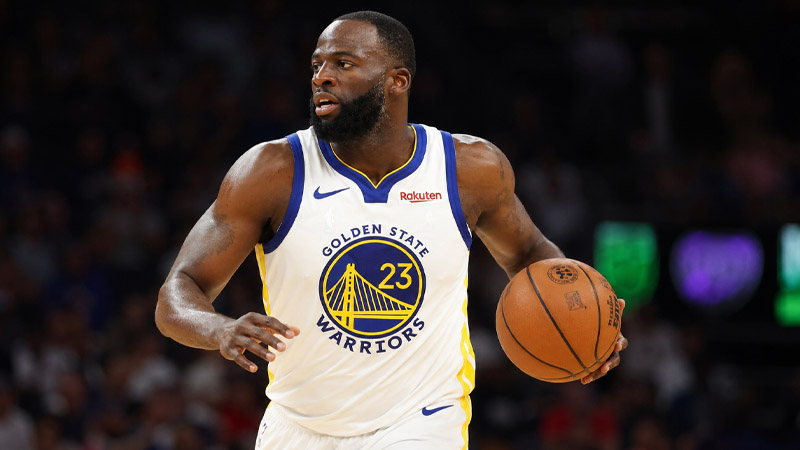
The Golden State Warriors stand at a definitive crossroads, balancing the weight of a four-ring legacy against the cold mechanics of a modern salary cap.
Draymond Green, the defensive engine of the greatest dynasty in modern basketball, now faces a future where his financial demands and his on-court production are under intense scrutiny.
As the Warriors navigate the twilight of the Stephen Curry era, the decision to offer Green a maximum extension is no longer just about rewarding loyalty.
It is a high-stakes chess move that will determine if this franchise can remain a title contender or if it will buckle under the pressure of the NBA’s restrictive new financial era.
The Economic Wall: Navigating the Second Luxury Tax Apron
The primary hurdle in any conversation regarding a maximum contract for Draymond Green is the current Collective Bargaining Agreement (CBA).
The NBA has introduced punitive measures for high-spending teams, specifically the “second luxury tax apron,” which significantly limits how a front office can build a roster.
The Heavy Cost of a Top-Heavy Roster
For the Warriors, the financial ledger is already strained. To understand the gravity of the situation, one must look at the guaranteed commitments already on the books for the 2026-27 season.
| Player | Projected Salary (2026-27) | Role |
|---|---|---|
| Stephen Curry | $62.5 Million | Franchise Cornerstone |
| Jimmy Butler | $56.8 Million | Primary Wing Scorer |
| Draymond Green (Option) | $27.68 Million | Defensive Anchor |
Offering Green a max extension would essentially lock the Warriors into a “permanent rebuild” once their core stars eventually decline.
A maximum deal, potentially worth over $130 million over four years, would strip the front office of trade exceptions and the ability to sign impact depth, leaving them with no avenues to improve a roster that is already aging.
In the 2022-23 season, the Warriors carried a league-high payroll of approximately $199 million, showing a willingness to spend, but the new rules make such spending “catastrophic” for future flexibility.
Analyzing the Performance Curve: Value vs. Statistics
When evaluating whether a player deserves a maximum contract, the first instinct is to look at the box score. For Draymond Green, this has always been a deceptive exercise, as his impact is felt in ways that traditional data often fails to capture.
The Paradox of the Draymond Green Stat Sheet
Draymond’s statistical output has seen a steady, if not dramatic, decline as he has moved into his mid-30s. During the 2025-26 season, he averaged 8.4 points, 5.5 rebounds, and 5.5 assists per game.
While these numbers are consistent with his career averages of 8.7 points and 5.4 assists, they do not traditionally scream “max player”. However, the Warriors’ system is built on his unique ability to act as a “point forward.”
His value is inextricably linked to Stephen Curry’s “gravity”. On any other team, Green’s lack of spacing and shooting—highlighted by a career 31.5% from beyond the arc—might be a liability.
In San Francisco, however, he remains an elite facilitator and a defensive mastermind who earned All-Defensive First Team honors as recently as age 35. The question for the front office is whether that defensive brilliance can be maintained as he enters his late 30s.
The Defensive Anchor’s Longevity
While Green remains one of the smartest defenders in basketball history, the physical toll of his high-intensity style is a concern. A four-year max extension would pay him premium money until he is 40 years old.
History suggests that undersized big men who rely on lateral quickness and explosive rotations see a sharp decline in their late 30s. For a team already paying top dollar to Curry and Butler, betting on Green’s health during his age-38 and age-39 seasons is a massive risk.
The “Warrior Way”: Lessons from Franchise History
The Warriors have a very specific methodology when it comes to veteran extensions. They rarely rush to the table, preferring to let the market and the player’s health dictate the terms of the next deal.
Patience as a Strategic Advantage
Historically, the Warriors wait until a veteran has only one year remaining on their contract before engaging in serious extension talks. This was the case with Stephen Curry, and the organization used that precedent to manage expectations with Klay Thompson.
By applying this same logic to Green, who is currently navigating the final years of his current deal, the Warriors gain the benefit of time.
There is little incentive for Golden State to offer a max deal now when Green’s market value outside of the Bay Area is questionable.
As analyst Nick Wright noted, very few teams have the specific coaching infrastructure, like Steve Kerr, or the specific offensive superstars, like Curry, to offset Green’s unique “personality” and offensive limitations. This lack of outside leverage should, in theory, allow the Warriors to negotiate from a position of strength.
The Volatility Factor: On-Court Discipline and Continuity
A critical component of any “max player” is their reliability. A maximum contract suggests that the player is a pillar of the organization, both in performance and in conduct. This is where the Draymond Green conversation becomes most polarized.
The High Risk of Unpredictability
Despite his brilliance, Green continues to be a high-risk asset due to his on-court volatility. In the 2025-26 season alone, he recorded 13 technical fouls and 2 ejections.
This followed a multi-year pattern of suspensions and disciplinary issues that have, at times, compromised the team’s continuity and chemistry.
When a team is operating under the “second apron,” every roster spot is precious. Having a maximum-salary player who is frequently unavailable due to league-mandated suspensions is a luxury the Warriors may no longer be able to afford.
The “outbursts” that were once seen as a necessary fire for a young championship team are now viewed by many as a liability for an aging roster that needs every available minute from its stars.
Potential Offseason Scenarios for 2026
If the Warriors decide—as many expect—that a max extension is off the table, what are the realistic paths forward for both the player and the franchise? The goal is to keep the “Core Three” together without destroying the team’s ability to compete.
The Opt-In and the Trade Chip
One likely scenario is that Green exercises his $27.68 million player option for the 2026-27 season. This would allow him to stay with the only franchise he has ever known while maintaining a high salary for at least one more year.
From the Warriors’ perspective, this creates an expiring contract that could be used as a “bulky trade chip” if they decide a radical roster shakeup is necessary.
The “Team-Friendly” Compromise
The most logical path for long-term stability is for Green to decline his option in favor of a longer, lower-salaried extension. A three-year deal in the range of $20 million per year would provide Green with security into his late 30s while significantly lowering the Warriors’ immediate luxury tax bill.
This “Decline & Extend” strategy is the ideal compromise, allowing the organization to honor Green’s legacy while maintaining enough cap space to sign the role players needed to support Curry and Butler.
Strategic FAQ: Understanding the Draymond Green Dilemma
Why is Draymond Green’s contract such a major issue for the Warriors?
The Warriors are facing extreme financial penalties under the new NBA CBA. With massive salaries already owed to Stephen Curry and Jimmy Butler, a max deal for Green would trigger “second apron” restrictions, preventing the team from making trades or signing mid-level players.
Does Draymond Green have leverage to demand a max contract from other teams?
Most analysts believe Green has very little leverage outside of Golden State. His specific skill set—elite defense combined with non-traditional playmaking—is perfectly suited for the Warriors but would “ruin the spacing” for almost any other team that doesn’t possess a shooter like Curry.
How has Draymond’s performance changed as he has aged?
While Green remains an All-Defensive level talent, his offensive scoring has dipped, and his disciplinary issues remain a concern. He averaged just 8.4 points in the 2025-26 season and continued a trend of frequent technical fouls and ejections.
What is the “Warrior Way” of handling extensions?
The Warriors typically wait until a player has only one year left on their contract before signing an extension. They used this approach with both Curry and Klay Thompson, and they are expected to do the same with Green to avoid over-committing to an aging asset.
Conclusion: Balancing the Legend with the Ledger
The Golden State Warriors owe much of their historical dominance to Draymond Green’s fire, intellect, and defensive versatility. However, the business of basketball in the “second apron” era does not allow for sentimental decision-making.
Giving Green a maximum contract at age 36 would be a catastrophic strategic error that would likely lock the franchise into a period of mediocrity once Stephen Curry retires.
The path forward must be one of pragmatic loyalty. By pursuing a restructured, lower annual rate or a shorter-term extension, the Warriors can ensure that Green retires in the Bay Area without sacrificing the team’s ability to build a competitive roster around him.
The goal is to keep the dynasty alive, but that can only happen if the price of loyalty is one the franchise can actually afford to pay.