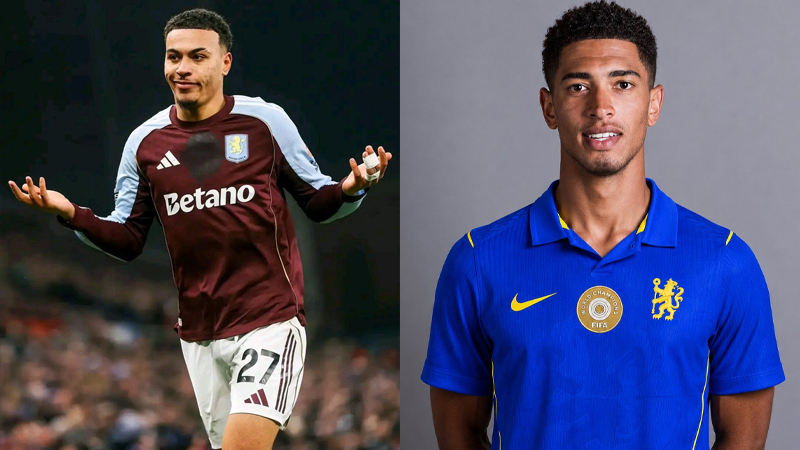
The appointment of Thomas Tuchel as England’s head coach has fundamentally altered the tactical landscape for the Three Lions, specifically concerning the central attacking role.
While Jude Bellingham has long been the undisputed focal point of England’s midfield, the emergence of Morgan Rogers at Aston Villa has created a legitimate selection dilemma.
Tuchel has explicitly stated that these two players are in direct competition for the “number ten” position, prioritizing functional “glue” over individual reputation.
This analysis explores the statistical nuances, tactical profiles, and career trajectories of both players to determine who best fits Tuchel’s vision.
The Tactical Evolution: From Star Power to Team Cohesion
Under previous regimes, England’s selection often felt like a collection of the most talented individuals rather than a cohesive unit.
Thomas Tuchel has signaled a departure from this approach, emphasizing that he is not simply “collecting” talent but building a team capable of winning major trophies.
This shift puts Jude Bellingham’s “untouchable” status under the microscope as Rogers offers a different, more disciplined profile.
Building the “Glue” in Midfield
Tuchel’s “radical statement” is that the best team at the World Cup will likely be the one with the most cohesion, not necessarily the most stars.
He seeks players who provide the “glue”—the tactical discipline to stick to a role and facilitate others like Harry Kane and Bukayo Saka.
Rogers has demonstrated an ability to “coast” through games, remaining positionally disciplined for long periods before delivering a decisive physical drive or final pass.
This contrasts with Bellingham, whose “main character” energy often leads him to roam across the pitch, potentially disrupting the team’s structural balance.
The Search for a “Vertical Enforcer”
In Tuchel’s system, the advanced playmaker must be more than just a creative outlet; they must be a “Vertical Enforcer.” This role requires a blend of goal threat, high-press discipline, and overwhelming physicality.
While Bellingham is world-class, Rogers’ 1.88m frame and ability to ride challenges with raw power make him a unique tactical weapon.
Tuchel is looking for a player who can execute a high press and provide influential goal-scoring threat while maintaining position—a set of boxes that Rogers currently ticks with surprising frequency.
2025–26 Season Statistical Breakdown
To understand why this has become a legitimate debate, one must look at the raw output from the current campaign. While Bellingham has dealt with injury recovery, Rogers has enjoyed a meteoric rise.
| Statistic (All Competitions) | Morgan Rogers (Aston Villa) | Jude Bellingham (Real Madrid) |
|---|---|---|
| Total Appearances | 55 | 41 |
| Goals | 14 | 9 |
| Assists | 11 | 5 |
| League Passing Accuracy | 79% | 91% |
| League Chances Created | 36 | 36 |
| Expected Threat (xT) | 642.87 | 526.78 |
| Interceptions (League) | 7 | 12 |
| Successful Tackles (League) | 25 | 32 |
| Defensive Stability Rating | -11.1 | 17.4 |
Jude Bellingham: The Prodigal Controller
Despite the rise of Rogers, Jude Bellingham remains a generational talent whose pedigree is nearly unmatched in world football.
His ability to perform for Real Madrid, winning a Champions League and La Liga double in his debut season, cements his status as a “world-beater.” However, a shoulder injury requiring an NFL-style brace and subsequent surgery has disrupted his 2025–26 rhythm.
Elite Efficiency and Ball Retention
Bellingham’s greatest asset in a Tuchel system is his composure. With a 91% passing accuracy and a 92.07% success rate on short passes, he provides a level of ball security that is vital for a team looking to dominate possession in high-pressure knockout games.
He takes fewer risks in the build-up phase compared to Rogers, who misplaced 93 passes into the final third this season. Bellingham’s ability to take care of the ball ensures that England remains stable and less susceptible to counter-attacks.
Defensive Dominance and Positional Versatility
One of the most overlooked aspects of Bellingham’s game is his defensive contribution. He registers more tackles (32) and interceptions (12) than Rogers, maintaining a defensive stability rating of 17.4.
This makes him essentially a “defensive midfielder” in an attacking role, capable of winning duels and regaining possession high up the pitch.
Tuchel has already experimented with Bellingham in deeper roles, linking with the left wing, showing that while he is a world-class No. 10, his future might involve dropping back to allow other creative forces to flourish.
Morgan Rogers: The Vertical Revolution
Morgan Rogers represents the “momentum” choice for England. After moving to Aston Villa for €9.4M, he transitioned from an EFL loanee to a Premier League powerhouse.
His style is often compared to a “Dele Alli 2.0,” defined by the ability to impact games with minimal touches.
Physicality and Directness
Rogers utilizes his imposing 1.88m frame to drive through midfield blocks, making him one of Europe’s most dangerous ball-carriers.
His “Expected Threat” (xT) rating of 642.87 is significantly higher than Bellingham’s 526.78, indicating that when Rogers has the ball, he is more likely to initiate threatening situations through direct movement.
This verticality is exactly what Tuchel craves in a system designed to stretch opposition defenses and create space for finishers like Harry Kane.
The “Less is More” Efficiency
In a standout performance against Serbia, Rogers had only 40 touches in 90 minutes but was hailed as the catalyst for England’s 5-0 victory. This efficiency is highly valued by Tuchel, who wants his number ten to facilitate play rather than demand it.
Rogers is comfortable flitting between the lines and drifting wide, building relationships with teammates without needing to be the “main character” in every attacking sequence.
While he has faced recent struggles at Aston Villa, including being booed by fans during a Europa League match, his international form has remained consistently high.
All-Time Career Statistics Breakdown
When looking beyond the current season, the gap in experience and established excellence between the two players becomes undeniable.
Bellingham has spent his entire career at the elite level, while Rogers is a “late bloomer” who found his footing through the EFL loan system.
| Category | Morgan Rogers | Jude Bellingham |
|---|---|---|
| Senior Club Appearances | 206 | 282 |
| All-Time Club Goals | 38 | 71 |
| All-Time Club Assists | 33 | 55 |
| Senior England Caps | 9 | 47 |
| International Goals | 0 | 6 |
| Major Trophies | 0 | 6 (UCL, La Liga, etc.) |
| Individual Accolades | 0 | Kopa Trophy, Golden Boy |
The “Tuchel Factor” and England’s Selection Headache
The rivalry between Rogers and Bellingham is not just about stats; it is about the “edge” and attitude each brings to the pitch.
Tuchel has famously commented on Bellingham’s “rage” and “hunger,” noting that while it is a special trait, it can sometimes manifest in ways that are “repulsive” to observers.
Positional Discipline vs. Roaming Freedom
The primary conflict Tuchel faces is whether to allow Bellingham the freedom to roam—a style that nearly won him a Ballon d’Or—or to enforce the positional discipline that Rogers provides.
Rogers’ willingness to play as a “cog in the system” aligns with Tuchel’s goal of arriving at the World Cup as the “best team” rather than an underdog relying on individual brilliance.
However, benching a player of Bellingham’s stature is a “radical statement” that could upset the dressing room and the national media.
Fan Sentiment and the “World Cup Headache”
Reddit discussions and fan polls reflect a massive divide. While the majority still view Bellingham as “levels above,” a growing number of supporters believe Rogers is better suited for the No. 10 role specifically to get Harry Kane firing.
Some fans argue that Rogers is “unplayable” on current form and should start against smaller teams where physical directness is required to break down low blocks.
This internal debate is a preview of the national “selection headache” predicted for the upcoming tournament.
Enhanced FAQ: Navigating the Midfield Dilemma
Can Thomas Tuchel play both Rogers and Bellingham in the same XI?
While Tuchel has framed them as direct competitors for the No. 10 role, tactical flexibility remains. Bellingham rose to prominence playing in a deeper “No. 8” role alongside Declan Rice.
It is possible Tuchel could deploy Bellingham deeper, allowing Rogers to act as the “Vertical Enforcer” higher up the pitch, though this would require sacrificing other stars like Phil Foden or Cole Palmer.
Is Morgan Rogers really a better fit for England than Bellingham?
“Better” is subjective, but Rogers currently offers more “momentum” and a specific profile of verticality that fits Tuchel’s “glue and cohesion” philosophy.
Bellingham provides superior ball retention, defensive stability, and elite big-game experience. The choice depends on whether Tuchel wants to control the game (Bellingham) or attack it directly (Rogers).
Why was Jude Bellingham left out of recent England camps?
His absence was largely due to a lack of match rhythm following major shoulder surgery. Tuchel emphasized that while “special players” like Bellingham merit “special rules,” he chose to stick with the squad that had already begun building cohesion during the September window.
How has Morgan Rogers performed for England so far?
Rogers has been highly impressive, notably scoring his first international goal in a 3-0 win over Wales. He has shown a remarkable ability to integrate quickly into the team, building immediate chemistry with leaders like Harry Kane.
Final Verdict: The Heir vs. The Engine
The Morgan Rogers vs Jude Bellingham debate highlights the embarrassment of riches currently available to England.
Jude Bellingham is the “Complete Controller,” a generational talent whose all-time statistics and elite pedigree make him a near-mandatory selection for any world-class side.
He provides the stability and defensive coverage that allows elite teams to survive high-stakes matches.
Conversely, Morgan Rogers is the “Vertical Enforcer” whose current form and physical dominance offer a tactical solution to England’s historical struggles with cohesion.
He embodies Tuchel’s desire for a disciplined, hard-working unit where individual talent serves the greater good of the team.
As England approaches the 2026 World Cup, Tuchel’s decision will ultimately reveal whether he values the established brilliance of the king or the rising momentum of the challenger.