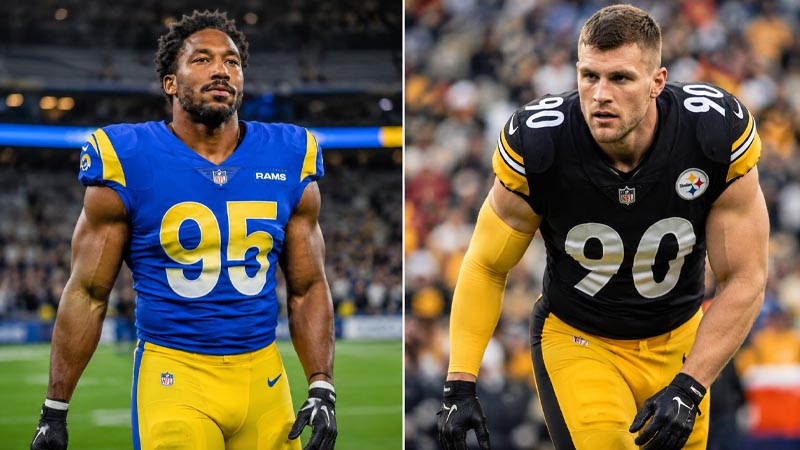
In the modern landscape of professional football, no position outside of quarterback influences the outcome of a game more than the edge rusher.
For nearly a decade, the discussion of who reigns as the premier edge defender has centered on two generational talents: Myles Garrett and T.J. Watt. This classic rivalry has divided analysts, coaches, and fan bases into two passionate camps.
Understanding this debate means understanding the evolution of defensive football. One camp champions the raw, unadulterated physical dominance and down-by-down efficiency of a prototypical defensive end.
The other champions the uncanny, game-altering playmaking ability and instinctual nose for the football of a classic outside linebacker. This analysis provides an exhaustive, data-driven comparison of Myles Garrett and T.J.
Watt, deconstructing their tactical profiles, scheme variations, historical metrics, and the broader strategic implications of their dominance.
Myles Garrett: Unmatched Physical Dominance & Positional Versatility
Drafted first overall by the Cleveland Browns in 2017, Myles Garrett entered the league with a physical profile that seemed engineered in a laboratory.
Standing 6-foot-4 and weighing over 270 pounds, Garrett possesses a rare combination of explosive first-step quickness, elite bend, and overwhelming raw power.
His game is defined by pass-rushing efficiency, high pass-rush win rates, and an ability to command constant attention from opposing offensive lines.
Garrett’s dominance reached a historic peak during his spectacular 2025 campaign, where he captured the single-season sack record by registering a staggering 23.0 sacks and earning Defensive Player of the Year honors.
Garrett’s brilliance lies in his efficiency; even when he is not securing a sack, his presence alters the opposing team’s entire offensive game plan.
He routinely faces the highest double-team rates in the league, forcing offensive coordinators to commit extra tight ends, running backs, and chipping schemes to his side of the line.
To counter these double-teams, Garrett possesses the versatility to move across the entire defensive line, shifting from his customary defensive end spot to find favorable matchups against interior offensive linemen.
While some critics have historically argued that this shifting is done to avoid elite blockers, analysts point out that this positional versatility is actually a premier strength that maximizes his disruptive capability.
Recently, Garrett waived his rare no-trade clause to finalize a blockbuster trade to the Los Angeles Rams, signing a massive five-year deal running from 2026 through 2030. For 2026, his compensation package increases to at least $37 million.
This move has sent shockwaves through the league, even prompting legendary defender Aaron Donald to contemplate a return to the field. As Garrett begins this new chapter in Los Angeles, wearing his signature No. 95, his long-term career goals remain clear: chasing down Bruce Smith’s historic record of 200 career sacks.
T.J. Watt: The Ultimate Disruptive Playmaker
Operating as an outside linebacker in a traditional 3-4 defensive front, T.J. Watt approaches the edge position with a completely different operational philosophy. If Garrett is the classic physical prototype, Watt is the ultimate tactician and defensive playmaker.
Standing 6-foot-4 and weighing roughly 252 pounds, Watt uses a relentless motor, elite hand combat techniques, and unmatched football intelligence to dominate games.
Watt is celebrated as a multi-faceted playmaker who consistently produces jaw-dropping statistics in categories that directly affect the turnover margin. Unlike Garrett, who operates as a down lineman in even fronts, Watt plays outside every down as a stand-up edge rusher.
Supporters of Watt highlight this positional consistency, arguing that he does not need to move across the line of scrimmage to find weaker offensive matchups.
From his established alignment, Watt has terrorized quarterbacks and ball-carriers alike, consistently serving as a front-runner for Defensive Player of the Year honors throughout his career.
The hallmark of Watt’s game is his ability to generate “splash plays”—moments where he single-handedly alters the course of a matchup.
His career is highlighted by historic milestones, including a legendary 2021 campaign that set the standard for modern pass-rushing excellence.
Watt’s impact is felt across the entire defensive box score, as he combines elite sack production with a rare ability to force fumbles, intercept passes, and knock down balls at the line of scrimmage.
The Quantitative Tale of the Tape
To truly appreciate the differences between these two edge titans, one must analyze their career profiles side-by-side.
The following comparison highlights the fundamental contrast in how they impact games: Garrett through high-frequency pass-rushing efficiency and Watt through broad, multi-faceted playmaking disruption.
Myles Garrett vs. T.J. Watt: Structural Comparison
| Metric / Category | Myles Garrett (DE) | T.J. Watt (OLB) |
|---|---|---|
| Primary Position | Defensive End (DE) | Outside Linebacker (OLB) |
| Defensive Scheme | Even Front (4-3 / Under) | Odd Front (3-4 / Over) |
| Pass-Rushing Style | Elite win-rate, high double-team focus | High pressure-to-sack conversion, elite motor |
| Positional Alignment | High versatility, moves across the line | Consistent outside alignment, stays wide |
| Sack Milestone Peak | 23.0 Sacks (2025 Season Record) | 22.5 Sacks (2021 Season Peak) |
| Combined Forced Fumbles + INTs | 20 Career Plays | 38 Career Plays |
| Career Pass Deflections | 16 Career Deflections | 48 Career Deflections |
| All-Time Milestones | 30+ Tackles for Loss in a single season | 30+ Tackles for Loss in a single season |
| Future Career Objective | Bruce Smith’s 200 Career Sacks Record | Hall of Fame trajectory, Steelers legacy |
Deconstructing the Scheme & Strategic Gaps
A major trap in the public debate surrounding Garrett and Watt is the simple comparison of raw, uncontextualized box score statistics.
To build a true, professional-level understanding of this rivalry, we must analyze the tactical underpinnings of their respective defensive schemes.
The Coverage Assignment Gap
- Watt’s Coverage Responsibilities: In the Steelers’ 3-4 system, Watt, as an outside linebacker, is occasionally asked to drop back into zone coverage or play flat assignments. This positioning gives him unique opportunities to read the quarterback’s eyes, jump passing lanes, and secure interceptions or pass deflections.
- Garrett’s Defensive Mandate: Conversely, in his defensive schemes, Garrett operates as a true hand-in-the-dirt defensive end. He is rarely, if ever, asked to drop back into coverage. His sole responsibility is to penetrate the line of scrimmage, set the edge against the run, and rush the passer. Therefore, citing Watt’s superior pass deflection and interception numbers as proof of defensive superiority ignores the reality that Garrett is simply not deployed in a manner that allows him to collect those specific metrics.
The Double-Team and Win-Rate Divide
- Garrett’s Blocking Environment: Garrett consistently leads the league in pass-rush win rate and overall pass-rush productivity. Because he commands a significantly higher double-team rate, Garrett’s ability to win his matchups on a per-snap basis is historically elite. He is twice as efficient as a pass-rusher on a per-snap basis compared to standard defenders, utilizing his unique athletic gifts to overpower or bend around blockers.
- Watt’s Scheme Advantages: Watt benefits from playing in a system that often isolates him on the edge, allowing him to utilize his explosive first step without facing the same volume of constant interior help sliding his way. This structural difference explains why Garrett is often viewed by analytic departments as the more consistently disruptive down-by-down force, even when his raw playmaking numbers do not match Watt’s.
Run Defense and Backfield Penetration
- Tackles for Loss: Both players are elite run defenders who excel at squeezing the edge and making plays in the backfield. In fact, Garrett joined J.J. Watt as the only defensive players to record 30+ tackles for loss (TFLs) in a single season. This metric underscores that while Garrett is celebrated for his pass-rushing, his run-stopping ability is equally elite.
The Public Perception: Full-Season Metrics vs. Fourth-Quarter Clutch
The debate between Garrett and Watt also manifests in how fans and analysts perceive their impact on winning games.
A common sentiment among NFL observers is that if you want a player who will deliver superior underlying metrics, analytical dominance, and consistent down-by-down pressures over the course of a full 17-game season, you choose Garrett.
However, if you are heading into the fourth quarter of a playoff game and need a defender to make a game-winning, strip-sack turnover, you choose Watt.
This perception highlights the different “flavors of dominance” that both players offer:
- Garrett’s Dominance is Cumulative and Systematic: His relentless pressure wears down offensive tackles, forces quarterbacks to speed up their internal clocks, and opens up opportunities for his teammates to make plays.
- Watt’s Dominance is Explosive and Highly Visible: He has an uncanny knack for identifying the exact moment an offense is vulnerable, exploiting a mistake, and securing a turnover that shifts the entire momentum of a game.
Both approaches are highly effective, but they appeal to different defensive philosophies.
The Blockbuster Shift: Myles Garrett’s Transition to Los Angeles
The rivalry took a dramatic turn with the stunning trade of Myles Garrett from the Cleveland Browns to the Los Angeles Rams.
This transaction stands as one of the most significant player movements in modern NFL history, reshaping the power dynamics of both the AFC and NFC.
For the Browns, trading away a franchise icon was a direct consequence of the organizational challenges stemming from the Deshaun Watson trade.
This move has left Browns fans grappling with the loss of their most dominant defensive player, although franchise legends like Hall of Famer Joe Thomas have expressed long-term optimism about the return Cleveland secured in the trade.
To fill the massive void left by Garrett’s departure, the Browns are leaning on emerging young talents like Jared Verse, who has made it clear that he is not trying to fill Garrett’s shoes, but rather forge his own path.
Meanwhile, the Los Angeles Rams, under General Manager Les Snead, spent months of the offseason working to pry Garrett away from Cleveland.
By securing his services on a five-year contract through 2030 with a massive 2026 compensation package, the Rams have paired one of the league’s most creative defensive minds with an unstoppable defensive force.
Opposing offensive linemen, including elite tackles like Trent Williams of the division-rival San Francisco 49ers, have openly expressed their frustration with the Rams’ addition of Garrett, simply stating that “it sucks” to have to face him twice a year.
The Final Verdict: A Choice of Defensive Philosophy
Ultimately, choosing between Myles Garrett and T.J. Watt is not a question of who is the better football player, but rather which style of defensive dominance a team values more.
If a defensive coordinator wants an unstoppable, down-by-down force who will completely disrupt an opponent’s blocking schemes, command constant double-teams, and win individual matchups at an historically elite rate, Myles Garrett is the ideal choice. His physical profile, combined with his historic 23.0-sack campaign and unmatched pass-rush win rate, makes him the ultimate offensive-line destroyer.
If a coordinator wants a dynamic, highly instinctual playmaker who will consistently deliver game-winning turnovers, dominate the splash-play columns, and single-handedly alter the momentum of a game in the fourth quarter, T.J. Watt is the choice. His legendary production in forced fumbles, interceptions, and pass deflections remains unmatched among modern edge rushers.
Both players are generational, first-ballot Hall of Fame talents who have redefined what is possible on the edge. As Garrett embarks on his new journey in Los Angeles and Watt continues to anchor the Steelers’ defense, football fans are privileged to witness a golden era of edge rusher dominance.