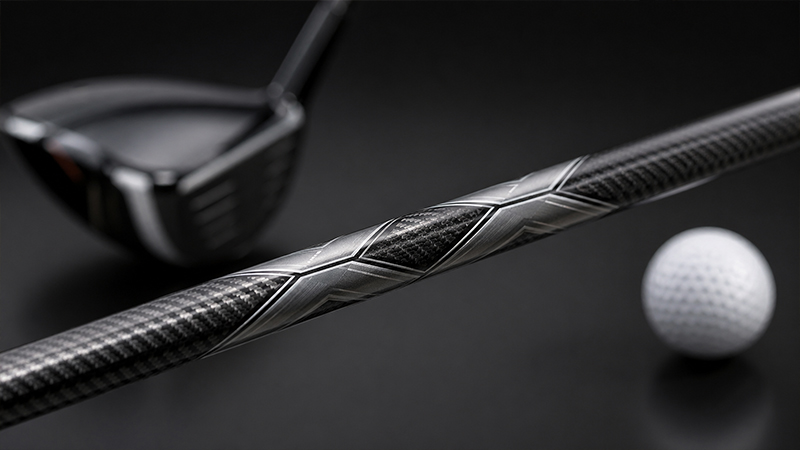
In the world of elite-level golf, speed is often described as the ultimate currency. However, for the golfer consistently clocking clubhead speeds between 112 and 115+ mph, speed without stability is a liability.
The “stability paradox” dictates that as velocity increases, the margin for error in face control shrinks exponentially. For these players, off-the-rack “Stiff” or even standard “Extra Stiff” (X) shafts often fail to provide the necessary feedback, resulting in a “loose” feel and inconsistent dispersion.
This comprehensive guide examines the transition from standard equipment to high-performance, Tour-validated components.
We will explore how specific technologies, such as Metal Mesh Technology (MMT) and TX-flex profiles, allow high-speed players to regain face awareness and achieve a unified “feel” across their entire bag.
The Iron Revolution: Why Heavy Graphite is Dominating High-Speed Play
For decades, the consensus was that high-swing-speed players required heavy steel shafts (e.g., Dynamic Gold X100) to maintain control. That paradigm has shifted.
The emergence of heavy, high-modulus graphite has proven that you can achieve steel-like stability with the vibration-damping and responsiveness of composite materials.
The Mitsubishi MMT 105TX: A “Game Changer” for Face Control
One of the most significant shifts in modern iron play for elite amateurs is the adoption of the Mitsubishi MMT 105TX.
Transitioning from a lighter, standard stiff shaft (such as the UST Recoil 95) to the MMT 105TX has been described as an “absolute game changer” for players with driver speeds in the 112–115 mph range.
Why the MMT 105TX succeeds where others fail:
- Metal Mesh Technology: By integrating a unique metal mesh into the layers of graphite, Mitsubishi creates a shaft that mimics the density and consistency of steel while retaining the energy transfer of graphite.
- Enhanced Face Awareness: High-speed players often struggle with “sensing” where the clubhead is during the transition. The MMT profile allows golfers to “control the face so much better,” facilitating the ability to hit various shot shapes (draws, fades, stingers) with ease.
- Tempo Synchronization: For those with an aggressive swing and tempo, the 105TX provides a stoutness that prevents the shaft from “loading” too deeply, which can lead to timing issues and the dreaded “left miss”.
Solving the Driver Dilemma: Matching the Big Stick to the Irons
A common pain point for golfers is a “disconnected” bag—where the irons feel stable and precise, but the driver feels erratic and “whippy.”
If you have successfully moved to a TX-flex in your irons, a standard X-flex driver shaft, such as the HZRDUS Smoke Black RDX 60, may no longer provide the feedback required for your aggressive tempo.
Transitioning to the TX-Flex Driver Profile
When iron play becomes precise through stability, the driver must follow suit. For players seeking the same “connected” feel as their MMT iron shafts, the industry standard points toward the Mitsubishi Tensei family.
The Tensei White and Tensei RAW White
The Tensei White series is specifically engineered for the high-speed, high-load player. It is characterized by a “low launch, low spin” profile with a stiff handle and tip section.
- The Recommendation: For golfers who love the MMT iron feel, the Tensei White is considered a “good start” for testing.
- Tensei RAW White: This iteration offers a slightly more “raw” feel (less finish on the material) and is often preferred by players who want maximum feedback from the shaft during the strike.
- The Goal: The objective of moving to a TX driver shaft is not necessarily to gain 10 yards of raw distance, but to “control the face better,” ensuring that the fastest swing of the day still finds the fairway.
The Technical Edge: Tipping, Length, and Accuracy
The Power of Shaft Tipping
When a golfer has an aggressive transition, the shaft can “droop” or “lag” excessively. Tipping—the process of cutting a small portion (usually 0.5 to 1.5 inches) off the tip end of the shaft before installation—effectively stiffens the overall profile.
- Does it help? For a player with an aggressive tempo, tipping can take a “loose” X-flex and move it closer to a TX-flex performance profile, providing a more stable platform through the hitting zone.
The 44.5-Inch Secret: Why Shorter is Often Longer
The standard driver length (often 45.5 to 46 inches) is designed for maximum potential arc. However, for high-speed players, this length often leads to off-center strikes.
- The Accuracy Gains: Shortening a driver to 44.5 inches has been shown to eliminate slices and improve the player’s ability to stay “inside and closed” at impact.
- The Paradox of Distance: While a shorter shaft technically reduces potential swing speed, many players find they actually gain distance because they are hitting the “sweet spot” more consistently.
- Shot Shaping: A shorter, more stable shaft allows for greater versatility, making it easier to intentionally draw or fade the ball under pressure.
Principle in Golf Fitting
While “feel” is a vital component of the game, high-performance decisions must be rooted in data.F
Why You Must Be Professionally Fitted
Even with a “shortlist” of premium options like the Tensei White or MMT 105TX, a professional fitting is the only way to validate performance.
- Surprising Results: Many golfers enter a fitting expecting one result and find that a completely different weight or flex profile produces better launch and spin numbers.
- The “Whole Bag” Perspective: A master fitter doesn’t just look at the driver; they ensure the swing weight and frequency of every club are synchronized, so you don’t have to “adjust” your swing for different clubs.
Strategic Takeaways for the 110+ MPH Golfer
To dominate from the tee to the green, your equipment must be an extension of your physical capabilities.
- Evaluate Your Iron Stability: If you feel you’ve outgrown “Stiff” shafts, look into heavy graphite like the MMT 105TX. The gain in face control is often more valuable than any minor change in swing speed.
- Match the Profile: If your irons are stable, don’t settle for a “loose” driver. Explore TX (Tour Extra Stiff) options to maintain a consistent feel.
- Optimize for Strike, Not Just Speed: Consider shortening your driver to 44.5 inches. The improvement in “fairway finders” and strike quality usually outweighs the theoretical loss of arc length.
- Trust the Professionals: Use community insights to build your shortlist, but use a launch monitor to make the final decision.
Enhanced FAQ
Q: Is 105g too light for a TX iron shaft?
A: Not necessarily. Because of the Metal Mesh Technology, the MMT 105TX plays “stouter” than its static weight suggests, offering the stability of 120g steel with the performance benefits of graphite.
Q: Will a shorter driver shaft (44.5″) lower my swing speed?
A: It may slightly lower your potential clubhead speed, but most high-speed players see an increase in ball speed because they are hitting the center of the face more frequently.
Q: What is the main difference between X and TX flex?
A: TX (Tour Extra Stiff) is a step above standard X-Stiff. It is designed for the highest load and most aggressive tempos, offering reinforced sections (usually in the handle or tip) to prevent the shaft from “shutting down” or twisting at high velocities.
Conclusion: Building the Ultimate High-Performance Unit
At clubhead speeds exceeding 110 mph, your equipment is either your greatest ally or your biggest obstacle.
By moving toward Tour-validated components like the Mitsubishi MMT and Tensei lines, and optimizing through tipping and shortened lengths, you transform your bag from a collection of clubs into a precision-engineered unit.
The goal is simple: total confidence that the clubface will be exactly where you intended it to be at the moment of impact.
Ready to dial in your gear? The first step is moving from “guessing” to “knowing.” Take your shortlist of TX shafts to a professional fitter and see the data for yourself.