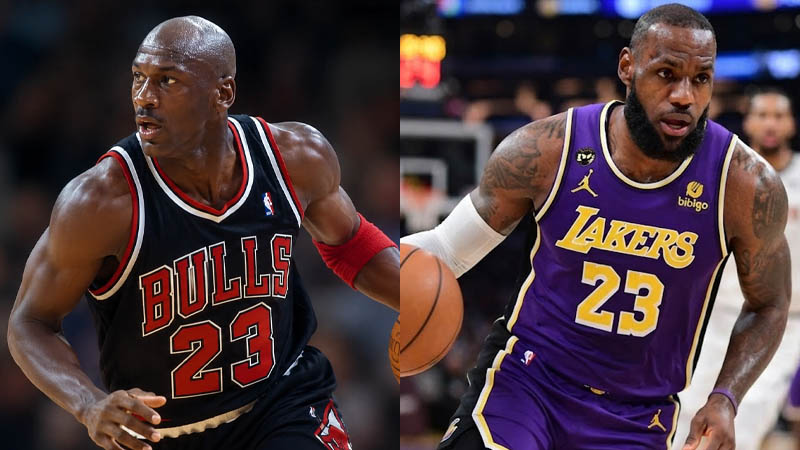
The Michael Jordan vs. LeBron James debate centers on a choice between peak perfection and perpetual greatness. Jordan defined the 1990s with a flawless 6-0 Finals record and ten scoring titles, representing the pinnacle of two-way dominance.
Conversely, LeBron James has redefined longevity, becoming the NBA’s all-time leading scorer while maintaining elite versatility over two decades.
While Jordan holds the edge in championship efficiency and per-game scoring, LeBron leads in cumulative totals and all-around playmaking.
Ultimately, the Greatest of All Time depends on whether one prioritizes an unbeatable peak or the most sustained excellence in basketball history.
Analyzing Career Achievements and Championship Records
The primary pillar of the argument for Michael Jordan is his unmatched championship efficiency. Jordan orchestrated two separate “three-peats” with the Chicago Bulls, remaining undefeated on the game’s biggest stage.
His ability to close out series is legendary; he never allowed a Finals series to reach a Game 7 and captured the Finals MVP award in every single one of his championship runs. This level of perfection created an aura of invincibility that defined his legacy.
LeBron James counters this with historic consistency and unparalleled team elevation. While his Finals record stands at 4-6, he has appeared in 10 NBA Finals—a feat accomplished across three different franchises: the Cleveland Cavaliers, Miami Heat, and Los Angeles Lakers.
James has conquered more individual playoff rounds than any other player in the modern era, demonstrating an ability to transform diverse rosters into championship contenders.
Major Accolades and Honors Comparison
| Award / Honor | Michael Jordan | LeBron James |
|---|---|---|
| NBA Championships | 6 | 4 |
| Finals MVP Awards | 6 | 4 |
| Regular Season MVPs | 5 | 4 |
| All-Star Selections | 14 | 22 |
| All-NBA Selections | 11 | 21 |
| All-Defensive First Team | 9 | 5 |
| Scoring Titles | 10 | 1 |
| Defensive Player of the Year | 1 | 0 |
Statistical Breakdown: Peak Scoring vs. Total Accumulation
Michael Jordan was the more explosive, volume-driven scorer, maintaining the highest career points-per-game average in NBA history.
His scoring dominance is evidenced by his 10 scoring titles, compared to LeBron’s single title. Jordan’s peak was so high that he averaged over 30 points per game in eight different seasons.
In contrast, LeBron James’ statistical profile is built on multi-dimensional mastery and longevity. He stands as the only player in NBA history to eclipse 40,000 career points, recently surpassing Kareem Abdul-Jabbar’s long-standing record.
James utilizes his size and vision to act as an elite point-forward, resulting in significant leads over Jordan in total rebounds and assists.
Regular Season Career Statistics (Per Game and Totals)
| Regular Season Metric | Michael Jordan | LeBron James |
|---|---|---|
| Total Games Played | 1,072 | 1,622 |
| Points Per Game (PPG) | 30.1 | 26.8 |
| Rebounds Per Game (RPG) | 6.2 | 7.5 |
| Assists Per Game (APG) | 5.3 | 7.4 |
| Total Points | 32,292 | 43,440 |
| Total Assists | 5,633 | 12,016 |
| Field Goal % (FG%) | 49.7% | 50.7% |
Playoff Performance: Who is the Ultimate Closer?
Michael Jordan’s postseason career is revered for a complete refusal to lose. He currently holds the record for the highest postseason scoring average at 33.4 points per game.
Jordan’s playoff intensity was so immense that his lowest-scoring postseason average was 29 points, a mark many elite players never reach even once. He was the ultimate two-way threat, combining lethal scoring with elite perimeter defense.
LeBron James’ playoff legacy is rooted in unmatched sustained greatness. While Jordan has the per-game edge, James has played in 302 playoff games compared to Jordan’s 179.
This massive volume has allowed James to amass more total playoff points, rebounds, assists, and blocks than Jordan. James’ supporters argue that his ability to lead different groups to the Finals repeatedly is a testament to his superior basketball IQ and floor generalship.
Career Playoff Statistics
| Postseason Metric | Michael Jordan | LeBron James |
|---|---|---|
| Finals Record | 6-0 | 4-6 |
| Playoff PPG | 33.4 | 28.4 |
| Playoff RPG | 6.4 | 9.0 |
| Playoff APG | 5.7 | 7.2 |
| Playoff Games | 179 | 302 |
Does Era and Physicality Change the Narrative?
Comparing these two icons requires understanding the vastly different environments in which they competed. The NBA has evolved from a physical, defensive-minded league into a high-paced, spacing-oriented era.
These changes heavily influence how statistics are interpreted and how each player’s skill set might translate across time.
The Defensive Intensity of the 1990s
Michael Jordan played in an era where hand-checking was permitted and technical fouls for physical altercations were rare.
Defenses were primarily man-to-man, and the presence of dominant post defenders like Hakeem Olajuwon and David Robinson made scoring in the paint significantly more difficult.
Critics of LeBron suggest he would struggle with the lack of spacing and the sheer physicality of the 80s and 90s.
Jordan’s mid-range game was exceptionally refined to combat this; he shot 50% or better from 10-19 feet, whereas LeBron has historically struggled more from those distances.
The Modern Game and Versatility
LeBron James has thrived in an era of positionless basketball and advanced spacing. Modern rules, such as the defensive three-second violation and the banning of hand-checking, have opened lanes for drivers.
However, James’ supporters argue that his 250-pound frame and elite athleticism would allow him to dominate any era, regardless of the rules.
Furthermore, James has developed into a superior three-point shooter compared to Jordan, which is essential for success in the current game. His versatility allows him to guard multiple positions and facilitate the offense in ways Jordan typically did not.
Advanced Metrics: Measuring Efficiency and Value
Advanced analytics provide a more nuanced view of the debate, often capturing the same “peak vs. longevity” narrative seen in basic stats.
Jordan typically edges out in efficiency-based ratings that look at per-game impact, while LeBron dominates accumulation stats that reward long-term value.
Efficiency Metrics and Per-Game Impact
Jordan holds a slight lead in Player Efficiency Rating (PER) and Box Plus/Minus (BPM). These metrics suggest that, on a minute-by-minute basis, Jordan was the more dominant individual force on the court.
His career PER of 27.9 remains the gold standard for high-volume scorers who also contribute significantly on the defensive end. Jordan’s ability to maintain such high efficiency while being his team’s primary offensive option is a key part of his GOAT case.
Longevity and Accumulation Metrics
LeBron James dominates metrics like Value Over Replacement Player (VORP) and Win Shares. His career VORP of 153.2 far exceeds Jordan’s 116.1, reflecting the sheer amount of winning basketball James has provided over 23 seasons.
While Jordan’s retirement stints limited his total accumulation, James’ durability has made him the most valuable player in league history when considering a full career arc.
James has also earned more All-NBA selections (21 vs. 11), underscoring his status as an elite player for a longer duration.
Leadership Styles and Team Loyalty
The way each player led their teams and managed their careers also factors into public perception. Jordan is often associated with fierce, internal team loyalty and a “tough love” leadership style.
LeBron is seen as a more collaborative leader who empowered himself through free agency.
The Jordan Way and Continuity
Michael Jordan achieved all his titles with the Chicago Bulls, pushing his teammates to reach their potential. Many of his teammates credit his demanding nature for their collective success.
Jordan’s path involved “getting his ass beat” by the Detroit Pistons until he finally overcame them with the roster the Bulls drafted and traded for. This narrative of staying in one place and conquering adversity is a major reason why many “old-school” fans prefer him.
The LeBron Way and Roster Mobility
LeBron James changed the landscape of the NBA by choosing his own teammates to form “superteams”. While some criticize him for leaving teams to find success, others view it as a brilliant management of his career to ensure he remained in title contention.
James has shown an unprecedented ability to adapt to different systems and cities, winning championships with three different organizations.
His leadership is often characterized by his high basketball IQ and his role as a primary playmaker who makes those around him better through his vision.
Frequently Asked Questions about the GOAT Debate
Who has more NBA championships, Jordan or LeBron?
Michael Jordan has six NBA championships, while LeBron James has four.
Who is the NBA’s all-time leading scorer?
LeBron James is the NBA’s all-time leading scorer, being the only player to surpass 40,000 career points.
What was Michael Jordan’s record in the NBA Finals?
Michael Jordan was a perfect 6-0 in the NBA Finals and won Finals MVP in every appearance.
Which player was a better defender?
Michael Jordan has 9 All-Defensive First Team selections and a Defensive Player of the Year award. LeBron James has 5 All-Defensive First Team selections.
Did Michael Jordan play more seasons than LeBron James?
No. LeBron James is currently in his 23rd season, while Michael Jordan played 15 seasons.
Conclusion: Deciding the Greatest of All Time
The choice between Michael Jordan and LeBron James ultimately rests on your personal definition of greatness.
If you value a flawless, unstoppable peak where a player refuses to lose and dominates both ends of the floor with lethal scoring, Jordan is your GOAT. His 6-0 Finals record and scoring titles remain the benchmark for competitive perfection.
However, if you value a player who has maintained elite status longer than anyone in history, acting as a one-man engine for championship-caliber teams for over two decades, then LeBron James is the choice.
His cumulative records in points, rebounds, and assists may never be broken. Both players have redefined what is possible on a basketball court, leaving a legacy that will be debated for generations.