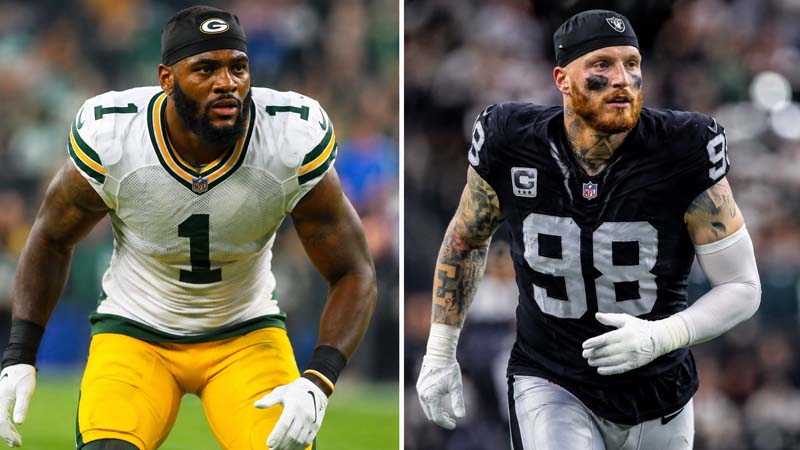
Evaluating the elite defensive anchors of professional football requires moving beyond simple box scores. It demands a deep examination of defensive architecture, athletic geometry, and franchise building.
At the pinnacle of this evaluation stand two defensive game-changers whose playing styles present a fascinating study in contrasts: Micah Parsons and Maxx Crosby.
Both players represent the gold standard of modern defense, yet they achieve their elite status through entirely different operational models.
One is a dynamic, multi-positional chess piece who disrupts offenses through pure acceleration and positional fluidity. The other is a relentless, every-down force of nature who wins through sheer volume, elite run containment, and an unmatched physical engine.
This executive analysis breaks down their careers, statistical trends, transaction values, and physical profiles to help franchise builders answer a critical question: If you were starting a franchise today, which defensive blueprint would you choose?
Contrasting Philosophies of Disruption
| Micah Parsons | Maxx Crosby |
|---|---|
| “The Explosive Chess Piece” | “The Relentless Ironman” |
| Elite short-area acceleration | Unmatched snap volume |
| Multi-alignment versatility | Premier run-edge defender |
| Linebacker-to-Edge fluidity | High-volume physical motor |
| Rapid pass-rush peak efficiency | Consistent under heavy load |
The Case for Micah Parsons: Positional Fluidity and Explosive Peak Value
The defensive system built around Micah Parsons is designed to exploit mismatches across the entire offensive line. Entering the professional ranks, Parsons split time heavily as an off-ball linebacker before transitioning into a primary edge defender.
This hybrid background gave him a unique athletic profile. With rare explosive speed and elite bend, he can rush from traditional three-point stances, stand up in the A-gaps, or drop back to neutralize running backs in space.
Parsons’ impact is defined by instant disruption. Offensive coordinators cannot slide their protections to a single side because they rarely know where he will line up before the snap.
This chess-piece deployment has allowed him to rack up multiple First-Team All-Pro selections in short order, cementing him as one of the most feared defensive disruptors in the sport.
His game is centered on high-efficiency rushes, utilizing a historic first step to compromise the pocket before the quarterback can complete a three-step drop.
The Case for Maxx Crosby: High-Volume Endurance and Run-Stopping Domination
While Parsons wins with speed and surprise, Maxx Crosby wins with relentless, high-volume pressure. Crosby has built a reputation on playing an extraordinarily high percentage of defensive snaps, rarely taking a play off despite drawing double-teams and chip blocks.
His stamina is legendary; he operates at the same high speed in the fourth quarter of a high-snap game as he does on the opening drive.
Furthermore, Crosby is a much more traditional, complete edge defender who excels against the run. He is exceptional at setting a hard edge, preventing outside zone runs, and crashing into the backfield to disrupt plays before they develop.
His consistency in leading the league in tackles for loss highlights an elite run-defense profile that complements his pass-rush abilities. What makes Crosby’s production even more impressive is the environment in which it has occurred.
For much of his career, he has anchored rebuilding rosters, producing elite individual numbers without the benefit of another elite rusher on the opposite side to draw attention away.
By the Numbers: Career Statistics and Efficiency Metrics
To appreciate the statistical difference between these two stars, we must look at their careers up to the conclusion of the 2025 regular season.
Career Statistical Comparison (Through the 2025 NFL Season)
| Defensive Metric | Micah Parsons | Maxx Crosby |
|---|---|---|
| Games Played (GP) | 77 | 110 |
| Career Sacks | 65.0 | 69.5 |
| Solo Tackles | 191 | 278 |
| Assisted Tackles | 106 | 161 |
| Total Combined Tackles | 297 | 439 |
| Forced Fumbles | 11 | 10 |
| Fumble Recoveries | 4 | N/A in core records |
| Sacks Per Game Average | 0.844 | 0.631 |
| Tackles Per Game Average | 3.857 | 3.991 |
Analyzing the Statistical Divide: Efficiency vs. Cumulative Volume
Analyzing these numbers reveals a clear difference in career trajectory and workload. Crosby has played in 33 more regular-season games than Parsons.
Despite this significant gap in durability and playing time, Crosby holds only a minor lead in career sacks, with 69.5 compared to Parsons’ 65.0.
This statistical comparison highlights Parsons’ exceptional efficiency. On a per-game basis, Parsons averages 0.844 sacks, a scoring rate that puts him among the most efficient pass rushers in NFL history. This efficiency was evident in his consistent production:
- 2021 (Dallas): 13.0 sacks, 84 combined tackles, 3 forced fumbles
- 2022 (Dallas): 13.5 sacks, 65 combined tackles, 3 forced fumbles
- 2023 (Dallas): 14.0 sacks, 64 combined tackles, 1 forced fumble
- 2024 (Dallas): 12.0 sacks, 43 combined tackles, 2 forced fumbles
- 2025 (Green Bay): 12.5 sacks, 41 combined tackles, 2 forced fumbles
Conversely, Crosby’s value is found in his high-volume durability and his heavy presence in run defense.
With 278 solo tackles and 161 assists, Crosby has participated in 439 total defensive stops. This reflects his role as an every-down run defender who rarely leaves the field.
While Parsons averages fewer total tackles per game, he forces fumbles at a higher rate, registering 11 career forced fumbles in 77 games compared to Crosby’s 10 in 110 games.
The Transactional Equation: Franchise-Altering Trade Valuations
The debate surrounding these two defenders reached a peak during the blockbuster transactions of the 2025 season. Analyzing these trades provides real-world insight into how NFL front offices value their unique skill sets.
| Green Bay Acquired | Dallas Acquired |
|---|---|
| Micah Parsons | Two First-Round Draft Picks |
| — | Kenny Clark (DT) |
| Strategic Impact for Green Bay | Key Benefits |
| Added elite edge rusher (12.5 sacks in 2025) | Gained significant draft capital |
| Preserved young interior star, Devonte Wyatt | Added veteran defensive tackle Kenny Clark |
| Shifted defense into Super Bowl contention | — |
The Cost of Acquiring Micah Parsons
On August 28, 2025, right before the start of the regular season, the Green Bay Packers completed a blockbuster trade to acquire Micah Parsons from the Dallas Cowboys.
The deal was a massive risk for Green Bay, requiring them to surrender two first-round draft picks along with their top interior defensive lineman, Kenny Clark.
This transaction sparked intense debate among fans and analysts:
- The Loss of Kenny Clark: Many observers warned against overlooking the value of Kenny Clark, who had long served as the anchor of the Packers’ defensive line. Losing Clark to Dallas was a major blow, especially since he was locked in with his roster bonus already paid at the time of the trade.
- The Rise of Devonte Wyatt: The trade became much more tolerable for the Packers because they kept young defensive tackle Devonte Wyatt. Keeping Wyatt proved crucial, as he stepped up to anchor the interior line, allowing Parsons to disrupt from the edge.
- The Super Bowl Window: Ultimately, consensus favored the move. Adding a 26-year-old multi-time All-Pro was seen as a rare opportunity that instantly put the Packers in Super Bowl contention. Parsons responded with a stellar 12.5-sack season in 2025, leading Green Bay into a deep playoff push.
The Rumored Maxx Crosby Market
In contrast, Maxx Crosby’s market value was established when the Las Vegas Raiders reportedly shopped him, seeking a trade package similar to the one Green Bay surrendered for Parsons. The Baltimore Ravens were heavily linked to Crosby in trade rumors, but they ultimately backed out of negotiations.
This difference in trade outcomes highlights a subtle gap in how the league views their values:
- Parsons was traded for a premium package (two first-rounders and an elite starting interior lineman). Front offices were willing to pay this steep price due to his younger age (26) and three First-Team All-Pro selections.
- Crosby, who was entering his late 20s (approaching age 29), carried a similarly high asking price. However, teams were more hesitant to pull the trigger on a player with a high-mileage, high-snap workload on rebuilding teams.
The Durability and Rehabilitation Matrix
With elite defensive investments comes the critical issue of durability. The physical toll of rushing the passer at an elite level is immense, and both players have taken different physical paths.
| Micah Parsons | Maxx Crosby |
|---|---|
| Severe Knee Injury (2025) | Exceptional physical motor |
| ACL tear + meniscus procedure | High endurance history |
| Strict 9-month rehab protocol | Consistent snap counts |
| Prior back injuries (L4/L5 sprain) | Low-risk long-term outlook |
| — | Constant wear-and-tear |
The Injury Hurdles for Micah Parsons
While Parsons’ peak performance is historically dominant, his physical record has raised some durability concerns.
The most significant blow came during his 2025 campaign, when he suffered a severe knee injury consisting of a torn ACL and an associated meniscus procedure.
This injury sidelined the star defender, forcing him into a strict, mandatory nine-month rehabilitation protocol.
Recovering from both an ACL tear and a meniscus repair is notoriously difficult, especially for an athlete whose entire game relies on explosive first-step acceleration.
Some analysts have warned that fans should wait to see him return to form before declaring Green Bay the permanent winner of the trade, drawing comparisons to other star players who struggled after major knee reconstructions.
Additionally, Parsons has dealt with other physical setbacks. Earlier in his career, he battled an L4/L5 facet joint sprain in his back. This injury required epidural injections to manage the pain so he could play in crucial division matchups.
This history of back issues, combined with his recent major knee reconstruction, adds a layer of risk to his long-term projection.
Maxx Crosby’s Ironman Reputation
In contrast, Maxx Crosby’s greatest asset may be his durability. His ability to sustain an elite pass-rush win rate while playing nearly every defensive snap is rare for a modern edge rusher.
While Crosby has dealt with the standard wear-and-tear of an NFL season, he has avoided the devastating, season-ending ligament injuries that have impacted Parsons.
For coaches who prioritize availability and consistency, Crosby’s clean injury history and high snap counts make him a very safe investment.
Strategic Scheme Alignment: Which Blueprint Fits Your Franchise?
Choosing between Micah Parsons and Maxx Crosby is not a question of talent; it is a question of defensive identity and roster construction.
When to Build Around Micah Parsons
If your defensive coordinator runs a dynamic, hybrid system that relies on pre-snap confusion, simulated pressures, and varied alignments, Micah Parsons is the ideal choice.
His background as an off-ball linebacker allows you to run coverage drops and pressure packages that are impossible with a traditional edge defender.
Parsons’ elite acceleration gives you a game-wrecking weapon who can single-handedly ruin an opponent’s offensive game plan.
While his injury history adds some risk, his age (26) and historically high sack-per-game average (0.844) make him the premier high-ceiling defensive weapon in football.
When to Build Around Maxx Crosby
If your franchise prioritizes a disciplined, physical, even-front defense that wins in the trenches, Maxx Crosby is the perfect fit. Crosby gives you a traditional, dominant edge setter who excels at stopping the run and attacking the pocket from the weak side.
His unmatched stamina allows you to save roster spots and salary cap space on rotational edge rushers, knowing your star defender can handle 95%+ of the defensive snaps. He offers elite, consistent production without the durability concerns associated with major knee surgeries.
Executive Verdict
Ultimately, the choice between Micah Parsons and Maxx Crosby comes down to a franchise’s tolerance for risk and its defensive philosophy:
- Choose Micah Parsons if you want to maximize your defensive ceiling. If he fully recovers from his knee reconstruction, his rare speed, versatile alignments, and historic sack efficiency make him the ultimate defensive weapon in professional football.
- Choose Maxx Crosby if you value reliability and consistency above all else. He offers an elite motor, dominant run defense, and unmatched ironman durability, making him a safe, high-floor foundation for any franchise.