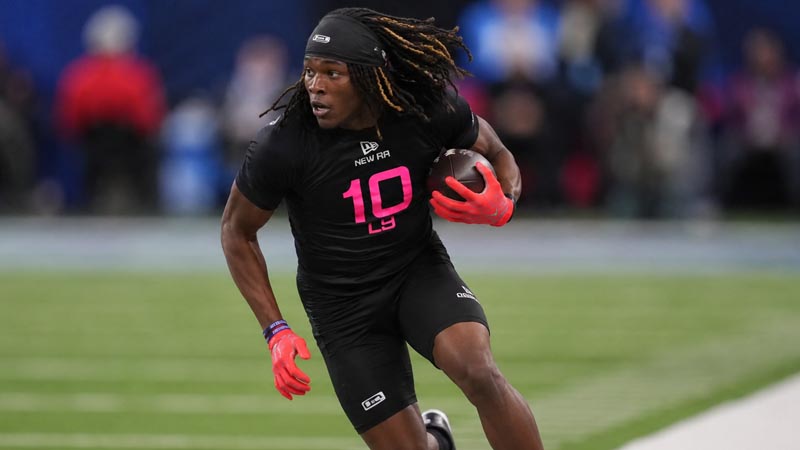
In the modern landscape of professional football, the margin between a defensive stop and a game-defining touchdown is measured in fractions of a second and inches of separation.
Every spring, the NFL Scouting Combine serves as the ultimate proving ground where collegiate prospects attempt to quantify their physical capabilities for professional front offices.
At the 2025 event in Indianapolis, former Kentucky Wildcats cornerback Maxwell Hairston did not merely participate; he delivered a masterclass in linear speed and explosive power, cementing his position as the premier athlete of his draft class.
By registering the fastest overall time of the entire event, Hairston commanded the attention of decision-makers across all 32 franchises. However, evaluating an elite defensive back prospect requires looking beyond a single headline number.
To truly understand how Hairston’s athletic profile translates to professional success, we must deconstruct his testing data, analyze the physics of his movement, and evaluate his performance within both historical and functional football contexts.
Deconstructing the 40-Yard Dash: The Science of 4.28 Seconds
The 40-yard dash remains the crown jewel of testing events, serving as the primary benchmark for straight-line speed. Hairston’s official time of 4.28 seconds is an elite metric that places him in a rarefied tier of athletic performers.
To fully grasp the biomechanical efficiency required to achieve this mark, we must analyze the two critical components of his run: the initial acceleration phase and his maximum velocity.
The Critical 10-Yard Split
For cornerbacks, the first ten yards of any sprint are arguably the most critical. In game scenarios, a defensive back rarely sprints 40 yards in a straight line without interruption.
Instead, they must react, plant, and accelerate to match the sudden vertical release of a wide receiver. Hairston cleared his opening 10-yard split in a remarkable 1.50 seconds.
A 1.50-second split indicates extraordinary starting power and mechanical efficiency out of a three-point stance. It demonstrates that Hairston can generate immense horizontal force almost instantly.
In a practical coverage setting, this level of initial acceleration allows a cornerback to recover rapidly if beaten at the line of scrimmage or to close the distance on short-to-intermediate breaking routes.
Reaching Maximum Velocity
While acceleration wins the first step, top-end speed determines who wins the deep vertical route. During his 40-yard sprint, Hairston reached an elite maximum velocity of 24.25 mph.
To put a speed of 24.25 mph into perspective, very few ball-carriers in the history of next-generation tracking data have ever surpassed the 23-mph threshold in full football pads during an active game.
Reaching over 24 mph in a track environment proves that Hairston possesses the true “track speed” required to neutralise serious vertical threats.
For defensive coordinators, having a cornerback with this level of recovery speed provides schematic flexibility, allowing safety help to be deployed elsewhere on the field.
Historical Context: A Place in the Combine Record Books
Every year, hundreds of elite athletes attempt to break the elusive 4.30-second barrier in the 40-yard dash. Few succeed.
By finishing at 4.28 seconds, Hairston officially tied for the 10th-fastest 40-yard dash recorded in Combine history since electronic timing benchmarks were standardized in 2006.
This historical ranking places Hairston in the company of legendary speedsters who transitioned their track metrics into impactful professional defensive careers.
Achieving a top-10 historical speed metric immediately elevates a prospect’s profile from a standard regional standout to a nationally recognized elite athlete.
It signals to front offices that they are evaluating a player with rare, unteachable physical gifts.
The Explosive Foundation: Power in the Vertical and Broad Jumps
While straight-line speed generates headlines, football is a multi-directional sport played in a three-dimensional space.
A truly elite cornerback must possess the explosive vertical power to contest high-pointed passes and the horizontal power to drive through tackles and close space.
Hairston proved his athletic profile is well-rounded by excelling in the jump portions of the testing program.
The 39.5-Inch Vertical Jump
Hairston recorded a vertical jump of 39.5 inches. A vertical jump approaching 40 inches is an elite indicator of lower-body explosiveness and vertical reach.
For a defensive back, vertical leap is directly tied to ball production. When defending a fade route in the red zone or contesting a 50/50 jump ball along the sideline, those extra inches of vertical elevation can be the difference between a pass deflection, an interception, or a touchdown.
This metric demonstrates that Hairston has the physical capacity to contest passes against much taller receivers at their highest point.
The 10-Foot-9 Broad Jump
In addition to his vertical leap, Hairston recorded a broad jump of 10 feet, 9 inches. The broad jump measures horizontal power production and lower-body muscle recruitment.
A broad jump of this distance shows that Hairston can generate tremendous force from a static position.
This explosive horizontal power translates directly to his ability to drive downhill out of his backpedal, execute transition breaks, and close windows on quick slants or screen passes.
Together, these jump metrics confirm that his 4.28-second speed is built on a foundation of genuine, explosive lower-body power rather than just quick turnover.
The Evaluation: Translating Metrics to the Professional Gridiron
For professional personnel executives, the ultimate task is translating track-and-field metrics into on-field production.
While Hairston’s physical profile is undeniably elite, a complete professional evaluation requires understanding what these numbers mean—and what they do not address.
The Importance of the Complete Profile
When a cornerback pairs a 1.50-second 10-yard split with a 39.5-inch vertical and a 10’9″ broad jump, it tells scouts that the athlete’s muscle fibers are highly efficient at generating rapid, explosive force.
This is not a “one-dimensional” sprinter; it is a dynamic, explosive athlete. This balanced profile suggests that his speed is highly functional and should support lateral agility, sudden transitions, and physical play.
Addressing the Evaluation Gaps
While the testing data in Indianapolis provides a clear picture of Hairston’s raw athletic ceiling, professional front offices must still reconcile these metrics with the realities of on-field performance.
Highly detailed scouting departments will focus on several critical areas that physical testing cannot measure:
- In-Game Coverage Instincts: How effectively does Hairston read the quarterback’s eyes and anticipate route concepts?
- Physicality in Run Support: Can he shed blocks from physical perimeter blockers and make secure tackles in space?
- Technique and Discipline: Does he rely too heavily on his recovery speed to bail him out of poor footwork or technical lapses at the line of scrimmage?
Bridging these information gaps requires an exhaustive review of his game tape from his collegiate career with the Kentucky Wildcats.
The teams that successfully marry this historic athletic data with refined tape study are the ones that will maximize Hairston’s immense potential at the next level.
Frequently Asked Questions About Maxwell Hairston’s Performance
How fast did Maxwell Hairston run at the 2025 Combine?
Maxwell Hairston ran an official 4.28-second 40-yard dash, making him the fastest overall player at the 2025 NFL Scouting Combine
What was Maxwell Hairston’s top speed during his run?
During his 40-yard dash sprint, Hairston reached an elite maximum speed of 24.25 mph.
How does his 40-yard dash time compare historically?
His 4.28-second run officially ties him for the 10th-fastest 40-yard dash recorded at the NFL Combine since 2006.
What other testing metrics did Hairston record?
Beyond his speed, Hairston recorded an explosive 39.5-inch vertical jump and a 10-foot-9 broad jump, demonstrating well-rounded lower-body power.
For which college team did Maxwell Hairston play?
Hairston is a former cornerback for the Kentucky Wildcats.
Conclusion: The Path Forward
Maxwell Hairston’s performance at the 2025 NFL Scouting Combine will be remembered as one of the most dominant athletic displays in recent history.
By pairing historic straight-line speed with elite vertical and horizontal power, he has answered any lingering questions about his pure athletic ceiling.
As franchises finalize their boards, Hairston has established himself not just as a cornerback with high potential, but as a verified game-changer whose physical capabilities are built for the modern, high-speed professional game.