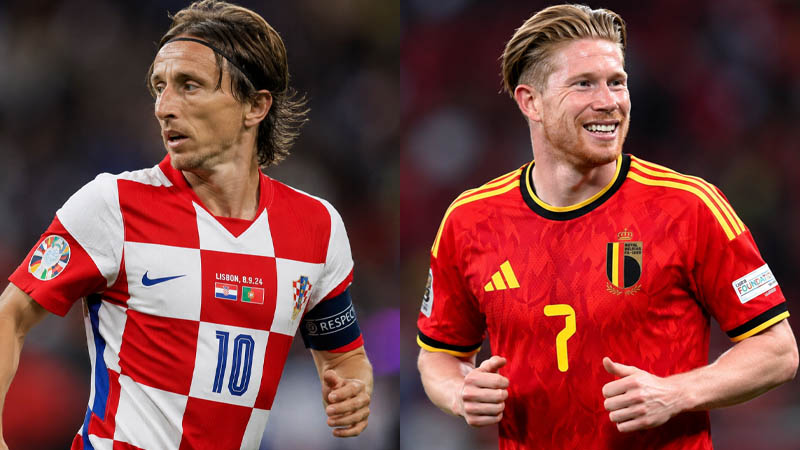
The debate between Luka Modrić and Kevin De Bruyne represents a fundamental clash between two different definitions of midfield mastery: the ultimate controller versus the ultimate creator.
As of June 2026, these two legends continue to grace the pitch in Italy’s Serie A, with the 40-year-old Modrić anchoring AC Milan and the 34-year-old De Bruyne pulling the strings for SSC Napoli.
While Modrić dictates the tempo through game management, De Bruyne functions as a high-volume weapon generating direct attacking output with unmatched efficiency. This analysis dissects their careers, tactical roles, and statistical dominance.
Tactical Archetypes: The Deep Dictator vs. The Final-Third Weapon
Understanding the rivalry requires a deep dive into the specific zones these players occupy and how they influence the flow of a modern football match.
They are both leaders for their national teams and their respective clubs, yet their methods of leadership on the pitch vary significantly.
The Conductor: Luka Modrić
Luka Modrić operates primarily as a deep-lying playmaker, a role that requires him to connect the defensive line to the attack while navigating high-pressure environments.
His game is built on positional intelligence, body feints, and an extraordinary ability to maintain match tempo even against elite opposition.
One of his most recognizable traits is the trivela, or outside-of-the-boot pass, which allows him to manipulate passing angles that other midfielders cannot see.
This technical versatility has made him “immortal” in the eyes of managers like Carlo Ancelotti, who praised his constant readiness and game-changing ability.
At 40, his role at AC Milan focuses on resisting heavy pressure and ensuring his team never loses control of the ball.
The Creator: Kevin De Bruyne
In contrast, Kevin De Bruyne functions higher up the pitch as an aggressive, forward-thinking attacking midfielder.
His philosophy is rooted in “keeping it simple,” yet his execution is anything but basic, involving high-risk, high-reward plays that create chaos in the final third.
De Bruyne is renowned for his explosive crossing, precise through-balls, and long-range shooting. Pep Guardiola has described him as a “key man” not just for his creativity, but for his selfless approach to team success.
Now leading the charge for SSC Napoli, De Bruyne remains the premier engine for breaking down low-block defenses through sheer volume of chance creation.
Career by the Numbers: Efficiency vs. Longevity
The statistical landscape of this comparison reveals a stark divide between direct offensive production and career-long consistency across different eras and leagues.
Because of their differing roles, a simple goal-and-assist count does not tell the full story, though it highlights the specific impact each player provides.
| Metric | Luka Modrić | Kevin De Bruyne |
|---|---|---|
| Total Career Appearances | 932 | 672 |
| Total Career Goals | 99 | 160 |
| Total Career Assists | 143 | 265 |
| National Team Caps | 198 | 119 |
| National Team Goals | 29 | 37 |
| Highest Market Value | €55.00m | €150.00m |
| Current Club (2026) | AC Milan | SSC Napoli |
Analyzing the Statistical Divide
The data shows that De Bruyne’s direct attacking output vastly eclipses that of Modrić, which is expected given his higher average position on the field. With over 260 career assists at the club level, De Bruyne is a statistical outlier in terms of creative volume.
However, Modrić possesses superior longevity, with nearly 1,000 professional appearances across his career. His 198 caps for Croatia also dwarf De Bruyne’s 119 for Belgium, showcasing a level of international endurance that is rare in the history of the sport.
While De Bruyne’s peak market value hit a staggering €150 million, reflecting the premium placed on goal contributors, Modrić’s value has remained respectably stable even as he entered his late 30s.
The Trophy Cabinet: Individual Glory and Team Dominance
Success in football is often measured in silverware, and both players have anchored some of the most dominant club sides in history. Their lists of honors provide a roadmap of their influence across Europe’s top leagues.
Luka Modrić holds the ultimate individual achievement in this comparison: the 2018 Ballon d’Or.
This award was significant not only for recognizing his brilliance but for breaking the decade-long duopoly held by Lionel Messi and Cristiano Ronaldo. Beyond individual accolades, his team success is historic:
- 6× UEFA Champions League Titles (the most for any modern midfielder).
- 4× La Liga Titles during his time with Real Madrid.
- 2018 World Cup Golden Ball for being the best player in the tournament.
- Multiple domestic titles in Croatia with Dinamo Zagreb.
Kevin De Bruyne’s trophy room is defined by domestic dominance and his role as the heartbeat of a Manchester City dynasty. While he has fewer Champions League titles than Modrić, his impact on the Premier League is arguably greater:
- 6× Premier League Titles.
- 1× UEFA Champions League Title.
- 2× Premier League Player of the Season.
- Multiple domestic cups in Germany (Wolfsburg) and England (Man City).
International Legacies: Leading Golden Generations
Both players have shouldered the burden of leading relatively small footballing nations to the pinnacle of the sport. Their performances on the world stage have often been the “duel within the duel” that decides major tournament outcomes.
Luka Modrić’s international career is legendary for its persistence and overachievement. He led Croatia to a stunning World Cup Final appearance in 2018 and followed it up with a 3rd-place finish in 2022.
His 198 caps represent a level of dedication to the national team that few can match, making him the undisputed leader of Croatia’s greatest-ever generation.
In contrast, De Bruyne was the primary creative force behind Belgium’s “Golden Generation,” which achieved a 3rd-place finish at the 2018 World Cup.
While Belgium often entered tournaments with higher expectations, Modrić’s Croatia consistently managed to navigate deep into the knockout stages through his tactical discipline and leadership.
The 2026 Serie A Chapter: Sunset in Italy
As of June 2026, both players have entered the final stages of their illustrious careers, yet they remain highly valued assets in one of Europe’s top leagues. Their transition to Serie A in the summer of 2025 marked the end of their long tenures in Spain and England respectively.
Modrić, at 40 years old, joined AC Milan on a free transfer and continues to defy biological limits. His current market value sits at €3.5 million, reflecting his age, yet his influence on the pitch remains substantial.
De Bruyne, six years his junior at 34, joined SSC Napoli and currently holds a market value of €8 million. Their head-to-head history is closely contested; in 16 professional meetings against each other, De Bruyne has secured 7 victories to Modrić’s 5, with 4 draws.
These Italian chapters allow both players to utilize their intelligence and passing range in a league that historically prizes tactical nuance over pure athleticism.
Choosing the Master: Contextualizing the Superiority
Deciding which player is “better” is a question of team construction rather than a simple ranking of talent. Both are total midfielders who excel at both ends of the pitch, capable of directing play, providing assists, and scoring when the opportunity arises.
If a manager requires a relentless offensive engine to split a stubborn low-block defense and guarantee over 25 goal contributions per season, Kevin De Bruyne is the clear choice.
His ability to manufacture high-quality chances from almost any position in the final third makes him a unique tactical weapon.
However, if the requirement is a big-game specialist to resist heavy pressure, dictate the flow against elite opponents, and maintain world-class consistency for two decades, Luka Modrić is the preferred option.
Modrić’s 2018 Ballon d’Or and his six Champions League medals serve as tangible proof of his ability to perform at the highest possible level under the most intense scrutiny.
Frequently Asked Questions (FAQ)
Who has more assists, Modrić or De Bruyne?
Kevin De Bruyne has significantly more career assists, totaling 265 at the club level compared to Luka Modrić’s 143. This is largely due to De Bruyne’s more advanced role as an attacking midfielder.
How many Champions League titles has Luka Modrić won?
Luka Modrić has won 6 UEFA Champions League titles, making him one of the most decorated players in the history of the competition.
What is the current club of Kevin De Bruyne in 2026?
As of June 2026, Kevin De Bruyne plays for SSC Napoli in Italy’s Serie A, having joined the club in 2025.
Has Kevin De Bruyne ever won the Ballon d’Or?
No, Kevin De Bruyne has not won the Ballon d’Or. Luka Modrić won the award in 2018, becoming the only player to break the Messi-Ronaldo streak during that decade.
How many times have Modrić and De Bruyne played against each other?
They have faced each other 16 times in professional matches. De Bruyne has won 7 of those encounters, Modrić has won 5, and 4 ended in draws.
Strategic Conclusion and Final Takeaway
The rivalry between Luka Modrić and Kevin De Bruyne has defined the midfield position for over a decade.
While the “Conductor” Modrić and the “Creator” De Bruyne offer different tactical profiles, they share a common trait: they are both essential leaders who make their teammates better through technical excellence and unselfish play.
Modrić’s longevity and trophy haul place him in the pantheon of the greatest deep-lying playmakers of all time, while De Bruyne’s sheer creative volume and Premier League dominance cement his status as the premier attacking midfielder of his era.
Whether you prefer the control of the trivela or the chaos of a whipped cross, football is richer for having witnessed both masters at their peak.