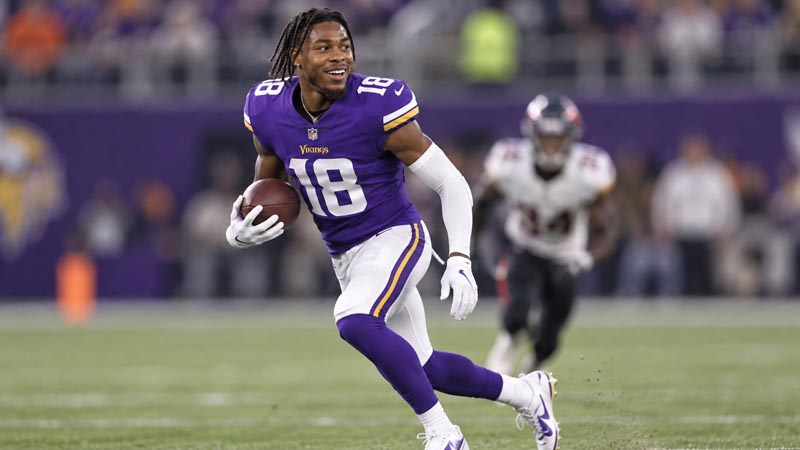
Since entering the league in 2020, Justin Jefferson has transitioned from a high-upside draft prospect to the definitive cornerstone of the Minnesota Vikings’ offensive unit.
His trajectory is not merely a collection of high-yardage games but a case study in consistent, high-volume production and athletic efficiency.
This analysis breaks down the numerical reality of his first 94 career games, evaluating his impact through receiving metrics, secondary offensive roles, and defensive utility.
Fundamental Athlete Profile and Professional Origins
To understand the statistical output, one must first establish the physical and biographical foundation. Jefferson’s ability to maintain high performance over nearly 100 professional games is rooted in his collegiate development and physical readiness.
| Attribute | Detail |
|---|---|
| Team | Minnesota Vikings |
| Jersey Number | 18 |
| Primary Position | Wide Receiver |
| Physical Dimensions | 6′ 1″, 195 lbs |
| Date of Birth | June 16, 1999 |
| Collegiate Program | LSU |
| Draft Pedigree | 2020: Round 1, Pick 22 (MIN) |
| Current Status | Active |
Jefferson arrived in Minnesota as a first-round investment tasked with filling a significant void in the receiving corps.
His 195-pound frame has proven resilient enough to handle a heavy target share while maintaining the explosive speed necessary to lead the league in yards per reception during various phases of his career.
The Evolution of Receiving Dominance: A Year-by-Year Analysis
The core of Jefferson’s value lies in his receiving statistics. Across 94 regular-season appearances, he has accumulated 8,480 receiving yards, averaging 14.6 yards per catch.
The table below provides a granular look at his progression from his rookie debut to his most recent performances.
| Season | Team | GP | REC | TGTS | YDS | AVG | TD | LNG | FD |
|---|---|---|---|---|---|---|---|---|---|
| 2020 | MIN | 16 | 88 | 125 | 1,400 | 15.9 | 7 | 71 | 58 |
| 2021 | MIN | 17 | 108 | 167 | 1,616 | 15.0 | 10 | 56 | 75 |
| 2022 | MIN | 17 | 128 | 184 | 1,809 | 14.1 | 8 | 64 | 80 |
| 2023 | MIN | 10 | 68 | 100 | 1,074 | 15.8 | 5 | 52 | 51 |
| 2024 | MIN | 17 | 103 | 154 | 1,533 | 14.9 | 10 | 97 | 62 |
| 2025 | MIN | 17 | 84 | 141 | 1,048 | 12.5 | 2 | 50 | 47 |
| Career | MIN | 94 | 579 | 871 | 8,480 | 14.6 | 42 | 97 | 373 |
Statistical Commentary:
- The 2022 Peak: The 2022 season remains Jefferson’s high-water mark for volume, where he secured 128 receptions on a massive 184 targets. This demonstrates not only his ability to find space but also the coaching staff’s absolute reliance on him as the primary offensive engine.
- Efficiency in 2023: Despite being limited to only 10 games, Jefferson still surpassed the 1,000-yard threshold, maintaining an elite 15.8 yards-per-reception average.
- 2025 Market Correction: The 2025 season saw a shift in his metrics, with a career-low average of 12.5 yards per catch and a significant drop in touchdowns to 2. This suggests a change in how defenses are accounting for his presence, often forcing shorter, high-percentage completions over deep-threat opportunities.
Assessing the 2025 Performance Context
In the 2025 regular season, Jefferson’s rankings among his peers shifted. While he remains a top-tier receiver, the league-wide data shows he is currently operating within a different offensive environment.
| Metric | 2025 Total | League Rank |
|---|---|---|
| Receptions | 84 | 13th |
| Receiving Yards | 1,048 | 12th |
| Touchdowns | 2 | Tied-96th |
| Average Yards | 12.5 | 47th |
The most striking data point is his touchdown count. Tied for 96th in the league with only 2 scores, Jefferson’s role as a red-zone finisher has diminished in the current scheme, even as he remains a vital yardage producer.
This disparity highlights his value as a “chain-mover” (recording 47 first downs in 2025) rather than a primary scoring threat in the current Minnesota offensive architecture.
Versatility: Passing, Rushing, and Defensive Utility
A hallmark of a generational talent is the ability to contribute beyond their primary designation. Jefferson has been utilized as a dual-threat asset in trick plays and rushing packages throughout his tenure.
The Rushing Profile: Jefferson is occasionally used in end-arounds or jet sweeps to leverage his speed against linebackers.
| Season | Carries | Yards | Average | Touchdowns | Long |
|---|---|---|---|---|---|
| Career | 15 | 38 | 2.5 | 1 | 11 |
While his rushing average of 2.5 is modest, his ability to score on the ground (recorded during the 2022 season) adds a layer of complexity to the Vikings’ playbook.
The Passing Profile: Perhaps more impressive is Jefferson’s efficiency as a situational passer. He has a career completion percentage of 62.5%.
| Metric | Career Value |
|---|---|
| Completions/Attempts | 5 / 8 |
| Passing Yards | 91 |
| Completion % | 62.5% |
| Passer Rating | 101.6 |
| Longest Pass | 24 yards |
This data confirms that Jefferson possesses the arm talent and composure to execute specialized offensive plays, further cementing his “First-Round” value as a multi-dimensional player.
The Defensive Contribution: Though rarely noted in standard wide receiver evaluations, Jefferson’s defensive stats indicate his involvement in special teams or pursuit after turnovers.
| Metric | Career Total |
|---|---|
| Total Tackles | 8 |
| Solo Tackles | 7 |
| Assisted Tackles | 1 |
These tackles, distributed across nearly every season of his career, showcase a high level of effort and team-oriented play even when the ball is not in his hands.
Scoring and Cumulative Impact
When examining the total points contributed to the Minnesota Vikings, Jefferson’s impact extends to two-point conversions and historical consistency.
| Category | Career Total |
|---|---|
| Receiving Touchdowns | 42 |
| Rushing Touchdowns | 1 |
| Total Touchdowns | 43 |
| Two-Point Conversions | 3 |
| Total Points Scored | 264 |
Jefferson has been a reliable source of points, particularly in 2021 and 2024, where he recorded 10 receiving touchdowns in each season.
His three successful two-point conversions also highlight his reliability in high-pressure, short-yardage situations where the team requires their best playmaker to secure a critical score.
Strategic Outlook: 2026 and Beyond
As of September 2026, the Minnesota Vikings find themselves in a challenging divisional position within the NFC North.
| Team | Record | Win % | PF | PA |
|---|---|---|---|---|
| Green Bay | 2-1-0 | .667 | 84 | 79 |
| Detroit | 2-1-0 | .667 | 56 | 45 |
| Chicago | 2-1-0 | .667 | 67 | 52 |
| Minnesota | 1-2-0 | .333 | 22 | 57 |
With only 22 points scored as a team through three games, the Vikings’ offense is underperforming compared to their divisional rivals. This puts immense pressure on Jefferson to return to his 2022-level production.
Analysts have noted that his current Average Draft Position (ADP) makes him an “incredible steal,” suggesting that his intrinsic value exceeds his recent statistical output.
The upcoming matchup against the Green Bay Packers on September 13, 2026, represents a pivotal moment for Jefferson to recalibrate his season and improve upon his 2025 yardage totals.
Conclusion: The Path Forward
Justin Jefferson remains the premier asset for the Minnesota Vikings. Despite a 2025 season that saw a decline in scoring and yardage-per-catch efficiency, his career totals of 579 receptions and over 8,400 yards place him on a legendary trajectory.
For the Vikings to climb out of the bottom of the NFC North, the offensive strategy must find ways to leverage Jefferson’s versatility—both as a primary receiver and a situational threat in the passing and rushing games.
As the team prepares for the critical September 2026 stretch, including the high-stakes rivalry game against Green Bay, the focus remains on whether Jefferson can reclaim the explosive 15.0+ yard average that defined his early years in the league.
Summary for Stakeholders:
- Total Career Yardage: 8,480
- Total Career Receptions: 579
- Key Future Date: September 13, 2026, vs. Packers
- Value Assessment: Currently regarded as a high-value asset despite recent statistical fluctuations.